 Simple machines are wonderful in their own right and serve as the cornerstones of many technological advances. This is certainly true for the humble lever and the role it plays in manual transmissions as evidenced in this week’s Retrotechtacular installment, the Chevrolet Motor Company’s 1936 film, “Spinning Levers”.
This educational gem happens to be a Jam Handy production. For you MST3K fans out there, he’s the guy behind shorts like Hired! from the episodes Bride of the Monster and the inimitable Manos: The Hands of Fate. Hilarity aside, “Spinning Levers” is a remarkably educational nine-ish minutes of slickly produced film that explains, well, how a manual transmission works. More specifically, it explains the 3-speed-plus-reverse transmissions of the early automobile era.
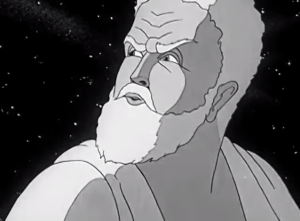
It begins with a nod to Archimedes’ assertion that a lever can move the world, explaining that the longer the lever, the better the magic. In a slightly different configuration, a lever can become a crank or even a double crank. Continuous motion of a lever or series of levers affords the most power for the least work, and this is illustrated with some top-drawer stop motion animation of two meshing paddle wheels.
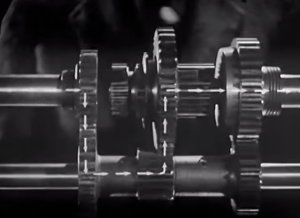 Next, we are shown how engine power is transferred to the rear wheels: it travels from a gear on the engine shaft to a gear on the drive shaft through gears on the countershaft. At low speeds, we let the smallest gear on the countershaft turn the largest gear on the drive shaft. When the engine is turning 90 RPM, the rear wheel turns at 30 RPM. At high speeds using high gears, the power goes directly from the engine shaft to the drive shaft and the RPM on both is equal. The film goes on to explain how the gearbox handles reverse, and the vast improvements to transmission life made possible through synchromesh gearing.
 As [Shahriar] points out in the introductory matter to
 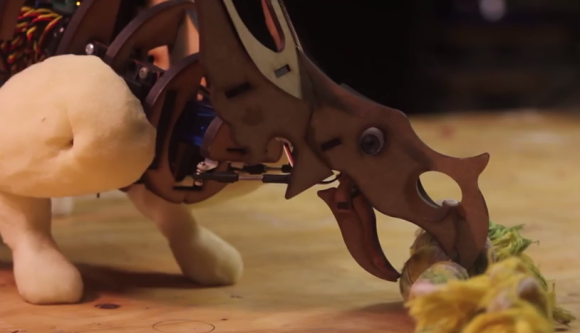 Inspired by a childhood love of dinosaurs, [Robert] set out to build a robotic dinosaur from the Ceratopsian family. After about a year of design, building, and coding, he has sent us
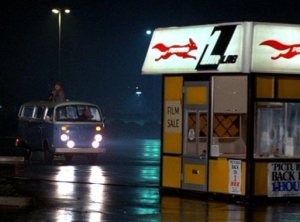 I ran into a guy at Maker Faire Kansas City who I used to scoop ice cream with twenty years ago. We were slinging frozen dairy at a Baskin Robbins in a dying suburban strip mall that had a one-hour photo booth in the parking lot. It was just far enough away from our doorstep that dotting its backside with the hard-frozen ice cream balls that had been scooped and then not always accidentally dropped into the depths of the freezer was challenging. This guy, [Blake], kept a hockey stick hidden in the back room especially for this purpose. I never could get them to fly that far, but he was pretty good at it.
 How many Ma Bell employees does it take to build an ESS mainframe? This week, Retrotechtacular takes you into the more poetic recesses of the AT&T Archive to answer that very question. This wordless 1974 gem is