Monitor All The Laundry Things With This Sleek IoT System

If like us you live in mortal fear of someone breaking into your house when you’re on vacation and starting a dryer fire while doing laundry, this full-featured IoT laundry room monitor is for you. And there’s a school bus. But don’t ask about the school bus.

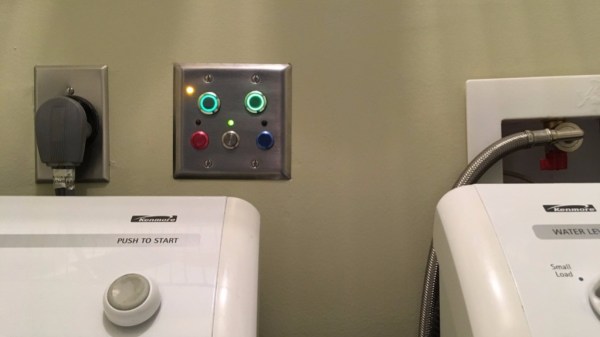
In what [seasider1960] describes as “a classic case of scope creep,” there’s very little about laundry room goings on that escapes the notice of this nicely executed project. It started as a water sensor to prevent a repeat of a leak that resulted in some downstairs damage. But once you get going, why not go too far? [seasider1960] added current sensing to know when the washer and dryer are operating, as well as to tote up power usage. A temperature sensor watches the dryer vent and warns against the potential for the aforementioned tragedy by sounding an obnoxious local alarm — that’s where the school bus comes in. The whole system is also linked into Blynk for IoT monitoring, with an equally obnoxious alarm you can hear in the video below. Oh, and there are buttons for testing each alarm and for making an Internet note to reorder laundry supplies.

We’ve seen a spate of laundry monitoring projects lately, all of which have their relative merits. But you’ve got to like the fit and finish of [seasider1960]’s build. The stainless face plate and in-wall mount makes for a sleek, professional appearance which is fitting with the scope-creepy nature of the build.

Continue reading “Monitor All The Laundry Things With This Sleek IoT System”
Relay Computer Starts With An Adder That Makes A Racket

Computers built using discrete logic chips? Seen it. Computers from individual transistors? Impressive, but it’s been done. A computer built out of electromechanical relays? Bring on the ozone!

The aptly named [Clickity Clack]’s new YouTube channel promises to be very interesting if he can actually pull off a working computer using nothing but relays. But even if he doesn’t get beyond the three videos in the playlist already, the channel is definitely worth checking out. We’ve never seen a simpler, clearer explanation of binary logic, and [Clickity Clack]’s relay version of the basic logic gates is a great introduction to the concepts.

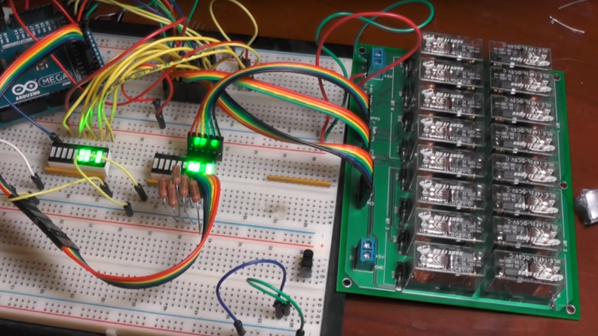
Using custom PCBs hosting banks of DPDT relays, he progresses from the basic AND and XOR gates to half adders and full adders, explaining how carry in and carry out works. Everything is modular, so four of his 4-bit adder cards eventually get together to form a 16-bit adder, which we assume will be used to build out a very noisy yet entertaining ALU. We’re looking forward to that and relay implementations of the flip-flops and other elements he’ll need for a full computer.

And pay no mind to our earlier dismissal of non-traditional computer projects. It’s worth checking out this discrete 7400 logic computer and this all-transistor build. They’re impressive too in their own way, if a bit quieter than [Clickety Clack]’s project.

Continue reading “Relay Computer Starts With An Adder That Makes A Racket”

Video Series Shows Custom Machined Fly Reel

For those of us who can’t get enough vicarious machining, YouTube is becoming a gold mine. Intricate timepieces, gigantic pump shafts, and more and better machine tools are all projects that seem to pop up in our feed regularly.

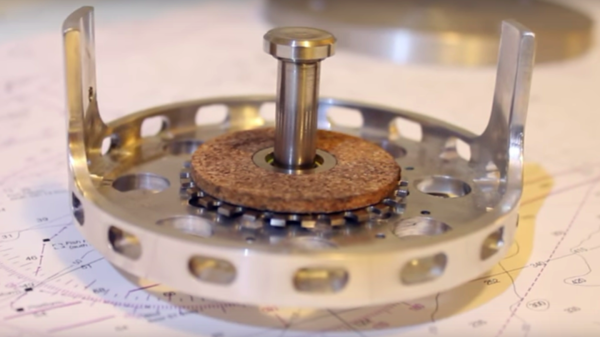
With all that to choose from, can a series on building a fly fishing reel actually prove interesting? We think so, and if you enjoyed [Clickspring]’s recently completed pedestal clock, you might just get a kick out of what’s cooking in [JH Reels]’ shop. Comparing any machining videos to [Clickspring]’s probably isn’t very fair, but even with a high bar to hurdle, [JH Reels] comes out looking pretty good. The challenge here is that this is a saltwater fly reel, so extra care with material selection and machining methods ought to make for some interesting viewing. Also of interest is the range of tooling needed to produce the reel. From lathe to mill to waterjet cutter, a lot goes into these parts, and watching them come together is fascinating.

You wouldn’t think a seemingly simple mechanism like a fly reel would be so complicated to build. But there’s a lot more to it than meets the eye, and with a reel that’s clearly destined to be an heirloom piece, [JH Reels]’ attention to detail is impressive. The series currently stands at 10 videos, and we’re keen to see how it turns out.

The first video is posted below to whet your appetite. But if machining and fishing don’t do it for you, maybe you can try drones and fishing instead.

Continue reading “Video Series Shows Custom Machined Fly Reel”

Down And Dirty With Contact Cleaners

I had a friend who was an engineer for a small TV station. I visited him at work once, and despite the fact that he wouldn’t let me climb the 1,200′ antenna tower, I had a great time. I was working for a video production studio at the time, so there was a fair amount in common about our jobs. One of the regular chores we faced was cleaning the heads on tape machines. He had a 5-gallon pail of cleaning solution under his bench that he told me was Freon, which he swore by for head cleaning and general contact cleaning. He gave me some for my shop in a little jar.

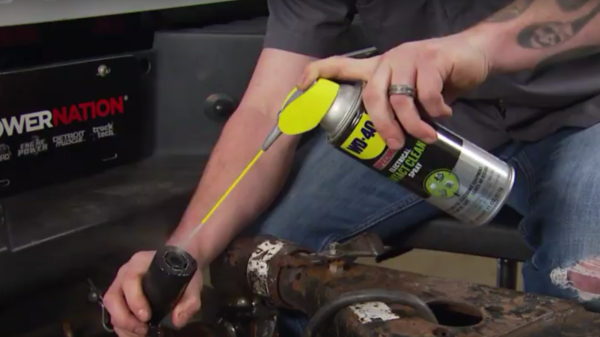
I never knew for sure if that stuff was Freon, but it was the mid-80s, shortly before CFCs were banned, so it might have been. All I know is that I’ve never found its equal for cleaning electronics gear. With that in mind, I thought I’d look at contact cleaners that are in use today, what’s really going on when you clean contacts, and why contacts even need cleaning in the first place.

Continue reading “Down And Dirty With Contact Cleaners”

Pint-Sized, Low-Cost CNC Machine

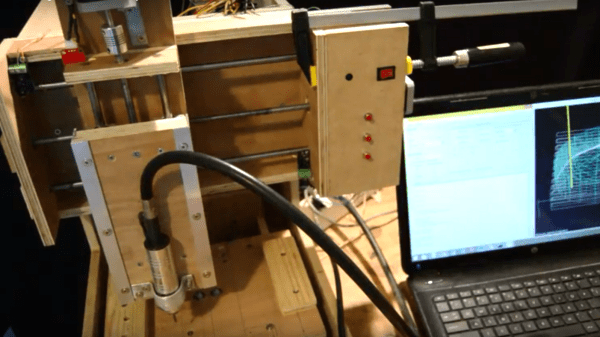
A little MDF, a little plywood, some bits of threaded rod – put it all together and you’ve got this low-cost desktop CNC build using very few parts you’d need to go farther afield than the local home center to procure.

We’ve seen lots of e-waste and dumpster diving CNC builds here before; what’s appealing here is not only the low price tag of the build but also its approachability. As the short videos below show, [Thimo Voorwinden] does an admirable job of using the tools and materials he has on hand. We also appreciate the modularity of the build – the X- and Y-axis carriages are nearly identical and could be interchanged to alter the dimensions of the work area, or even replaced with a larger carriage if needed. The Z-axis is a little different from the usual low-end CNC build in that it doesn’t use a Dremel or other small rotary tool but rather mounts the handpiece of a flexible shaft rotary tool. Keeping the motor off the machine allows for more torque, less vibration, and reduced dead load.

The end result is a desktop CNC for about €200 with a work area large enough to fabricate small wooden and plastic parts, or to mill foam blocks for use as casting molds. It looks like [Thimo] has more in store for his little CNC machine, and we’re looking forward to seeing what improvements he can come up with.

Continue reading “Pint-Sized, Low-Cost CNC Machine”

RFID Stethoscope Wheezes And Murmurs For Medical Training

You’d think that with as many sick people as there are in the world, it wouldn’t be too difficult for a doctor in training to get practice. It’s easy to get experience treating common complaints like colds and the flu, but it might take the young doctor a while to run across a dissecting abdominal aortic aneurysm, and that won’t be the time for on the job training.

Enter the SP, or standardized patient – people trained to deliver information to medical students to simulate a particular case. There’s a problem with SPs, though. While it’s easy enough to coach someone to deliver an oral history reflecting a medical condition, the student eventually needs to examine the SP, which will reveal none of the signs and symptoms associated with the simulated case. To remedy this, [Chris Sanders] and [J Scott Christianson] from the University of Missouri developed an open-source RFID stethoscope to simulate patient findings.

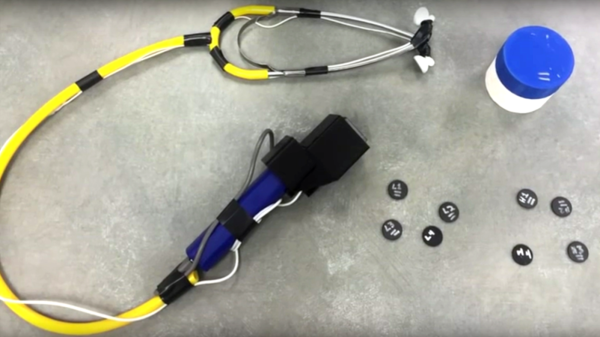
This is one of those “why didn’t I think of that?” ideas. A cheap stethoscope is fitted with an Arduino, and RFID reader, and a small audio board. RFID tags are placed at diagnostic points over an SP’s chest and abdomen. When the stethoscope is placed over a tag, a specific sound file is fetched from an SD card and played over earbuds. The student doesn’t have to ask, “What am I hearing?” anymore – the actual sound of bruits or borborygmi are heard.

We can easily see expanding this system – RFID tags that trigger a faux ultrasound machine to display diagnostic images, or tiny OLED screens displaying tagged images into an otoscope. A good place to start expanding this idea might be this digital stethoscope recorder and analyzer.

Continue reading “RFID Stethoscope Wheezes And Murmurs For Medical Training”

Explosive New Process Produces Graphene By The Gram

You say you need some graphene so you can invent the Next Big Thing, but you can’t be bothered with processes that yield a few measly milligrams of the precious stuff. Luckily for you there’s a new method for producing gram quantities of graphene. Perhaps unluckily, it requires building a controlled fuel-air bomb.

Graphene is all the rage today, promising to revolutionize everything from batteries to supercapacitors to semiconductors. A molecularly-2D surface with unique properties, graphene can be made in very small quantities with such tedious methods as pulling flakes of the stuff off graphite lumps with Scotch tape. Slightly less ad hoc methods involve lasers, microwaves, or high temperatures and nasty chemicals. But all of these methods are batch methods that produce vanishingly small amounts of the stuff.

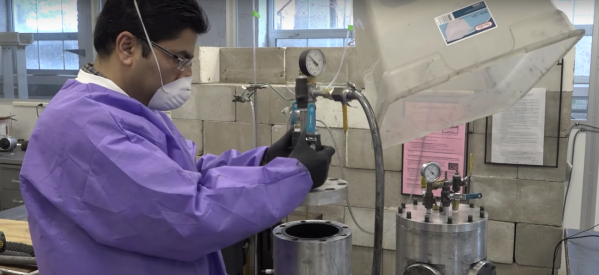
The method [Chris Sorenson] et al of Kansas State University developed, which involves detonating acetylene and oxygen in a sturdy pressure vessel with a spark plug, can produce grams of graphene at a go. And what’s more, as their patent application makes clear, the method is amenable to a continuous production process using essentially an acetylene-fueled internal combustion engine.

While we can’t encourage our readers to build an acetylene bomb in the garage, the process is so simple that it would be easily replicated. We wonder how far down it could scale for safety and still produce graphene. Obviously, be careful if you choose to replicate this experiment. If you don’t like explosions and can source some soybean oil and nickel foil, maybe try this method instead. Then you’ll have something to mix with your Silly Putty.

Continue reading “Explosive New Process Produces Graphene By The Gram”