Turbine-driven Robot To Navigate Inside Space Station

It may look more like a Companion Cube than R2-D2, but the ISS is getting an astromech droid of sorts.

According to [Trey Smith] of the NASA Ames Research Center, Astrobee is an autonomous robot that will be able to maneuver inside the ISS in three dimensions using vectored thrust from a pair of turbines. The floating droid will navigate visually, using a camera to pick out landmarks aboard the station, including docking ports that let it interface with power and data. A simple arm allows Astrobee to grab onto any of the hand rails inside the ISS to provide a stable point for viewing astronaut activities or helping out with the science.

As cool as Astrobee is, we’re intrigued by how the team at Ames is testing it. The droid is mounted on a stand that floats over an enormous and perfectly flat granite slab using low-friction CO₂ gas bearings, giving it freedom to move in two dimensions. We can’t help but wonder why they didn’t suspend the Astrobee from a gantry using a counterweight to add that third dimension in. Maybe that’s next.

From the sound of it, Astrobee is slated to be flight ready by the end of 2017, so we’ll be watching to see how it does. But if they find themselves with a little free time in the schedule, perhaps adding a few 3D-printed cosmetics would allow them to enter the Hackaday Sci-Fi Contest.


It’s A Synthesizer. It’s A Violin. It’s A Modulin

It sounds a little like a Theremin and looks a lot like the contents of your scrap bin. But it’s a unique musical instrument called a modulin, and after a few teasers we finally have some details on how it was built.

Making music with marbles is how we first heard of [Martin] of the Swedish music group Wintergatan. He seems as passionate about making his own instruments as he is about the music itself, and we like that. The last time we saw one of his builds was this concert-ready music box, which he accompanied with an instrument he called a modulin. That video gave only a tantalizing look at this hacked together instrument, but the video below details it.

“Modulin” comes from the modular synthesizer units that create the waveforms and pressure-sensitive ribbon controller on the violin-like neck. The instrument has 10 Doepfer synthesizer modules mounted to a hacked-together frame of wood and connected by a forest of patch cables. [Martin]’s tour of the instrument is a good primer on how synthesizers synthesize – VCOs, VCAs, envelope generators, filters – it’s all there. We’re treated to a sample of the sounds a synthesizer can make, plus majestic and appropriately sci-fi sounding versions of Also sprach Zarathustra and the theme from Jurassic Park. And be sure to check out the other video for another possibly familiar tune.

This might be old hat to musicians, but for those of us to whom music is a mystery, such builds hold extra sway. Not only is [Martin] making music, he’s making the means to make music. We’re looking forward to hearing what’s next.

Continue reading “It’s A Synthesizer. It’s A Violin. It’s A Modulin”

Tiny LED Earrings Are A Miniaturization Tour De Force

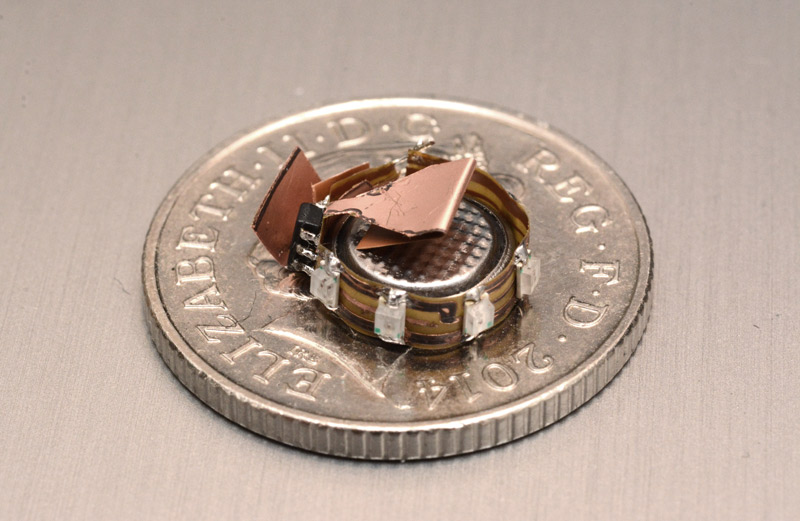
Light up jewelry is nothing new – we see wearables all the time here. But home brew, self-contained, programmable LED earrings that are barely larger than the watch batteries which power them? That’s something worth looking into.

assembly5Settle back and watch [mitxela]’s miniature wizardry in the video below, but be forewarned: it runs 36 minutes. Most of the video is necessarily shot through a microscope where giant fingers come perilously close to soldering iron and razor blade.

The heart of the project is an ATtiny9, a six-legged flea of a chip. The flexible PCB is fabricated from Pyralux, which is essentially copper-clad Kapton tape. [Mitxela] etched the board after removing spray-paint resist with a laser engraver – an interesting process in its own right.

After some ridiculously tedious soldering, the whole circuit wraps around a CR927 battery and goes into a custom aluminum and polypropylene case, which required some delicate turning. Hung from off-the-shelf ear hooks, the 12 multiplexed LEDs flash fetchingly and are sure to attract attention, especially of those who know Morse.

This isn’t exactly [mitxela]’s first tiny rodeo, of course. We’ve featured his work many times, including a Morse code USB keyboardthe world’s smallest MIDI synthesizer, and the world’s smallest MIDI synthesizer again.

Continue reading “Tiny LED Earrings Are A Miniaturization Tour De Force”

Good In A Pinch: The Physics Of Crimped Connections

I had a friend who was an electronics assembly tech for a big defense contractor. He was a production floor guy who had a chip on his shoulder for the engineers with their fancy book-learnin’ who couldn’t figure out the simplest problems. He claimed that one assembly wasn’t passing QC and a bunch of the guys in ties couldn’t figure it out. He sidled up to assess the situation and delivered his two-word diagnosis: “Bad crimp.” The dodgy connector was re-worked and the assembly passed, much to the chagrin of the guys in the short-sleeved shirts.

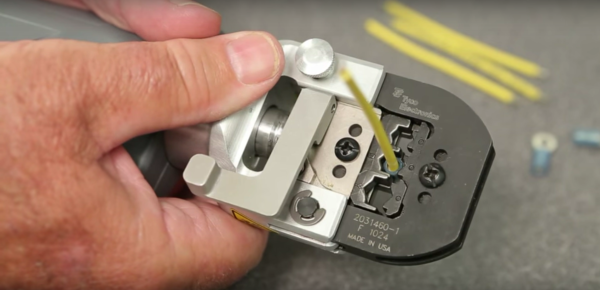
Aside from the object lesson in experience sometimes trumping education, I always wondered about that “bad crimp” proclamation. What could go wrong with a crimp to so subtly futz with a circuit that engineers were baffled? How is it that we can rely on such a simple technology to wire up so much of the modern world? What exactly is going on inside a crimped connection anyway?

Continue reading “Good In A Pinch: The Physics Of Crimped Connections”

Metalworking Hacks Add Functionality To Snap-On Tool Chest

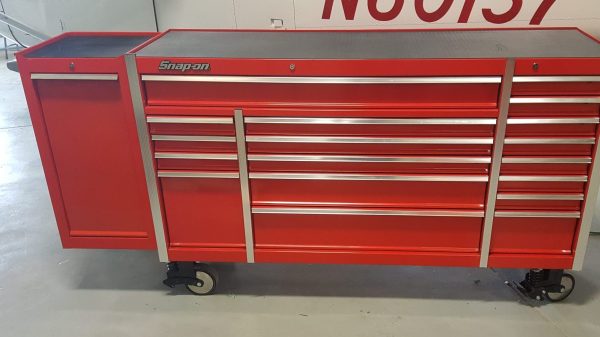
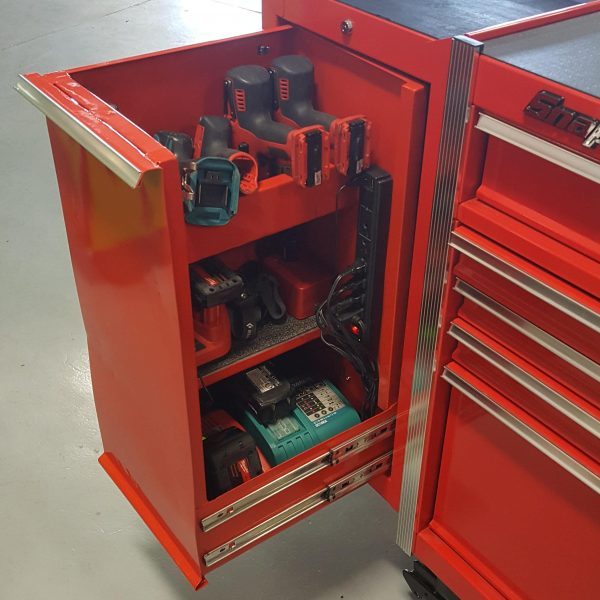
Problem: you’re a student mechanic and you’ve already poured a ton of money into a Snap-On roller cabinet loaded with the tools of the trade, but you still need sensible storage for your cordless tools. Solution: a DIY version of Snap-On’s PowerCab cordless tool station at a fraction of the cost.

rnqvgsoMechanics seem to have a love-hate relationship with Snap-On tools. Some love the brand, others hate it, but the majority seem to hate that they love the tools. It sounds like [GenTQ] reached her limit on brand loyalty when even her 50% student discount wasn’t enough to entice her to add Snap-On’s admittedly very cool KRL1099 cabinet for cordless drivers and chargers. So it was off to Harbor Freight for their seven-drawer side cabinet for less than $200. The cabinet was gutted of drawers, a frame for the new slide-out was welded up, and sheet steel was fabricated into organizer shelves and a new drawer front. A power strip and drag-chain were added to feed the chargers, and the new drawer went off to the powder coater for a matching paint job.

It may not have the Snap-On badge, and purists may cringe at the mixed-marriage with Horror Fright, but we like the results just fine. And she saved something like $1200 in the process. We think Harbor Freight gets a bad rap, deservedly so for some tools, but there are hidden gems amid the dross just ripe for the hacking, as [GenTQ] ably shows.

[via r/DIY]

More Power: Powel Crosley And The Cincinnati Flamethrower

We tend to think that there was a time in America when invention was a solo game. The picture of the lone entrepreneur struggling against the odds to invent the next big thing is an enduring theme, if a bit inaccurate and romanticized. Certainly many great inventions came from independent inventors, but the truth is that corporate R&D has been responsible for most of the innovations from the late nineteenth century onward. But sometimes these outfits are not soulless corporate giants. Some are founded by one inventive soul who drives the business to greatness by the power of imagination and marketing. Thomas Edison’s Menlo Park “Invention Factory” comes to mind as an example, but there was another prolific inventor and relentless promoter who contributed vastly to the early consumer electronics industry in the USA: Powel Crosley, Jr.

Continue reading “More Power: Powel Crosley And The Cincinnati Flamethrower”

Bantam-sized Jukebox Reproduction Tops The Fabrication Charts

Restoring a genuine vintage jukebox is a fun project, but finding suitable candidates can be a difficult proposition. Not only can a full-size machine take a huge bite out of your wallet, it can take up a lot of room, too. So a replica miniature jukebox might be just the thing.

We have to admit, at first glance [Allan_D_Murray]’s project seemed like just another juke upgrade. It was only after diving into his very detailed build log that we realized this classic-looking juke is only about 30″ (80 cm) tall. It’s not exactly diminutive, but certainly more compact than the original Wurlitzer 1015 from which it draws its inspiration. But it sure looks like the real thing. Everything is custom made, from the round-top case to the 3D-printed trim pieces, which are painted to look like chrome-plated castings. The guts of the juke are pretty much what you’d expect these days — a PC playing MP3s. But an LCD monitor occupies the place where vinyl records would have lived in the original and displays playlists of the albums available. There’s an original-looking control panel on the front, and there are even bubblers in the lighted pilasters and arches.

Hats off to [Allan] for such a detailed and authentic tribute to a mid-century classic. But if a reproduction just won’t cut it for you, check out this full-size juke with the original electronics.

Continue reading “Bantam-sized Jukebox Reproduction Tops The Fabrication Charts”