Own The Night With This Open Source Night Vision Monocular

If you’ve always wanted to see in the dark but haven’t been able to score those perfect Soviet-era military surplus night vision goggles, you may be in luck. Now there’s an open-source night vision monocular that you can build to keep tabs on the nighttime goings-on in your yard.

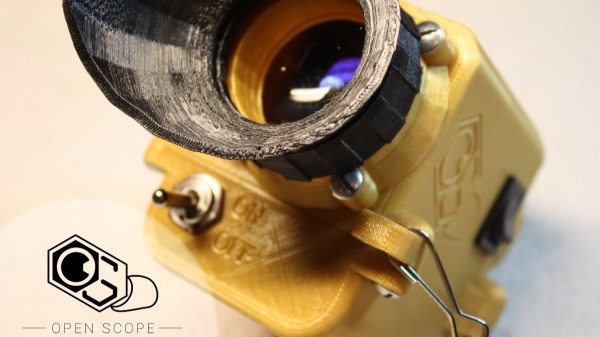
Where this project stands out is not so much the electronics — it’s really just a simple CCD camera module with the IR pass filter removed, an LCD screen to display the image, and a big fat IR LED to throw some light around. [MattGyver92] seemed to put most of his effort into designing a great case for the monocular, at the price of 25 hours of 3D printer time. The main body of the case is nicely contoured, the eyepiece has a comfortable eyecup printed in NinjaFlex, and the camera is mounted on a ball-and-socket gimbal to allow fine off-axis angle adjustments. That comes in handy to eliminate parallax errors while using the monocular for nighttime walks with both eyes open. One quibble: the faux mil-surp look is achieved with a green filter over the TFT LCD panel. We wonder if somehow eliminating the red and blue channels from the camera might not have been slightly more elegant.

Overall, though, we like the way this project came out, and we also like the way [MattGyver92] bucked the Fusion 360 trend and used SketchUp to design the case. But if walking around at night with a monocular at your face isn’t appealing, you can always try biohacking yourself to achieve night vision.

Plasma Cutter Jig Notches Tubing Quickly And Cleanly

It may be [MakeItExtreme]’s most ambitious build to date. There are a lot of moving parts to this plasma cutter tubing notcher, but it ought to make a fine addition to the shop and open up a lot of fabrication possibilities.

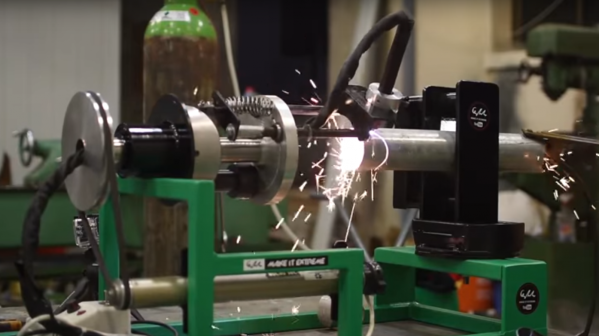
We have to admit to a certain initial bafflement when watching the video below for the first time. We can usually see where [MakeItExtreme]’s builds are going right from the first pieces of stock that get cut, but the large tube with the pressed-in bearing had us scratching our heads. The plan soon became clear — a motorized horizontal rotary table with a hollow quill for the plasma torch leads. There’s a jig for holding the torch itself that can move in and out relative to the table. Cams made of tube sections can be bolted to a fixed platen; a cam follower rides on the cams and moves the torch in and out as the table rotates. This makes the cuts needed to properly fit tubes together — known as fish mouth cuts or saddle cuts. The cams can be removed for straight cuts, and the custom pipe vise can be adjusted to make miter cuts.

All in all a sturdy and versatile build that ought to enable tons of new projects, especially when teamed up with [MakeIt Extreme]’s recent roll bender.

Continue reading “Plasma Cutter Jig Notches Tubing Quickly And Cleanly”

Keep The Peace In The Bedroom With A Snore Stopping Sleep Mask

Despite what my wife says, I have absolutely no evidence that I snore. After all, I’ve never actually heard me snoring. But I’ll take her word for it that I do, and that it bothers her, so perhaps I should be a sport and build this snore-detecting vibrating sleep mask so she can get a few winks more.

Part wearable tech and part life hack, [mopluschen]’s project requires a little of the threadworker’s skill. The textile part of the project is actually pretty simple, and although [mopluschen] went with a custom mask made from fabric and foam shoulder pads, it should be possible to round up a ready-made mask that could be easily modified. The electronics are equally simple – an Arduino with a sound sensor module and a couple of Lilypad Vibe boards. The mic rides just above the snore resonating chamber and the vibrators are right over the eyes. When your snore volume exceeds a preset threshold, the motors wake you up.

Whether this fixes the underlying problem or just evens the score with your sleep partner is debatable, but either way there’s some potential here. And not just for snore-correction – a similar system could detect a smoke alarm and help rouse the hearing impaired. But if the sewing part of this project puts you off, you should probably check out [Jenny List]’s persuasive argument that sewing is not just for cosplayers anymore.

Reverse Engineering Enables Slick Bluetooth Solution For Old Car Stereo

Those of us who prefer to drive older cars often have to make sacrifices in the entertainment system department to realize the benefits of not having a car payment. The latest cars have all the bells and whistles, while the cars of us tightwads predate the iPod revolution and many lack even an auxiliary input jack. Tightwads who are also hackers often remedy this with conversion projects, like this very slick Bluetooth conversion on a Jeep radio.

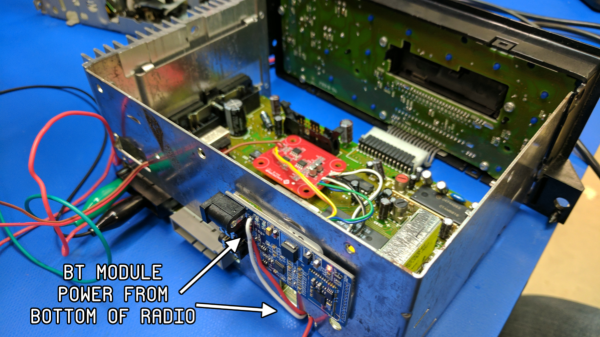
There are plenty of ways to go about piping your favorite tunes from a phone to an old car stereo, but few are as nicely integrated as [Parker Dillmann]’s project. An aftermarket radio of newer vintage than the OEM stereo in his 1999 Jeep would be one way to go, but there’s no sport in that, and besides, fancy stereos are easy pickings from soft-top vehicles. [Parker] was so determined to hack the original stereo that he bought a duplicate unit off eBay so he could reverse engineer it on the bench. What’s really impressive is the way [Parker] integrates the Bluetooth without any change to OEM functionality, which required a custom PCB to host an audio level shifter and input switch. He documents his efforts very thoroughly in the video after the break, but fair warning of a Rickroll near the end.

So many of these hacks highjack the tape deck or CD input, but thanks to his sleuthing and building skills, [Parker] has added functionality without sacrificing anything.

Continue reading “Reverse Engineering Enables Slick Bluetooth Solution For Old Car Stereo”

Custom Parts Put IKEA Window Shades On IoT

No matter what the project is about, we’re always suckers for nicely integrated builds with good fit and finish. There’s a certain appeal to rat’s nest wiring on a breadboard, and such projects are valuable because they push the limits. But eventually you need to go from prototype to product, and that’s where this IKEA window shade automation project shines.

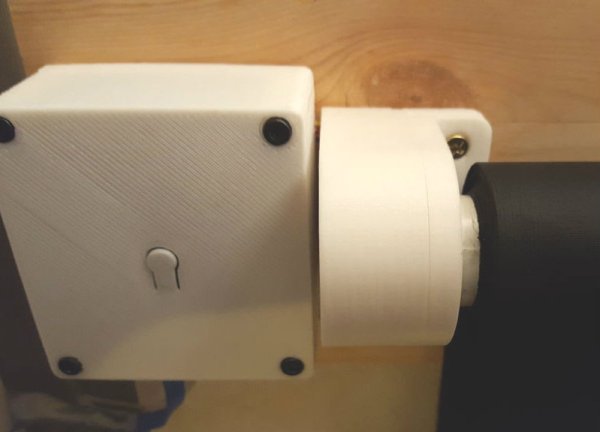
Integration is more than just putting everything in a nice box, especially for home automation gear – it really needs to blend. [ehsmaes] roller blind motorization project accomplishes that nicely with a 3D-printed case for the electronics, as well as a custom case for the geared stepper motor to drive the shade. The drive replaces the standard spring-loaded cap on the end of the IKEA Tupplur shade, and the neutral color of both cases blends nicely with the shade and surroundings. The control electronics include a NodeMCU and a motor shield; [eshmaes] warns that narrow shades work just fine off of USB power, but that wider windows will need a power boost. The IoT end of things is taken care of by MQTT and OpenHab, allowing the shades to be raised and lowered to any position. The short video below shows the calibration procedure for the shade.

Need a primer on MQTT? We’ve got you covered. Or perhaps you need to control the windows rather than the treatments.

Continue reading “Custom Parts Put IKEA Window Shades On IoT”

Can A Bundle Of Soda Straws Be A Camera?

This one is hard to classify. Is it a hack, or is it art? Perhaps it’s both. However you want to classify it, it’s pretty cool to turn a bundle of drinking straws into a camera.

strawcamera_012
Click for larger image

If you’re looking for the technology here, you won’t find much. There’s no lens, no shutter, and no electronics of any kind in [Mick Farrell] and [Cliff Haynes]’ Straw Camera. This is literally a box full of drinking straws standing on end, with a sheet of photo paper behind it. Each straw sends a spot of light that represents the average hue and luminance of its limited view of the subject directly to the film. The process of making an exposure consists of composing the scene, turning out the lights, loading the camera, and setting off a flash.

The resulting images are defocused but recognizable, like seeing familiar sights through a heavy fog. The straws make a strong texture over the ghostly image of the subject – indeed, the straws are the only thing in focus. The fact that the straws don’t form a perfect honeycomb due to settling and imperfections in the bundles is jarring at first, but as you see the images you get used to the extra texture.

When we first saw this, we wondered about the possibility of putting a simple photosensor at the bottom of each straw to capture similar images digitally. The TCS3200 would be about the right size, but given that there are about 32,000 straws in the bundle, the BOM might get a little out of hand. Still, a scaled down digital straw camera might yield some interesting images.

Thanks to [Stuart Rogers] for the tip.

Genetically Engineered Muscle Cells Power Tiny Bio-Robots

One of the essential problems of bio-robotics is actuators. The rotors, bearings, and electrical elements of the stepper motors and other electromechanical drives we generally turn to for robotics projects are not really happy in living systems. But building actuators the way nature does it — from muscle tissue — opens up a host of applications. That’s where this complete how-to guide on building and controlling muscle-powered machines comes in.

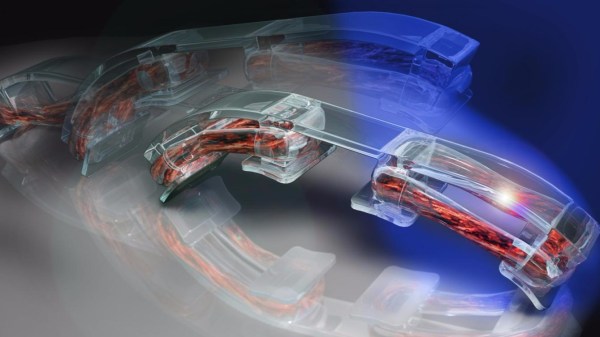
Coming out of the [Rashid Bashir] lab at the University of Illinois at Urbana-Campaign, the underlying principles are simple, which of course is the key to their power. The technique involves growing rings of muscle tissue in culture using 3D-printed hydrogel as forms. The grown muscle rings are fitted on another 3D-printed structure, this one a skeleton with stiff legs on a flexible backbone. Stretched over the legs like rubber bands, the muscle rings can be made to contract and move the little bots around.

Previous incarnations of this technique relied on cultured rat heart muscle cells, which contract rhythmically of their own accord. That yielded motion but lacked control, so for this go-around, [Bashir] et al used skeletal muscle cells genetically engineered to contract when exposed to light. Illuminating different parts of the muscle ring lets the researchers move the bio-bots anywhere they want. They can also use electric stimulation to control the bio-bots.

The method isn’t quite at the point where home lab biohackers will start churning out armies of bio-bots. But the paper is remarkably detailed in methods and materials, from the CAD files for 3D-printing the forms and bio-bot skeletons to a complete troubleshooting guide. It’s all there, and it could be a game changer for developing the robotic surgeons of the future.

Continue reading “Genetically Engineered Muscle Cells Power Tiny Bio-Robots”