
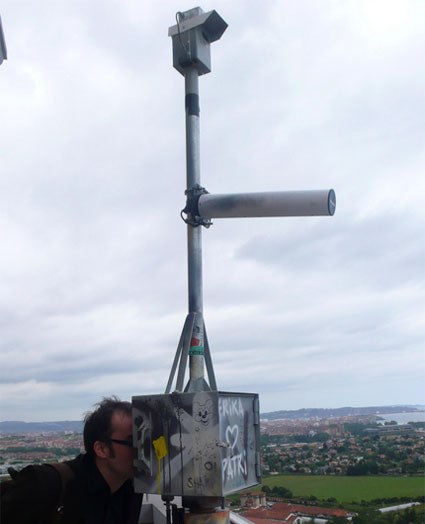
We Make Money Not Art recently visited the LABoral Art and Industrial Creation Centre in Gijón, Spain. The installation that left the strongest impression on [Regine] was the WiFi sightseeing telescope built by Clara Boj and Diego Diaz. Spain is in a situation similar to the USA: A few years ago many municipal WiFi projects launched only to be squashed because of theoretical unfair competition with local utilities. Now commercial projects like WeFi, Whisher, and FON encourage people to “share” their WiFi. Observatorio (Observatory) is designed to provide insight into the current state of local WiFi. It uses a highly directional Yagi antenna to collect wireless access data from the local area. The antenna has a 30deg aperture which is matched to a camera with an identical field of view. The observer sees the camera’s viewpoint with the WiFi data overlaid showing where accesspoints are and whether the AP is open. WMMNA also recommends you check out the WiFi Camera which photographs electromagnetic space.
Author: Eliot1332 Articles
BBtv: Playing The Building
Today’s episode of BoingBoing TV visits [David Byrne]’s Playing the Building installation which we covered before. The video provides some insight into the artistic process: they wandered around and whacked things with mallets to see what sounded good. They use counterweighted motors to vibrate cast iron girders and columns. Many of the empty radiators are being struck by solenoids. He says the installation is very approachable because people realize that even if a skilled musician sat down they wouldn’t be any better at playing the device.
Hackit: What To Do With A 1st Gen IPhone?

There’s a new iPhone 3G coming out in July. If that statement shocks you, you might want to check your connection. We love new shiny hardware, but what we’re really interested in is the number of “old” iPhones that are going to be hitting the market. Many people will be ditching their 1st generation iPhones just to get GPS and 3G. This abundance plus the new $200 price tag is bound to depress the price for used phones.
A used 1st generation iPhone is actually a pretty attractive device. It’s already been laid wide open by hackers so you can run pretty much anything you want on it instead of waiting for the App Store to tell you what you can and can’t do. You could use it as a WiFi Voip phone, a simple web pad, run an NES emulator, use it as a musical instrument, or build an army of robots.
What will you do when the price of used iPhones bottoms out?
TI-83 Intervalometer
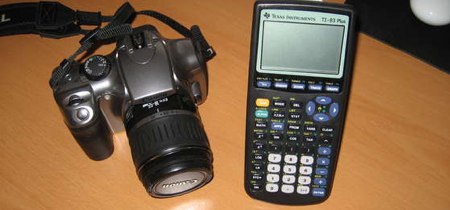
The headline How to Make Time Lapse Video With Your DSLR didn’t really grab us. Honestly, you pay that much for a camera and it can’t do time lapse out of the box? Well, we nearly missed the real story: [Chris Martino] was using a TI-83 to act as the intervalometer for the camera. The calculator has a 2.5mm audio jack for it’s data port and the camera has an identical port for the shutter trigger. The TI-83 runs a program with a FOR loop to act as the timer. When the loop completes it sends data to the port, and the voltage triggers the shutter. The rate isn’t very exact and varies depending on the charge left in the batteries. [Chris] estimated 10000 program iterations ends up being about 26 seconds between pictures. This technique has been tested on 84, 86, and 89 series calculators too. There are a couple example time lapse videos embedded after the break.
Hackit: Simple Portable Monitor
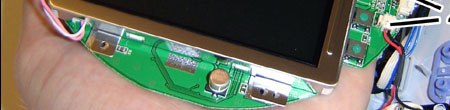
We’re often asked what a simple way to add a display to a project is and we even hinted at this yesterday with the HMD comparison. The answer is: we’re not really sure. In the past, the go to was PSOne add on displays. They accept composite input which means you can painlessly attach almost any other consumer device with video out. The problem is they’re a little large. Then there’s the spy video car HMD. It’s black and white and accepts composite video too. It’s a little small though, which makes it difficult to work with outside of the original application. So, Hack-a-Day readers, what have you used as a simple palm sized portable display in your projects?
Portrait Robot
[bre] passed along this portrait drawing robot from the same people that brought you the chief cook robot. Like the previous project, the portrait drawing bot emphasizes man machine interaction. The subject sits down and is asked for the quill. The robot captures the subject’s image and runs it through several processing steps. One set is to determine the contours and another is to determine the fill. The robot then draws the the contours and fills returning to the ink pot each time it reaches a trajectory threshold. Quill drawing can be quite hard for novice illustrators, but the robot’s smooth trajectory calculations prevent drips and stains.
Consumer HMD Comparison

We’ve wanted headed mounted display technology to take hold for a long time. Gizmodo recently compared two consumer models: the Zeiss Cinemizer ($400) and the Myvu Crystal ($300). Unfortunately the resolution of HMDs has gone nowhere in the last 10 years. These two devices only support 640×480 and are aimed specifically at iPod users. With computers getting smaller and higher resolution, we’re surprised that HMDs have not followed suit. Why isn’t someone going to market with a 1280×720 headset? If you really must choose one of these two, we’d recommend the Myvu. It has composite input so you can hook almost anything up to it.









