An Automated Watch Cleaner From An Older 3D Printer

The many delicate parts in a mechanical wristwatch present a tricky cleaning problem, one that for professionals there is a variety of machines to tackle. As you might expect, such specialty equipment doesn’t come cheap, so [daveburkeaus] came up with his own solution, automated using an older 3D printer.

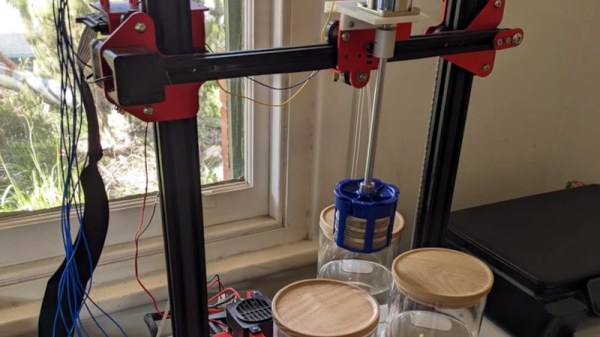
The premise is straightforward enough: it’s a machine with a succession of stations for cleaning, rinsing, and drying, through which the watch is moved on a set cycle. The hot end and extruder is replaced with a motor and shaft, on the end of which is a basket in which the watch sits. The basket is a commercial part for simplicity of construction, though one could certainly fabricate their own if need be. The printer gets a controller upgrade and of course a motor controller, and with a software stack built upwards from the Klipper firmware seems ready to go. There is the small matter of the heater used for drying not keeping the firmware happy as a substitute for the heated bed it thinks it’s driving, but that is fixed by controlling it directly.

We’ve remarked before that superseded 3D printers are present in large numbers in our community, and particularly now a few years since that article was written we’re reaching the point at which many very capable machines are sitting idle. It’s thus particularly good to see a project that brings one of them out of retirement for a useful purpose.

Sometimes It’s Worth Waiting: Kodak Finally Release Their Super 8 Camera

Think of all those promised products that looked so good and were eagerly awaited, but never materialized. Have you ever backed a Kickstarter project in the vain hope that one day your novelty 3D printer might appear? Good luck with the wait! But sometimes, just sometimes, a product everyone thought was dead and gone pops up unexpectedly.

So it is with Kodak’s infamous new Super 8 camera, which they announced in 2018 and had the world of film geeks salivating over, then went quiet on. It’s abandoned, we all thought, and then suddenly five years later it isn’t. If you really must have the latest in analog film-making gear, you can put your name down to order one now.

Continue reading “Sometimes It’s Worth Waiting: Kodak Finally Release Their Super 8 Camera”

A Low Voltage Tube Makes For A Handy Preamplifier

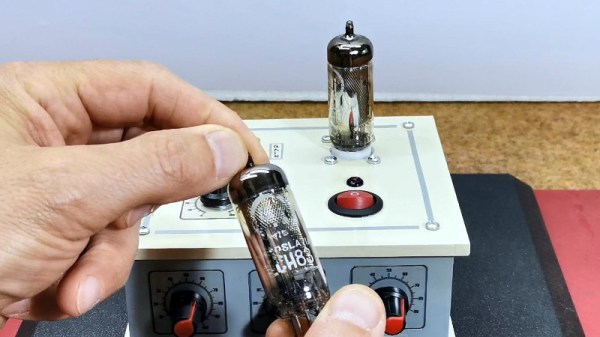
When most people think of tube circuits, the first thing that comes to mind is often the use of high-voltage power supplies. It wasn’t a given for tube circuits, though, as a range of low-voltage devices were developed for applications such as car radios. It’s one of these, an ECH83 triode-heptode, which [mircemk] has taken as the basis of an audio preamplifier circuit.

The preamp circuit is pretty simple, being a two-stage single-ended design using both halves of the tube. Between the two is a three-band tone control circuit as used in classic guitar amplifiers, making for a serviceable and easily achievable way to chase that elusive “valve sound.”

There is much discussion among audio enthusiasts about the supposed benefits of vacuum technology as opposed to transistors in an amplifier. Much of it centres around the idea that tubes distort in the even harmonics while semiconductors are supposed to do so in the odd harmonics. Still, we’d be inclined to spot a bit of snake oil instead and point to early transistor amplifiers simply being not very good compared to the tube amps of the day. That said, a well-made tube amplifier set-up will sound just as amazing as it always did, and since this one is paired with a matching power amp we wouldn’t say no to it ourselves.

If you fancy messing about with tubes for not a lot, there’s a cheap module for that.

You Can Now Build Your Own Polaroid-style Pack Film Cartridge

Instant photography was one of the twentieth century’s coolest-to-have consumer inventions, but when the digital photography revolution came it had few answers. It survives as a niche format thanks to Fuji’s Instax line and a group of Dutch entrepreneurs who revived a defunct Polaroid works, but what hasn’t made it are the earlier pack and roll film formats for which the picture is revealed by peeling apart a negative and positive side. All isn’t lost though, because a small Austrian company has been producing pack film cartridges as a handmade artisan product. To reduce the cost per print they’re now available as a DIY self-assembly kit, and it’s this which [In an Instant] is taking a look at in their latest video.

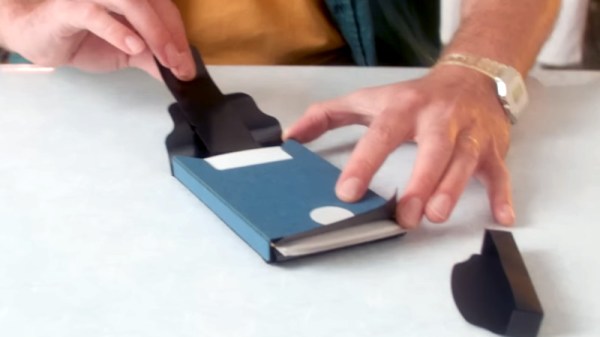
The kit has enough components for eight shots, and where the original cartridge would have held multiple exposures this one can only hold one at a time. The cartridge itself is cleverly formed from folded card as opposed to the plastic and metal of the original, and the components are a relatively straightforward assembly task. It’s a fascinating window into how the Polaroid pack film process worked, with the light-sensitive layer behind a pull-away black light screen, in front of the white positive sheet and with a pouch of developer chemicals to one side. It’s in no way cheap at somewhere about 10 dollars a shot, but it’s amazing that pack film can be recreated and for enthusiasts it’s a lifeline that keeps their cameras useful.

This isn’t the first time we’ve looked at revitalising a pack film camera, but it’s a lot easier than hacking a Fuji cartridge to do the job.

Continue reading “You Can Now Build Your Own Polaroid-style Pack Film Cartridge”

The Case For A Technology Aware Lobby Correspondent

We cover all manner of stories here at Hackaday, including awesome hardware hacks, the latest trends and inventions, and in-depth guides to fascinating technologies. We also cover a few news stories from the wider world outside our community, usually when they have some knock-on effect that has an impact on us. Recently this last category of stories has included laws which present a threat to online encryption and privacy in the UK and in the European Union, for example. They’re not the most joyful of news, but it’s vital for everyone with an interest in online matters to be informed about them.

A Long And Inglorious History

A quad flat-pack computer chip, made by VLSI
The infamous Clipper chip. Travis Goodspeed, CC BY 2.0

Those of us who have followed the world of technology will know that badly thought out laws with a negative impact on technology have a long and inglorious history. Some like the infamous backdoored Clipper chip encryption device die an inglorious death as industry or the public succeed in making them irrelevant, but others such as the Digital Millennium Copyright Act or DMCA live on for decades and present an ongoing malign influence. Most recently our ongoing coverage of dubious drone stories included a hefty dose of equally dubious action from lawmakers.

When considering these pieces of legislation it’s easy to characterise the politicians who advance them as gullible idiots easily swayed by any commercial lobbyist with a fistful of cash. But the reality is far more nuanced, while some of them may well be tempted by those lobbyists  they are in most cases neither gullible nor foolish. Instead they are better characterised as clueless on technical issues, and thus easily swayed by received opinion rather than by technological reality. If there’s a fault in the system it’s that the essential feedback which provides the checks and balances is missing, and oddly while sitting here writing this story, the responsibility for this comes close to home. The solution doesn’t lie in changing the politicians, but in changing how they are treated by journalists. Continue reading “The Case For A Technology Aware Lobby Correspondent”

Apple Archeology: The Future Once Had Server Side Computing In It

To read the IT press in the early 1990s, those far-off days just before the Web was the go-to source of information, was to be fed a rosy vision of a future in which desktop and server computing would be a unified and powerful experience. IBM and Apple would unite behind a new OS called Taligent that would run Apple, OS/2, and 16-bit Windows code, and coupled with UNIX-based servers, this would revolutionise computing.

We know that this never quite happened as prophesied, but along the way, it did deliver a few forgotten but interesting technologies. [Old VCR] has a look at one of these, a feature of the IBM AIX, which shipped with mid-90s Apple servers as a result of this partnership, in which Mac client applications could have server-side components, allowing them to offload computing power to the more powerful machine.

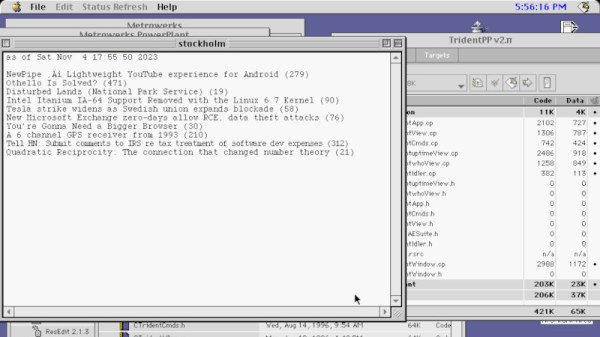
The full article is very long but full of interesting nuggets of forgotten 1990s computing history, but it’s a reminder that DOS/Windows and Novell Netware weren’t the only games in town. The Taligent/AIX combo never happened, but its legacy found its way into the subsequent products of both companies. By the middle of the decade, even Microsoft had famously been caught out by the rapid rise of the Web. He finishes off by creating a simple sample application using the server-side computing feature, a native Mac OS application that calls a server component to grab the latest Hacker News stories. Unexpectedly, this wasn’t the only 1990s venture from Apple involving another company’s operating system. Sometimes, you just want to run Doom.

No TP? No Problem!

Among First World Problems, there can be few worse than running out of toilet paper. The horror! If you’re not able to do as we did yesterday and borrow a pack until more can be bought, then you’re not without options. A handy copy of the Daily Mail could be cut into squares and hung up in your Smallest Room, or you can even make your own with the help of this handy instructional video from [whoisandrewfahmy]. It appears from a casual search to be one of many such guides that appeared during the pandemic when the bog roll supply was seen as endangered, but it’s still interesting simply as a diversion into how something is made.

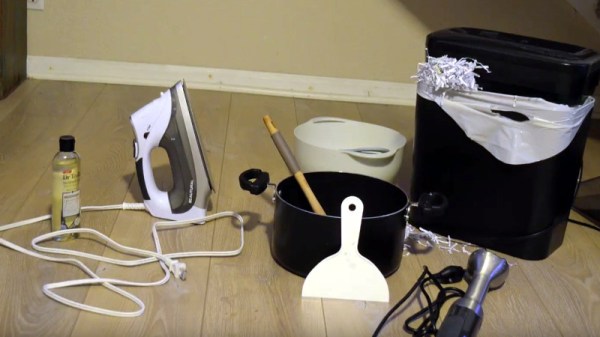
The process is surprisingly straightforward, starting with scrap paper, which is shredded and soaked before being boiled to break down to pulp. The pulp is then emulsified, and some body oil is added to remove the sandpaper-on-the-butt experience before being spread between a sheet and a piece of window screen to be ironed dry. It’s an energy-intensive process, so the Daily Mail is likely to be an easier stopgap if no friends can lend you a few rolls, but it’s left us here curious about papermaking. The butts of Hackaday may be safe from homemade TP, but that’s not to say that it wouldn’t be interesting to make other paper products. Check out the video below.

Of course, back in April 2020 we had our own solution to the pandemic toilet paper shortage. After you make your bespoke dunny roll, how can you wind it into a nice roll? Don’t worry. We got you.

Continue reading “No TP? No Problem!”