CSS, Now It’s Got Your 8086

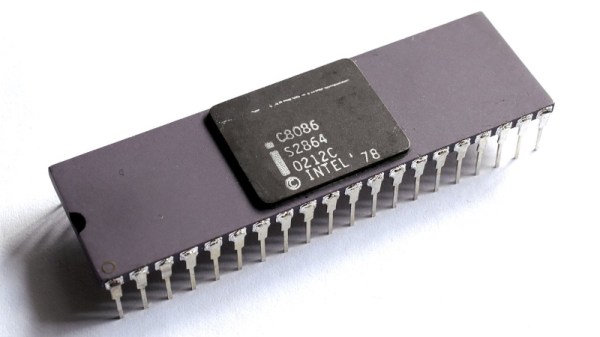
The modern web browser is now far more than a thing for rendering web pages, it’s a multi-faceted environment that can provide a home for almost any application you could imagine. But why should JavaScript or Wasm have all the fun? CSS is Turing complete now, right? Why not, as [Lyra Rebane] has done, write an 8086 emulator in pure CSS?

The web page at the link above may contain an 8086, but missing MMU aside, don’t expect it to run Linux just yet. Instead it has limited resources, just enough to run a demo program. It needs a Chrome-adjacent browser because it uses some CSS functions not available in for example Firefox, but we’ll forgive it that oddity. Its clock is provided by a small piece of JavaScript not because CSS can’t provide one, but because the JS version is more stable.

On one hand this is of little practical use, but to dismiss it as such is to entirely miss the point. It’s in the fine spirit of experimentation, and we love it. Perhaps a better way to look at it is to see what could be done more efficiently with the same idea. A 1970s CISC microprocessor might not be the best choice, but would for example a minimalist and optimized RISC design be more capable? We’re looking forward to where others take this thread.

It’s not the first unexpected computing environment we’ve found, who could forget theĀ DOOM calculator!


Header: Thomas Nguyen, CC BY-SA 4.0.
Building The Haxocorder

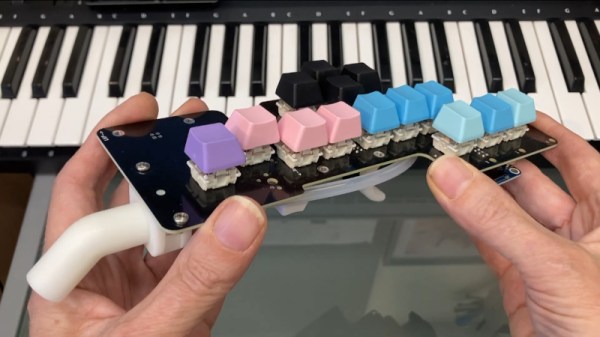
The Haxophone is an open source MIDI saxophone project that has achieved some popularity. It’s caught the attention of [Shieladixon] not because she is a saxophonist but because she plays the recorder and is dissatisfied with existing MIDI recorder peripherals. She’s set about modifying the device to produce the Haxocorder, a better MIDI recorder.

The video below the break is the third of a series, of which part one and part two deal with the Haxophone and the shortcomings of her existing recorder peripheral. She’s replacing the Pi Zero of the Haxophone with a Pi Pico in a Zero form factor, and simplifying its design significantly to remove unnecessary features. The result is a versatile instrument capable at a touch of becoming the full range of recorders, which she demonstrates with some nifty duet work.

The upstream Haxophone project can be found here if you are interested, and we hope she follows this up with a release of her mods to make the Haxocorder. Meanwhile if you feel you might have seen her work before, she’s the brains behind the MIDISID.

Continue reading “Building The Haxocorder”

The Engineering Of A Jimi Hendrix Performance

The guitarist Jimi Hendrix had a unique sound which has influenced countless musicians over the decades. He achieved it through mastery not only of his instrument, but of the complex feedback relationship between amplifier, environment, and guitar — coupled with a series of effects pedals including some then-unique ones made for him. Musical commentators have pored over his work for decades, but a recent piece in IEEE Spectrum is particularly interesting as it examines things from a technical perspective.

It centers around an electrical simulation of Hendrix’s effects chain, and makes an assertion that’s obvious on consideration but not the usual take on a Hendrix performance; that in his hands it became a wave synthesizer rather than the instrument itself. Certainly for anyone with an interest in analogue audio electronics as they pertain to musical synthesis it helps in placing the influence of the different circuits on the sound, and in hearing the familiar performances in a new light.

This isn’t the first time we’ve seen someone take a modelling approach to a guitar effects chain, indeed it’s obvious something missing from the work above is the guitar itself.


Header image: Gemeente Rotterdam (Stadsarchief) CC-0.

A TV Transmitter From An STM32

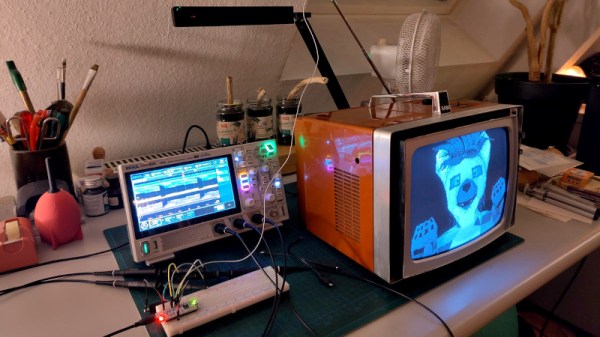
Analog TV may have shuffled off its mortal coil years ago, but there are still plenty of old CRT TV sets around that could receive it. [Kris Slyka] has just such a device, and decided to feed it something from an STM32 microcontroller. An STM32G431, to be precise, and they’re doing it using the on-chip hardware rather than in software.

This unexpected feat is made possible by clever use of the internal oscillators and analog multiplexer. The video itself is generated using the MCU’s DAC, and fed into the on-board op-amp multiplexer which is switched at the VHF transmission frequency. This creates the required VHF TV transmission, but without audio. This component comes by abusing another peripheral, the internal RC oscillator for the USB. This is frequency modulated, and set to the required 5.5 MHz spacing from the vision carrier for the TV in question. It doesn’t (yet) generate the PAL color sub-carrier so for now it’s black and white only, but maybe someone will figure out a way.

We like unexpected out-of-spec uses of parts like these microcontrollers, and we especially like analog TV hereabouts. We marked its very final moments, back in 2021.

Hackaday Podcast Episode Ep 358: Soft Displays, LCD Apertures, And Mind Controlled Toys

For today’s podcast Elliot Williams is joined by Jenny List, and we’re pushing the limits of mobile connectivity as Jenny’s coming to us from a North Sea ferry. We start by looking forward to the upcoming Hackaday Europe, with a new location in Lecco, Italy. We hope you can join us there!

There’s a bumper collection of hacks to talk about, with a novel soft pneumatic display, a CRT-based VR headset, an LCD photographic aperture, and a novel time-of-flight sensor array in the line-up.Then there are 3D printed PCBs, Scotch tape for a lens, and a project to map farts. We kid you not. Finally we wrap up with mind controlled toys, and a a treatise on requirements and specifications in an age of AI.

Or download it yourself in glorious 192 kbps MP3.


Continue reading “Hackaday Podcast Episode Ep 358: Soft Displays, LCD Apertures, And Mind Controlled Toys”

HD On A VHS Tape? How Did They Do It?

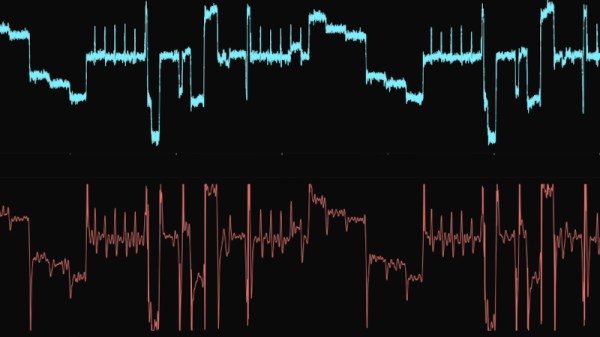
There was a period from the 1970s to the mid-2000s or so when a fixture underneath the family TV set was a VHS videocassette recorder. These were a masterpiece of cramming a color video signal into the restricted bandwidth of an affordable 1970s helical-scan tape deck, which was achieved by clever use of frequency shifting and FM carrier modulation. Very few of us will have had the ultimate iteration of the VHS format though, W-VHS, which managed the same trick but with HD video. But how? [Superchromat] is here with the answer.

W-VHS used a frequency modulated carrier, but instead of splitting luminance and chrominance in the frequency domain like its VHS ancestor, it did so in the time domain in the same way as some 1980s satellite TV standards did. Each line first contained the color information, then the brightness. Thus it sacrificed some color resolution and a little horizontal image resolution, but kept a much higher vertical image resolution. In the video below the break we go into significant detail about the compromises required to pull this off, and if you watch it through you’ll learn something about magnetic tape recording as well as FM.

The W-VHS standard is largely forgotten now as a last hurrah for the format, but it’s still in the sights of the VHS Decode project. The work in this video is helping them retrieve the highest quality images from these tapes, by capturing the raw RF from the heads and using DSP techniques to decode them.

Continue reading “HD On A VHS Tape? How Did They Do It?”

The Raspberry Pi As A Studio Camera

The Raspberry Pi has brought digital camera experimentation within the reach of everybody, with its combination of an accessible computing platform and some almost-decent camera sensors. If there’s a flaw in the Pi as a camera though, it lies in the software, which can be slow and frustrating to use. [Martijn Braam] is here with an interesting project that might yield some useful results in this direction, he’s making a Raspberry Pi studio camera.

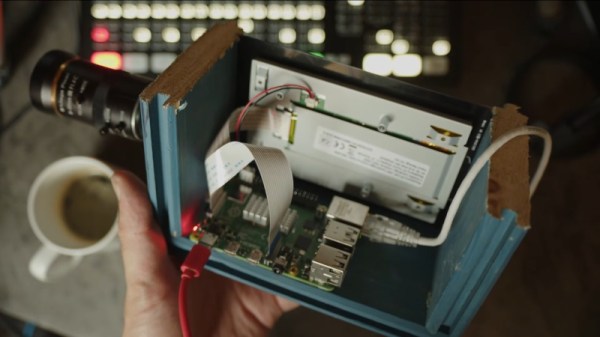
His camera hardware is very straightforward, a Pi 5 and touchscreen with the HD camera module in a rough but serviceable wooden box. The interesting part comes in the software, in which he’s written a low-latency GUI over an HDMI output camera application. It’s designed to plug into video mixing hardware, and one of the HDMI outputs carries the GUI while the other carries the unadulterated video. We can see this used to great effect with for example OBS Studio. It’s for now a work in progress as you can see in the video below the break, but we expect that it can only get better.

The video below exposes the obvious flaw in many Pi camera setups, that the available lenses don’t match the quality of the sensor, in that good glass ain’t cheap. But we think it’s one to watch, and could provide competition for CinePi.

Continue reading “The Raspberry Pi As A Studio Camera”