The Sunspots Are Coming (Again)

There are a bunch of ways to estimate the age of a radio amateur, by the letters in their callsign, by their preferred choice of homebrewing technology, or sometimes by their operating style. One that perhaps doesn’t immediately come to mind is to count how many solar cycles they remember, and since the current cycle 25 is my fourth I guess I’ve seen a few. Cycle 25 is so far shaping up to be quite an active one especially of late, which popular media are describing as bombarding us with flares from a “sunspot archipelago” and the more measured tones of spaceweather.com giving us warning of X-class flares heading in our direction, today!

Jean-Claude Roy, VP, Hydro Quebec
We wouldn’t be this guy for anything. From CBC’s coverage of the 1989 power outage.

As the technology for solar observation has increased in sophistication and the Internet has allowed anyone to follow the events above us as they unfold, the awareness of solar phenomena has shifted away from the relatively small numbers of astronomers and radio amateurs who would once have been eagerly awaiting a solar cycle to a wider audience. Ever since a particularly severe event in March 1989  during cycle 22 caused disruptions including the blackout of a significant part of Canada it’s been a periodic topic of mild doom in slow news moments. But what lies behind the reports of solar activity? Perhaps it’s time to take a look.

The solar cycle refers to the 11-year period of solar activity from a maximum of observed sunspots through a minimum to a new maximum. The sunspots are the visible evidence of the solar magnetic field changing its polarity, and appear as darker areas where there is a greater strength of magnetic flux in the sun’s photosphere. We refer to solar cycles by number with solar cycle 1 occurring in 1755 because that year represents the earliest cycle which can be found in modern astronomical observation data, but previous cycles have been deduced over millennia through dendrochronology, sediment analysis, isotope observations, and other methods. Continue reading “The Sunspots Are Coming (Again)”

A Few New Car Owners Will Join The 48V Future

Leaving aside all the annoying hype surrounding Tesla’s Cybertruck, there’s a little technical detail which might be of more interest to readers than the automotive behemoth itself. It’s one of very few vehicles on the road to eschew 12 volt electrics for not 24 volt, but 48 volt. This has been one of those automotive innovations promised as just around the corner for many years, and it seems finally we’ll see it in practice.

The reason that there’s nothing new in the prospect of moving on from 12 volt electrics has been brewing for decades now. A typical car has plenty of motorized gadgets from seat adjusters to sunroofs, as well as at least one heated windscreen or other surface. These devices take a lot of power, and at the lower voltage require significant current to operate. The 48 volt system will require much less in the way of copper to get the power where it’s needed, so the surprise is that we’ve not yet seen it in run-of-the-mill vehicles from the likes of Ford or Volkswagen.

What we’re guessing is that other manufacturers will be watching from the sidelines as to whether 48 volt electrics cause any problems for the Tesla, and it’s not impossible we could see it becoming the new hotness. There are many choice words we could say relating to the hype around Tesla and its supposed level of innovation, but it could be that this time they’ve really been first with something the whole industry will go for. If so we should rejoice, because it’s likely to push down the prices of 48 volt lithium-ion packs.

Header image: Mliu92, CC BY-SA 3.0.

The Minimum Required For A Film Camera

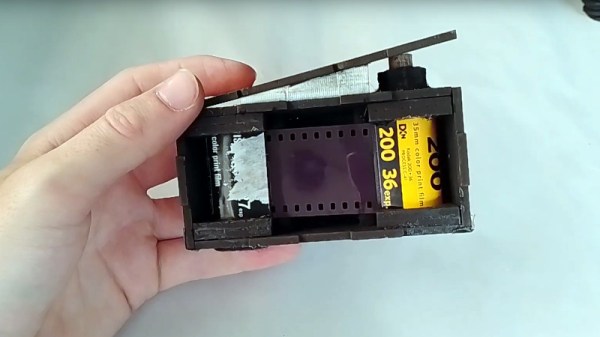
Film cameras can be complex and exquisitely-crafted masterpieces of analogue technology. But at their very simplest they need be little more than a light-proof box with a piece of film at the back of it, and some kind of lens or pinhole with a shutter. [ChickenCrimpy] adds the most basic of 35 mm cartridge to create what he calls the Minimum Viable Camera. It’s a half-frame 35 mm pinhole film camera with the simplest possible construction.

A grainy B&W picture of a bird perched on a railingIt can be built from almost any flat light-proof 3 mm thick stock, though something that you can run through a laser cutter is probably ideal. Once snapped together to make to box-like structure, tape is added along the joins for light-proofing. The film is reeled from a full 35 mm cartridge to an empty one, and cranked back frame-by-frame by means of a wooden key that engages with the spindle.



There’s no lens, instead this is a pinhole camera, and the shutter is a piece of the stock held on the front of the camera with bolts and butterfly nuts. Taking a photo is as simple as pointing the device at the subject and lifting the shutter away for a few seconds. There’s a video overview for the project which we’ve placed below the break.

It’s true that this camera needs a moment in the darkroom to load, but we like its extreme simplicity and the ethereal and grainy pictures it produces. If you fancy an introduction to 35 mm photography you could definitely do worse.

Continue reading “The Minimum Required For A Film Camera”

Noise Cancelling Isn’t As Easy As You’d Think

On the face of it, producing a set of noise cancelling headphones should be a relatively straightforward project. But as [Pete Lewis] found out, things are not always as they seem. The result is a deep dive into microphone specifications, through which most of us could probably learn something.

Noise cancelling headphones have a set of microphones which provide anti-phase noise through an amplifier to the ‘phones, thus in theory cancelling out the external noise. Since [Pete] is a musician this pair would have to be capable of operating at high noise levels, so he checked the spec for his microphone and with an acoustic overload point at 124 dB for a 115 environment he was ready to go.

Unfortunately these ‘phones showed distortion, which brings us back to the acoustic overload point. This is the sound level at which the microphone has 10% distortion, which is a very high figure, and certainly meant there was enough distortion to be audible at the lower level. After a search for a higher spec microphone and a move to a digital codec-based solution with an ESP32 he eventually cracks it though, leading to an inexpensive set of noise cancelling headphones for high-noise environments.

If distortion interests you, it’s a subject we’ve visited in the past.

Header image: fir0002, GFDL 1.2.

A Flasher Mac, 25 Years Later

Apple Macintosh computers of the 1990s came with a system ROM containing an Open Firmware implementation and the Mac Toolbox required to start the operating system. In many cases this was on a SIMM-like daughter board, and it would have been a true ROM that was unable to be reprogrammed. This is not the end of the story though, and [Doug Brown] set out on the trail of a Flash-based ROM module allowing the firmware on these machines to be updated.

The trail was warm thanks to an Apple developer utility found on a secondhand Mac prototype, allowing ROM flashing. A little disassembly allowed a list of valid IDs to be made, and this info coupled with a bit of reverse engineering from online photos of a real Apple Flash ROM from the ’90s allowed a new board to be created with four Am28F020  chips. He can now flash at will, with such oddities as running ROMs from different machines with the “wrong” startup chime. It’s an interesting little piece of 1990s Mac trivia, settled.

This isn’t the first time we’ve peered at Apple ROMs, indeed some of the older ones had plenty of Easter eggs hidden within.

A 48 Volt Battery Pack With Carefully Balanced Cells

Many readers will have at some time or another built their own lithium-ion battery packs, whether they are using tiny cells or the huge ones found in automotive packs. A popular choice it to salvage ubiquitous 18650 cylindrical cells, as [limpkin] has with this 48 volt pack. It’s based around an off-the-shelf kit aimed at the e-bike market, but it’s much more than a simple assembly job.

Faced with a hundred salvaged cells of unknown provenance, the first thing to do was ensure that they were all balanced and showed the same voltage. Some might do this the inefficient way by hooking each one up to a charger and a programmable load, but in this case a much more radical route was taken. A huge PCB was designed with sockets for all hundred cells, connected in parallel through individual series resistors. This allowed them to balance to a common voltage before being discharged to a safe voltage for assembly. Their individual ESRs were the measured, and the best performing examples were then spot-welded into the final 13s-6p final pack.

We all use lithium-ion batteries, but how many of us know how they work?

A Tube Guitar Amp For A Modest Budget

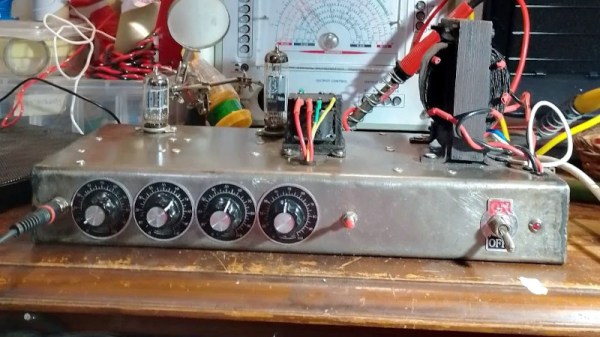
There’s a mystique among both audiophiles and musicians about vacuum technology, thus having a tube amp still carries a bit of a cachet. New ones can be bought for eye-watering prices and old ones can be had for the same price with the added frisson of unreliability. Happily it’s surprisingly straightforward to build your own, as [_electroidiot] shows us with a fairly inexpensive build.

The design is inspired by the guitar amps of the 1950s and 1960s so it’s not for audiophiles. The circuit is a pretty conventional single-ended one with a two stage double triode preamp and a single power output tube. The transformers are usually the difficult part of a build like this one, and here instead of resorting to using a mains transformer for audio they come from a defunct 1960s Phillips radio. We especially like the old-school construction technique with a folded aluminium chassis and liberal use of tag strips on which to build the circuits.

The result is something that would have been in no way out of place in the 1960s, and proves that tube circuitry isn’t beyond the constructor in 2023. If it’s whetted your appetite for more, we can help you there.