Black Graphics On Your TV, For A Greener World?

Can you really save energy by carefully choosing the colors displayed on a TV screen? Under some conditions, yes. Or at least that’s the conclusion of a team at the BBC that looked at reducing the energy consumption impact of their output by using what they call Lower Carbon Graphics. In short, they’re trying to ensure that OLED displays or those with reactive backlights use less energy when displaying BBC graphics, simply by using more black.
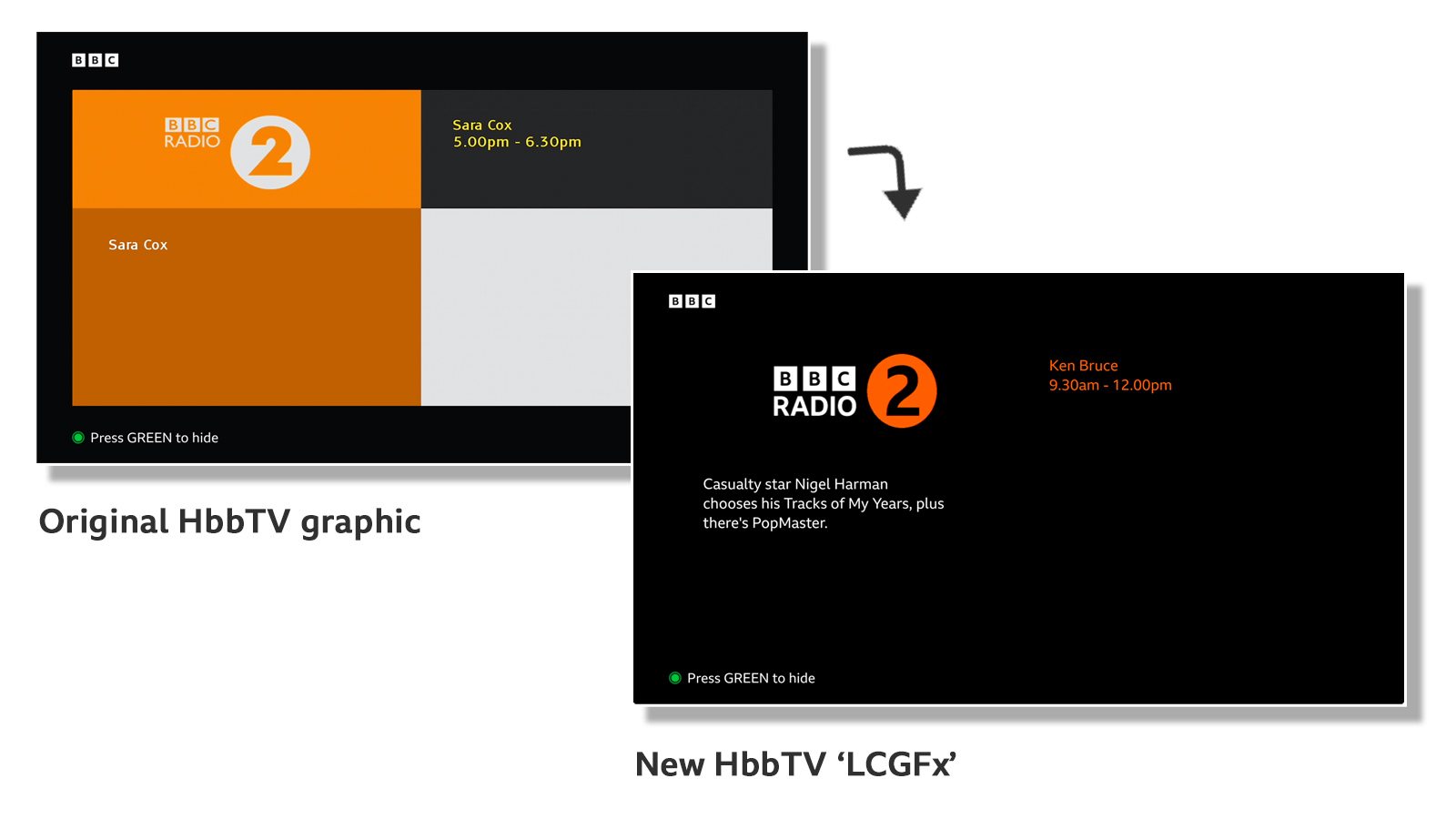
It turns out that a lot of British households play radio stations on their TVs, and the BBC sends a static image to each screen in this mode. As part of a redesign across the organisation, the BBC removed the bright background colours from these images and replaced it with black, with a remarkable reduction in power consumption, at least on OLED and FALD screens. (On normally backlit screens, 89% of British TVs, this does nothing.)

If you look hard at their numbers, though, listening to radio on the TV is horrendously inefficient; can you imagine a radio that consumes 100 W?  If the BBC really wants to help reduce media-related energy consumption, maybe they should stop broadcasting radio programming on the TV entirely.

Anyway, as we move toward a larger fraction of OLED screens, on TVs and monitors alike, it’s fun to think that darker images use up to 40% less power. Who knew that Hackaday was so environmentally friendly? Black is the new green!

Header: RIA Novosti archive/ Igor Vinogradov, CC-BY-SA 3.0.
This 3D Scanner Uses A Sensor You Might Not Know About

The huge diversity of sensors and other hardware which our community now has access to seems comprehensive, but there remain many parts which have made little impact due to cost or scarcity. It’s one of these which [Enginoor] has taken for the sensor in a 3D scanner, an industrial laser displacement sensor.

This sensor measures distance, but it’s not one of the time-of-flight sensors we’re familiar with. Instead it’s similar to a photographic rangefinder, relying on the parallax angle as seen from a sensor a distance apart from the laser. They are extremely expensive due to their high-precision construction, but happily they can be found at a more affordable level second-hand from decommissioned machinery.

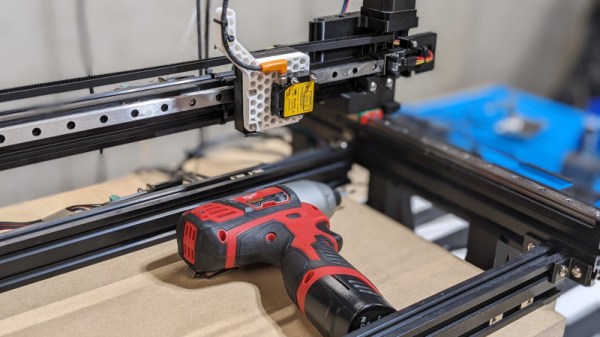
In this case the sensor is mounted on an X-Y gantry, and scans the part making individual point measurements. The sensor is interfaced to a Teensy, which in turn spits the data back to a PC for processing. By their own admission it’s not the most practical of builds, but for us that’s not the point. We hope that bringing these parts to the attention of our community might see them used in other ways.

We’ve featured huge numbers of 3D scanners over the years, including a look at how not to make one.

Update Your Chinese Radio Without The Pain

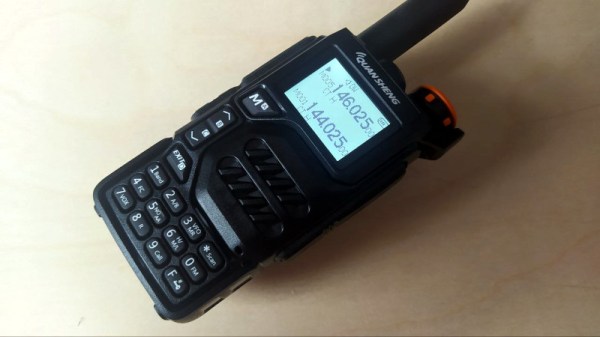
The new hotness in cheap radios this year has been the Quansheng UV-K5, a Chinese handheld transceiver with significant RF abilities and easy modding. The amateur radio community have seized upon it with glee and already reverse-engineered much of the firmware, but flashing the thing has always required a minor effort. Now thanks to the work of [whosmatt], it can be flashed with little more than a web browser and a serial cable.

This feat was made possible through the magic of WebSerial, a handy feature that allows web applications to talk to connected hardware. We’ve seen it in action a few times in the world of badges, and as browser support for it has improved it’s now available through browsers on all the major platforms.

The web app allows tweaking of the Quansheng settings and will, no doubt, be capable of uploading that when fully open-source firmware is available. It should be of great interest well beyond the world of Chinese radios, though, because we’re guessing there are a lot of projects that could benefit from such a ubiquitous interface tool.

If you’d like to know more, WebSerial is something we’ve looked at in the past.

Header image: [Concretedog]

Myth Tested: DOS Can’t Multitask

It’s a piece of common knowledge, that MS-DOS wasn’t capable of multitasking. For that, the Microsoft-based PC user would have to wait for the 80386, and usable versions of Windows. But like so many such pieces of received Opinion, this one is full of holes. As [Lunduke] investigates, there were several ways to multitask DOS, and they didn’t all depend on third-party software.

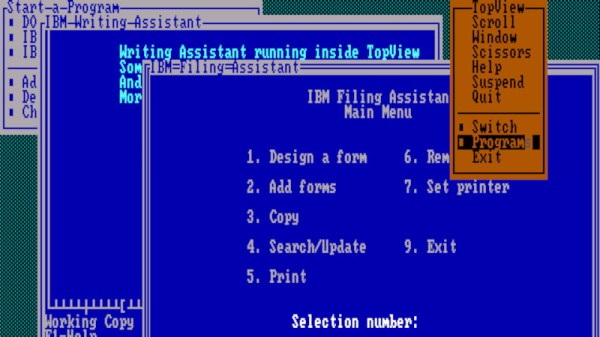
A quick look at DESQview and Concurrent DOS was expected from this article, but of more surprise is that IBM had a multitasking DOS called TopView, or even that Microsoft themselves released the fully multitasking MS-DOS 4.0. We remember DOS 4 as being less than sparkling, but reading the article it’s obvious that we’re thinking of the single-tasking version 4.01.

From 2023 it seems obvious that multitasking is a fundamental requirement of PC use, but surprisingly back in the 1980s a PC was much more a single-application device. On one hand it’s surprising given the number of multitasking DOS products on the market that none of them became mainstream, but perhaps the best evidence of the PC market simply not being ready for it comes in the fact that they didn’t.

If you fancy experimenting with DOS multitasking, at least machines on which to do it can still be found.

LK-99: Diamagnetc Semiconductor, Not Superconductor?

Every so often, along comes a story which, like [Fox Mulder] with his unexplained phenomena, we want to believe. EM drives and cold fusion for example would be the coolest of the cool if they worked, but sadly they crumbled when subjected to scientific inquiry outside the labs of their originators. The jury’s still out on the latest example, a claimed room-temperature superconductor, but it’s starting to seem that it might instead be a diamagnetic semiconductor.

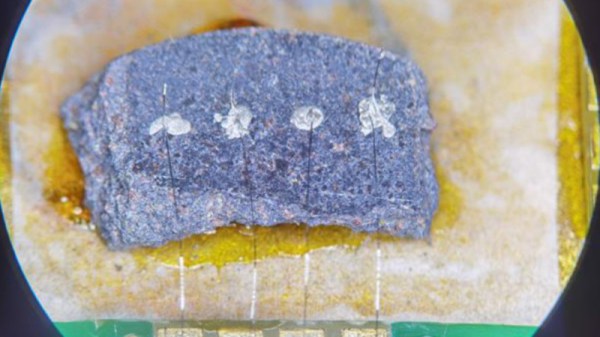
We covered some of the story surrounding the announcement of LK-99 and subsequent reports of it levitating under magnetic fields, but today’s installment comes courtesy of a team from Beihang University in Beijing. They’ve published a paper in which they characterize their sample of LK-99, and sadly according to them it’s no superconductor.

Instead it’s a diamagnetic semiconductor, something that in itself probably bears some explanation. We’re guessing most readers will be familiar with semiconductors, but diamagnetic substances possess the property of having an external magnetic field induce an internal magnetic field in the opposite direction. This means that they will levitate in a magnetic field, but not due to the Meissner effect, the property of superconductors which causes magnetic field to flow round their outside. The Beijing team have shown by measuring the resistance of the sample that it’s not a superconductor.

So sadly it seems LK-99 isn’t the miracle it was billed as, unless there’s some special quirk in the production of the original Korean sample which didn’t make it to the other teams. We can’t help wondering why a sample from Korea wasn’t subjected to external evaluation rather than leaving the other teams to make their own. Never mind, eh!

It’s Snake, In A QR Code, But Smaller

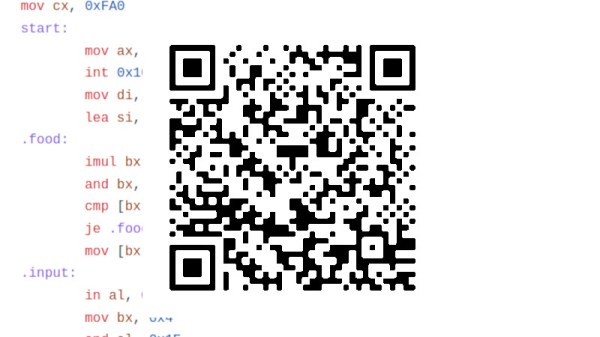
We’re not sure that many of you have recognised the need in your life for an x86 machine code program encoded into a QR code, but following on from someone else work [donno2048] has created a super-tiny Snake clone in assembly which comes in at only 85 bytes long. It fits far better in a QR code than the previous effort, but perhaps more useful is a web page demo which runs an in-browser DOS compatibility library. We followed the compilation instructions and got it running on our Manjaro installation, with the result of a somewhat unplayable but recognisable Snake, we’re guessing because it was written for a slower platform. The web version is more usable, and allows us to investigate its operation more thoroughly.

To achieve a working game in so little code is an impressive feat, and since we found different keys responded on machines with different keyboards we’re curious how it does its keyboard input. Also we think it has the Snake bug where turning back on yourself means instant game over. We would be interested to hear the views in the comments of readers who know something about x86 assembly, to help explain these points.

MIT Cracks The Concrete Capacitor

It’s a story we’ve heard so many times over the years: breathless reporting of a new scientific breakthrough that will deliver limitless power, energy storage, or whichever other of humanity’s problems needs solving today. Sadly, they so often fail to make the jump into our daily lives because the reporting glosses over some exotic material that costs a fortune or because there’s a huge issue elsewhere in their makeup. There’s a story from MIT that might just be the real thing, though, as a team from that university claim to have made a viable supercapacitor from materials as simple as cement, carbon black, and a salt solution. Continue reading “MIT Cracks The Concrete Capacitor”