A Fancy Connected Caliper For Not A Lot

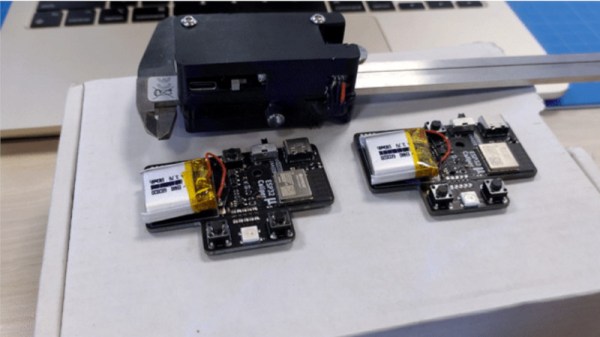
An essential for the engineer is a decent caliper, to measure dimensions with reasonable accuracy. Some of us have old-fashioned Vernier scales, while many up-to-date versions are electronic. When entering large numbers of dimensions into a CAD package matters can become a little tedious, so the fancier versions have connectivity for automatic reading transfer. [Mew463] didn’t want to shell out the cash for one of those, so modified a cheaper caliper with an ESP32-C3 microcontroller to provide a Bluetooth interface.

Many cheaper calipers have a handy hidden serial port, and it’s to this interface the mod is connected via a simple level shifter. The ESP and associated circuitry is mounted on a custom PCB on the back of the caliper body, with a very neatly designed case also holding a small Li-Po cell. It adds a little bulk to the instrument, but not enough to render it unusable. Whether the work required to design and build it is worth the cost saving over an off-the-shelf connected caliper is left to the reader to decide.

We’ve covered similar hacks in the past, but this one’s to a very high standard. Meanwhile if calipers are of interest to you then they’re a subject we’ve examined in some significant detail.

27 Litres And 12 Cylinders, With A Practical Station Wagon Body

If you were to name one of the most famous individual road cars in the world, what would it be? If you’re British and of a Certain Age, then it’s possible your nomination is for sale, because “The Beast”, the one-off creation of [John Dodd] using a 27-litre Rolls-Royce Merlin aero engine, is up for auction. The Late Brake Show’s [Jonny Smith] has given it a drive, and we’ve pasted the resulting video below the break.

A second-hand motor isn’t usual Hackaday fare, but it’s the manner of this car’s building which we think will draw you in. [John] originally acquired somebody’s failed project featuring not a Merlin but its de-tuned derivative intended for tanks. He solved the problem of finding a transmission able to handle the immense power, and built it up with a pretty 1970s coupe body. After a fire a few years later he commissioned a new body from a dragster manufacturer, which is the wildly period estate car you’ll see in the video. It famously originally had a Rolls-Royce Cars grille, for which he ended up in court in the 1980s as the carmaker sought successfully to have it removed.

The tale of this car is one of epic scale hackery, as there is quite simply nothing else like it. It was once the world’s most powerful road car, and remains capable of well over 200 miles per hour. Sadly we couldn’t afford to buy it even if we could fit its immense length in our parking space.

Hungry for more epic British car hackery? Have we got the roadster for you!

Continue reading “27 Litres And 12 Cylinders, With A Practical Station Wagon Body”

Hacker Hotel 2023 Had A Very Cool Badge

One effect of the global pandemic was that there were relatively few events in our sphere for a couple of years. This and that other by-product of COVID-19, the chip shortage, meant that over the past year we’ve been treated to several event badges that should have appeared in 2020 or 2021, but didn’t due to those cancelled events. We were lucky enough to receive probably the last of these delayed badges in mid February, as we made the journey to the central part of the Netherlands to Hacker Hotel 2023.

A Puzzle, A 4-Bit Computer, And An Artwork

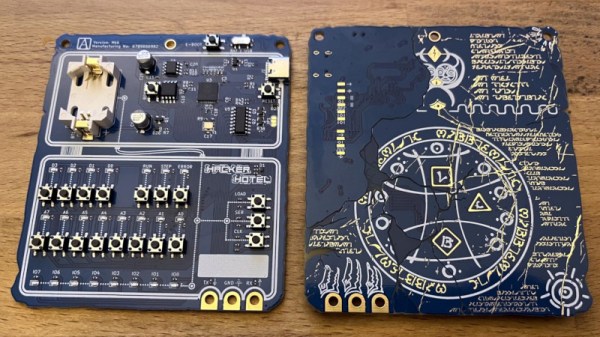
The badge takes the form of a rectangular PCB with all parts on the top side. The brains of the operation is an RP2040, and it’s powered by a CR2032 coin cell in a holder.  It’s divided into two parts, the top third which carries the circuitry and the lower two thirds of which as a row of buttons and LEDs. It’s pretty obvious from the start that it has data and address lines of a 4-bit computer, and as well as these there is an evident serial port and a USB socket. The artwork comes form the same artist whose work graced both the previous Hacker Hotel badge and the MCH2022 badge, and the rear of the PCB makes full use of all layers to create a mystical puzzle. The sum is to create a puzzle game intended to entertain the visitor, take them round the venue, and find clues to an eventual solution. I love the design both from an artistic and technical viewpoint, but have to admit that the puzzle aspect isn’t really my thing. Thus here we’ll concentrate on the badge hardware and production, and mention the puzzles only in passing. Continue reading “Hacker Hotel 2023 Had A Very Cool Badge”

A Tape Loop Echo You Can Build

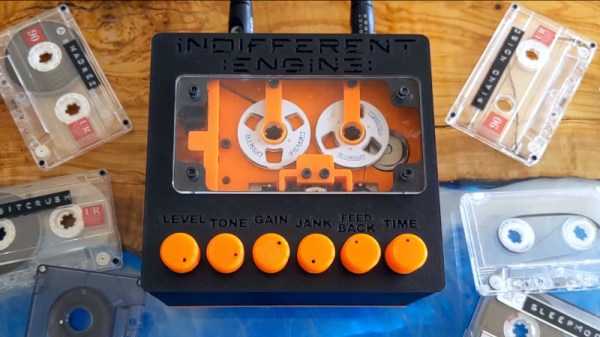
Echo and reverb are now electronic audio effects done in a computer or an integrated circuit, but originally they were achieved through mechanical means. Reverb units used springs, and echo units used loops of magnetic tape. As a musician hankering after a mechanical tape echo unit, [Adam Paul] was left with no choice but to build his own. We featured an early prototype, but now he’s back with a finished version that’s intended to be replicated by other musicians.

The unit takes a cassette mechanism from one of the last still-manufactured players available through the usual sources. It splits record and play heads, with the normal cassette replaced with a tape loop made from extra-thick computer tape. A custom PCB replaces most of the electronics, and the auto-reverse system is disabled.

The result is a functional tape echo system, as can be seen in the video below the break. This is ready to build yourself, with everything on a GitHub repository and an extremely comprehensive build guide, so do any of you fancy a go?

Read about the device’s earlier incarnation here.

Continue reading “A Tape Loop Echo You Can Build”

How Simple Can A Wind Generator Get?

As the world has moved towards sustainable energy sources over the last few years, it’s increasingly common to be close to a wind turbine. The huge turbines visible on the horizon from where this is being written are the upper end of the scale though, and along comes [Robert Murray-Smith] with the opposite, probably the simplest and smallest wind turbine we’ve seen.

His use of a 3-phase motor from a CD-ROM drive as the generator isn’t particularly unexpected, these motors are ubiquitous and readily generate power when spun up. A simple 3-phase rectifier and a capacitor delivers a DC voltage that while the ready availability of switching converter modules should be relatively easy to turn into something more useful.

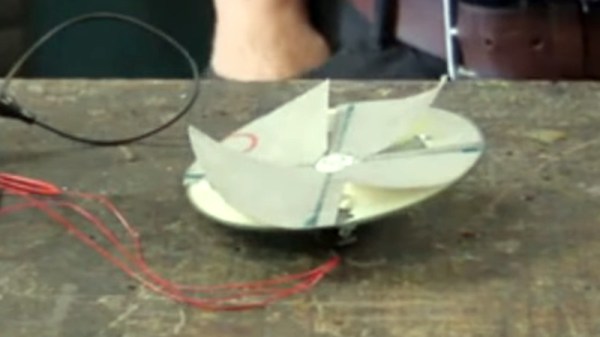
The clever part of this hack lies then in the rotor, it’s not the propeller-style bladed affair you might expect. Instead he takes a CD, as it’s the obvious thing to fit on a CD motor, and glues a piece of Tyvek on top of it. This is cut to form four flaps which make a rudimentary but effective turbine when the wind comes from the side. It’s beautifully simple, and we wish we’d thought of it ourselves. The whole thing is in the video below the break, so take a look.

Maybe this won’t solve the green energy requirement on its own, but we’ve shown you far larger fabric turbines in the past.

Continue reading “How Simple Can A Wind Generator Get?”

Old TV To RGB

As CRT televisions have faded from use, it’s become important for retro gaming enthusiasts to get their hands on one for that authentic experience. Alongside that phenomenon has been a resurgence of some of the hacks we used to do to CRT TV sets back in the day, as [Adrian’s Digital Basement] shows us when he adds an RGB interface to a mid-1990s Sony Trinitron.

Those of us lucky enough to have lived in Europe at the time were used to TVs with SCART sockets by the mid-1990s so no longer needed to plumb in RGB signals, but it appears that Americans were still firmly in the composite age. The TV might have only had a composite input, but this hack depends on many the video processor chips of the era having RGB input pins. If your set has a mains-isolated power supply then these pins can be hooked up with relative ease.

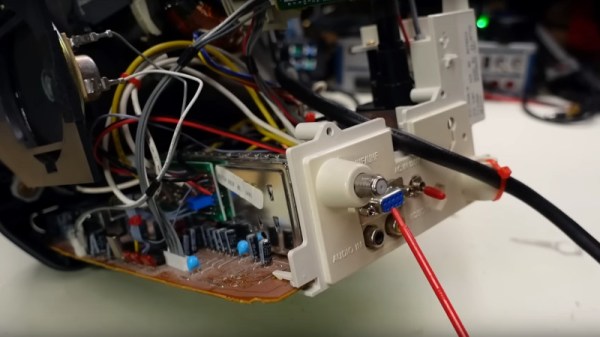
In the case of this little Sony, the RGB lines were used by the integrated on-screen display. He takes us through the process of pulling out these lines and interfacing to them, and comes up with a 9-pin D connector with the same pinout as a Commodore monitor, wired to the chip through a simple RC network and a sync level divider. There’s also a switch that selects RGB or TV mode, driving the OSD blanking pin on the video processor.

We like this hack just as much as we did when we were applying it to late-80s British TV sets, and it’s a great way to make an old TV a lot more useful. You can see it in the video below the break, so get out there and find a late-model CRT TV to try it on while stocks last!

Unsurprisingly, this mod has turned up here a few times in the past.

Continue reading “Old TV To RGB”

How To Make A Larger Air-Cored Inductor

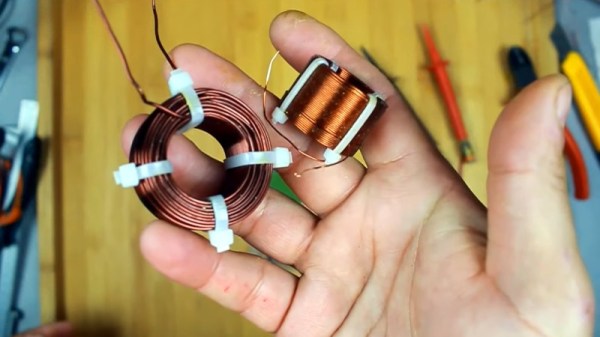
Radio amateurs often have a love-hate relationship with home-made inductors, sharing all kinds of tips and tricks as to how the most stable nanohenry inductor can be wound. But there’s another group in the world of electronics with an interest in high-quality inductors, namely the audio enthusiasts. They need good quality inductors with a values in the millihenries, to use in loudspeaker crossover networks. [Homemade Audio] takes us through their manufacturing process for these coils, and the result is a watchable video resulting in some very well-made components.

The adjustable former is a machined aluminium affair of which we’re treated to the full manufacture. It’s likely the same results could be achieved with a 3D printed reel. The free-as-in-beer Coil64 on Windows is used to calculate the dimensions and number of turns, and it’s set up on a jig with a cordless screwdriver doing the winding. The best technique for flat layers of turns is explained, and a coat of varnish is put on each completed layer. We’re guessing this is to stop the coil “singing” at audio frequencies.

With a set of cable ties holding it together the result is a very tidy component. It’s adjusted a few turns to get the right value with an LCR meter, however experience tells us that a tiny percentage either way won’t harm the resulting network too much. If you make your own speakers, the video below the break could be extremely useful.

Need a loudspeaker primer? We have just the article for you.

Continue reading “How To Make A Larger Air-Cored Inductor”