A Real-World Experience In PCB Dye-Sub Printing

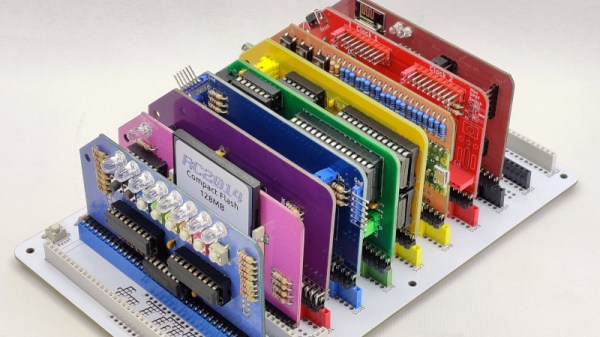
We all love PCB artwork, but those who create it work under the restriction of having a limited color palette to work with. If it’s not some combination of board, plating, solder mask, and silk screen, then it can’t easily be rendered on a conventional PCB. That’s not the end of the story though, because it’s technically possible to print onto a PCB and have it any color you like. Is it difficult? Read [Spencer]’s experience creating a rainbow Pride version of his RC2014 modular retrocomputer.

Dye-sublimation printing uses an ink that vaporizes at atmospheric pressure without a liquid phase, so a solid ink is heated and the vapor condenses back to solid on the surface to be printed. Commercial dye-sub printers are expensive, but there’s a cheaper route in the form of an Epson printer that can be converted. This in turn prints onto a transfer paper, from which the ink is applied to the PCB in a T-shirt printing press.

[Spencer] took the advice of creating boards with all-white silkscreen applied, and has come up with a good process for creating the colored boards. There is still an issue with discoloration from extra heat during soldering, so he advises in the instructions for the kit to take extra care. It remains however a fascinating look at the process, and raises the important point that it’s now within the reach of perhaps a hackerspace.

Regular readers will know we’ve long held an interest in the manufacture of artistic PCBs.
A Fresnel Lens Without The Pain

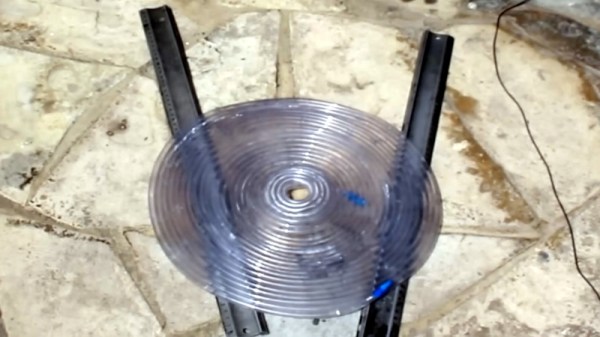
Making a traditional glass lens requires a lot of experience, skill, and patience grinding a piece of glass to the required shape, and is not for the casual experimenter. Making a glass Fresnel lens with its concentric rings requires even more work, but as the ever-resourceful [Robert Murray-Smith] shows us, a Fresnel lens can be made from far more mundane materials. He shows us a working lens made from transparent plastic tube, and even successfully smoulders a piece of paper with it under the anaemic British sun.

His lens, with its circular profile tube filled with water, is not perhaps the most efficient lens in terms of light focused per unit area of lens. From dredging up our highschool physics lessons we are guessing that half the light is diffracted outwards rather than inwards by the cylindrical profile of the coil, but for the cost of the whole device we’re not sure that matters. Next time we’re shipwrecked on a desolate island with a handy supply of clear plastic tube and fresh water, we know we can always raise a fire.

If Fresnel lenses interest you, we’ve taken a look in the past at their history.

Continue reading “A Fresnel Lens Without The Pain”

Is MINIX Dead? And Does It Matter?

Is MINIX dead? OSnews is sounding its death-knell, citing evidence from the operating system’s git log that its last updates happened as long ago as 2018. Given that the last news story on the MINIX website is from 2016 and the last release version, 3.3, came out in 2014, it appears they they may have a point. But perhaps it’s more appropriate to ask not whether or not MINIX is dead, but whether indeed it matters that the venerable OS appears no longer in development. It started as an example to teach OS theory before becoming popular in an era when there were no other inexpensive UNIX-like operating systems for 16-bit microcomputers, but given that its successors such as Linux-based operating systems have taken its torch and raced ahead, perhaps its day has passed.

No doubt many of you will now be about to point out that MINIX lives on unexpectedly baked into the management engine core on Intel microprocessors, and while there’s some debate as to whether that’s still the case, you may have a point. But the more important thing for us isn’t whether MINIX is still with us or even whether it’s a contender, but what it influenced and thus what it was responsible for. This is being written on a GNU/Linux operating system, which has its roots in [Linus Torvalds]’ desire to improve on… MINIX.

Read more about the tangled web of UNIX-like operating systems here.

What Next For The SBC That Has Everything?

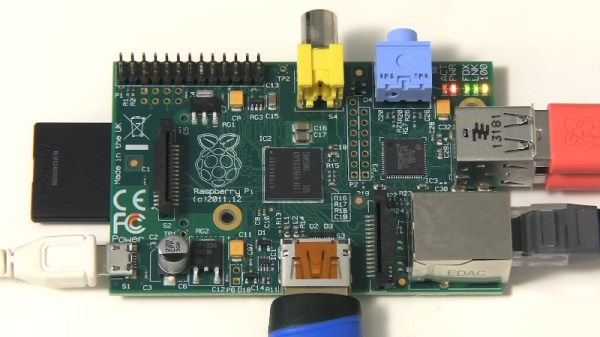
In the decade-and-a-bit since the first Raspberry Pi was launched we’ve seen an explosion of affordable single-board computers (SBCs), but as the prices creep up alongside user expectation and bloat, [Christopher Barnatt] asks where the industry will go next.

The Pi started with an unbeatable offer, $35 got you something similar to the desktop PC you’d had a decade earlier — able to run a Linux desktop on your TV from an SD card. Over the years the boards have become faster and more numerous, but the prices for ARM boards are now only nominally as affordable as they were in 2012, and meanwhile the lower end of x86 computing is now firmly in the same space. He demonstrates how much slower the 2023 Raspberry Pi OS distribution is on an original Pi compared to one of the early pre-Raspbian distros, and identifies in that a gap forming between users. From that he sees those people wanting a desktop heading towards the x86 machines, and the bare-metal makers at the lower end heading for the more powerful microcontrollers which simply weren’t so available a decade ago.

We have to admit that we agree with him, as the days when a new Raspberry Pi board was a special step forward rather than just another fast SBC are now probably behind us. In that we think the Pi people are probably also looking beyond their flagship product, as the hugely successful lunches of the RP2040 and the industrial-focused Compute Module 4 have shown.

What do you think about the SBC market? Tell us in the comments.

Continue reading “What Next For The SBC That Has Everything?”

Will Electric Tractors Farm Your Food?

There are two professions used to driving single-seaters with hundreds of horsepower, one of which is very exclusive and the other of which can be found anywhere the ground is fertile enough to support agriculture. Formula One drivers operate fragile machines pushed to the edges of their performance envelope, while the tractor at the hands of a farmer is designed to reliably perform huge tasks on dodgy ground in all weathers. Today’s tractor is invariably a large machine powered by a diesel engine, and it’s the equal of all tasks on a modern farm. Against that backdrop then it’s interesting to read the Smithsonian magazine’s look at the emerging world of electric tractors. Will they replace diesel as the source of traction in the fields?

Farm-ng’s Amiga

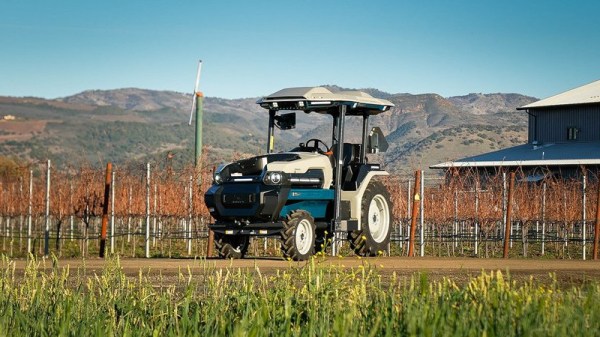
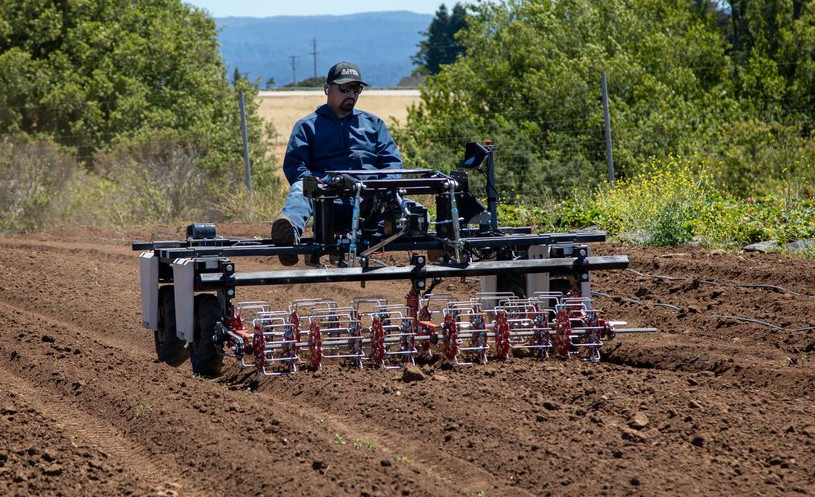
The two firms they focus on first are Monarch Tractor, and Solectrac. Both manufacturers offer small machines of the type we’d be inclined to describe as an orchard tractor, and Monarch are offering an autonomous option as part of their package. They also feature Farm-ng, whose machine called amusingly the Amiga, is a much smaller affair which we are guessing would be super-useful on a very intensive operation such as market gardening. We’re especially pleased to see that the emerging small electric tractor industry is embracing right to repair, something the traditional manufacturers are famous for ignoring.

It’s obvious that none of these machines are going to revolutionize the world of large high-power tractors any time soon, as they are too small for the job and can’t offer the 24/7 operation required at busy times on a farm. But it’s obvious they would be very useful on a small farm, and in particular for those tractor applications where the machine is a platform which goes from place to place to aid static work, they could be better than their diesel equivalents.

It’s odd that over the years we’ve not covered any electric tractors before. Perhaps that is, until you search instead for agricultural robots.

Restoring Dot Matrix Printer Cartridges For 2023

The noise of a dot matrix printer is probably as synonymous with 1980s computing as the modem handshake would become with the desktop experience a decade or more later. But unlike the computers that would have driven it, a dot matrix printer can still be a very useful device here in 2023. And why not? They’re cheap to operate and can produce surprisingly good quality when paired with suitable drivers. There is a snag though; while cartridges for popular models can still be found, there are plenty whose consumables are long gone. [Drygol] had an Apple ImageWriter II with exactly that problem, and after finding all his cartridges were non-functional, took a look at how to bring them back.

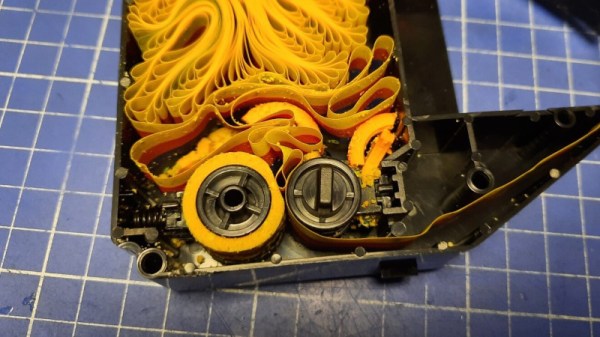
Inside a dot matrix cartridge is a fabric ribbon similar to the one that might once have been found on a typewriter. It’s not on a roll but folded into the space, and it’s drawn through by a pair of rollers. Not only had the ink on the fabric dried out, but the foam on the rollers had also disintegrated. Some careful dismantling, and a solution presented itself in the form of O-rings to replace the rollers. Those and a bit of mineral oil to soften the ink had the vintage Apple printing again as though it was the ’80s once more.

It’s a subject we’ve looked at before, as it turns out WD-40 makes a good ink solvent.

Nice Try, But It’s Not Aperture Synthesis

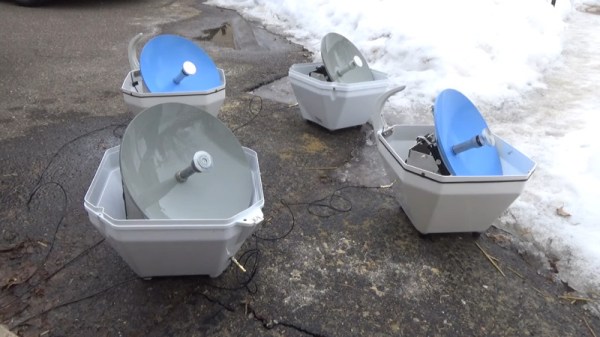
Some of the world’s largest radio telescopes are not in fact as physically large as they claim to be, but instead are a group of telescopes spread over a wide area whose outputs are combined to produce a virtual telescope equal in size to the maximum distance between the constituents of the array. Can this be done on the cheap with an array of satellite dishes? It’s possible, but as [saveitforparts] found out when combining a set of Tailgater portable dishes, not simply by linking together the outputs from a bunch of LNBs.

The video below the break still makes for an interesting investigation and the Tailgater units are particularly neat. It prompted us to read up a little on real aperture synthesis, which requires some clever maths and phase measurement for each antenna. Given four somewhat more fancy LNBs with phase-locked local oscillators and an software-defined radio (SDR) for each one then he might be on to something.

If you’re curious about the cyberdeck in the video, you might like to read our coverage of it. And the Tailgater might be a bit small, but you can still make a useful radio telescope from satellite TV parts.

Continue reading “Nice Try, But It’s Not Aperture Synthesis”