How Simple Can A Wind Generator Get?

As the world has moved towards sustainable energy sources over the last few years, it’s increasingly common to be close to a wind turbine. The huge turbines visible on the horizon from where this is being written are the upper end of the scale though, and along comes [Robert Murray-Smith] with the opposite, probably the simplest and smallest wind turbine we’ve seen.

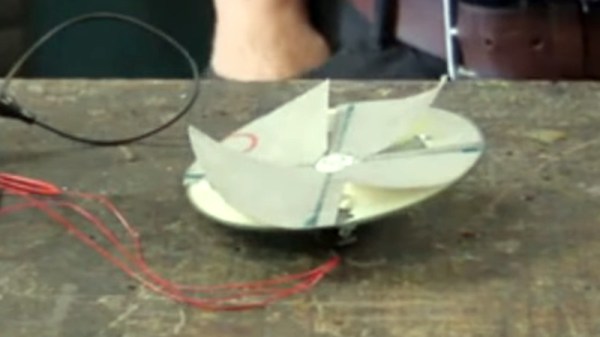
His use of a 3-phase motor from a CD-ROM drive as the generator isn’t particularly unexpected, these motors are ubiquitous and readily generate power when spun up. A simple 3-phase rectifier and a capacitor delivers a DC voltage that while the ready availability of switching converter modules should be relatively easy to turn into something more useful.

The clever part of this hack lies then in the rotor, it’s not the propeller-style bladed affair you might expect. Instead he takes a CD, as it’s the obvious thing to fit on a CD motor, and glues a piece of Tyvek on top of it. This is cut to form four flaps which make a rudimentary but effective turbine when the wind comes from the side. It’s beautifully simple, and we wish we’d thought of it ourselves. The whole thing is in the video below the break, so take a look.

Maybe this won’t solve the green energy requirement on its own, but we’ve shown you far larger fabric turbines in the past.
Continue reading “How Simple Can A Wind Generator Get?”

Old TV To RGB

As CRT televisions have faded from use, it’s become important for retro gaming enthusiasts to get their hands on one for that authentic experience. Alongside that phenomenon has been a resurgence of some of the hacks we used to do to CRT TV sets back in the day, as [Adrian’s Digital Basement] shows us when he adds an RGB interface to a mid-1990s Sony Trinitron.

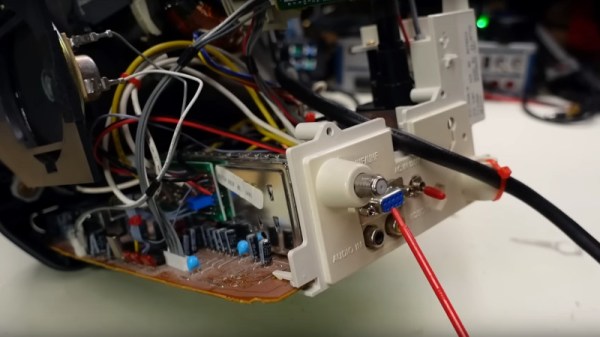
Those of us lucky enough to have lived in Europe at the time were used to TVs with SCART sockets by the mid-1990s so no longer needed to plumb in RGB signals, but it appears that Americans were still firmly in the composite age. The TV might have only had a composite input, but this hack depends on many the video processor chips of the era having RGB input pins. If your set has a mains-isolated power supply then these pins can be hooked up with relative ease.

In the case of this little Sony, the RGB lines were used by the integrated on-screen display. He takes us through the process of pulling out these lines and interfacing to them, and comes up with a 9-pin D connector with the same pinout as a Commodore monitor, wired to the chip through a simple RC network and a sync level divider. There’s also a switch that selects RGB or TV mode, driving the OSD blanking pin on the video processor.

We like this hack just as much as we did when we were applying it to late-80s British TV sets, and it’s a great way to make an old TV a lot more useful. You can see it in the video below the break, so get out there and find a late-model CRT TV to try it on while stocks last!

Unsurprisingly, this mod has turned up here a few times in the past.

Continue reading “Old TV To RGB”

How To Make A Larger Air-Cored Inductor

Radio amateurs often have a love-hate relationship with home-made inductors, sharing all kinds of tips and tricks as to how the most stable nanohenry inductor can be wound. But there’s another group in the world of electronics with an interest in high-quality inductors, namely the audio enthusiasts. They need good quality inductors with a values in the millihenries, to use in loudspeaker crossover networks. [Homemade Audio] takes us through their manufacturing process for these coils, and the result is a watchable video resulting in some very well-made components.

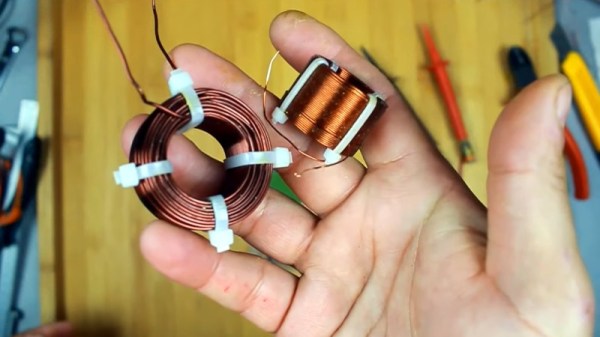
The adjustable former is a machined aluminium affair of which we’re treated to the full manufacture. It’s likely the same results could be achieved with a 3D printed reel. The free-as-in-beer Coil64 on Windows is used to calculate the dimensions and number of turns, and it’s set up on a jig with a cordless screwdriver doing the winding. The best technique for flat layers of turns is explained, and a coat of varnish is put on each completed layer. We’re guessing this is to stop the coil “singing” at audio frequencies.

With a set of cable ties holding it together the result is a very tidy component. It’s adjusted a few turns to get the right value with an LCR meter, however experience tells us that a tiny percentage either way won’t harm the resulting network too much. If you make your own speakers, the video below the break could be extremely useful.

Need a loudspeaker primer? We have just the article for you.

Continue reading “How To Make A Larger Air-Cored Inductor”

Pulling Data From HDMI RF Leakage

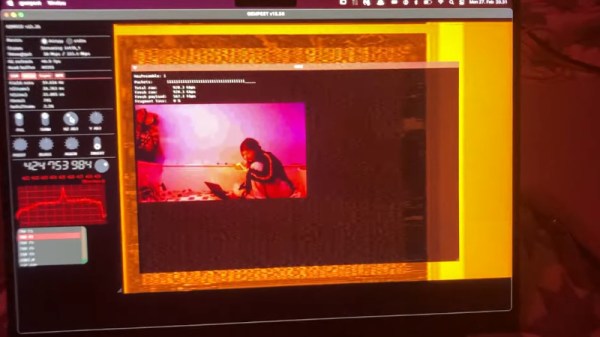
A long-running story in the world of electronic security has been the reconstruction of on-screen data using RF interference from monitors or televisions. From British TV detector vans half a century ago to 1980s scare stories about espionage, it was certainly easy enough to detect an analogue CRT with nothing more than an AM broadcast radio receiver. But can this still be done in the digital age? It’s something [Windytan] has looked into, as she reconstructs images using leakage from HDMI cables.

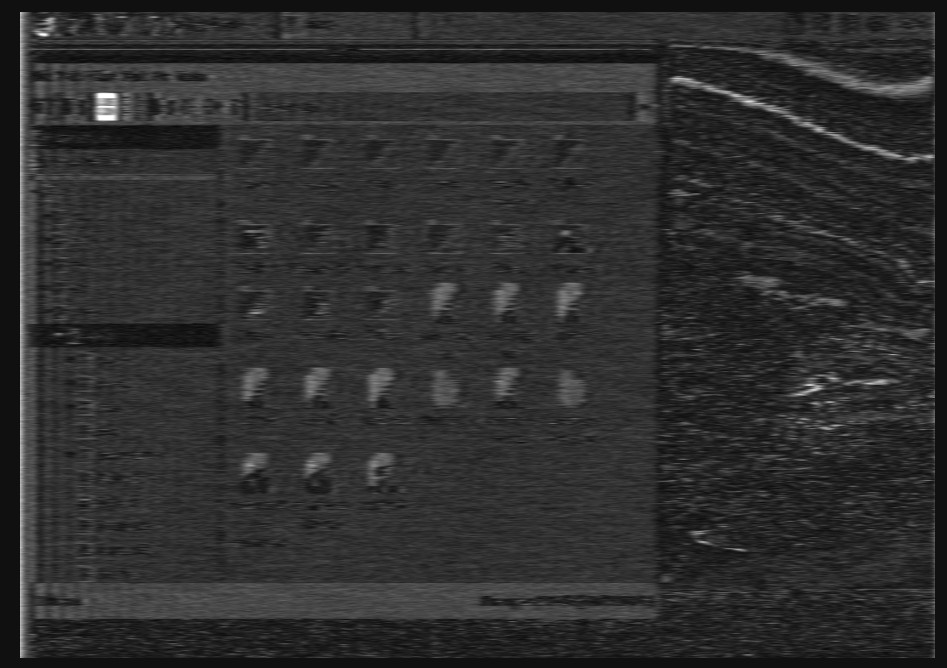
The tale starts with a mystery RF noise, soon identified as not unlike the scanning frequencies of a video signal. Plotting the noise intensities while treating the supposed scanning frequencies as video synchronization yields a shadowy version of her Raspberry Pi desktop, so she’s on to something. It’s important to note that this isn’t a video signal she’s receiving, but the noise associated with the bit transitions in an uncompressed digital video stream, so she quickly concludes that trying to resolve color would be futile.

It does however leave the tantalizing possibility of using this as a medium to wirelessly export data from a compromised machine, and it’s down this route she goes. She finally arrives on a scheme of encoding data as lines of individual colors that look like interference patterns over a desktop, and from there can send and retrieve files. It works for digital audio streams, and as shown in the video below, even an MJPEG video stream, hidden in the noise from a video signal. That’s impressive work, by any standard!

We covered those BBC detector vans in detail a while back.

Continue reading “Pulling Data From HDMI RF Leakage”

A Ground Source Heat Pump From An Air Conditioner

When it comes to lower-energy home heating, it’s accurate in all senses to say that heat pumps are the new hotness. But unless you happen to work with them professionally, it’s fair to say their inner workings are beyond most of us. Help is at hand though courtesy of [petey53], who made his own ground source heat pump for his Toronto house using a pair of window-mounted air conditioning units.

Continue reading “A Ground Source Heat Pump From An Air Conditioner”

Probably The World’s Most Expensive Bar Bot

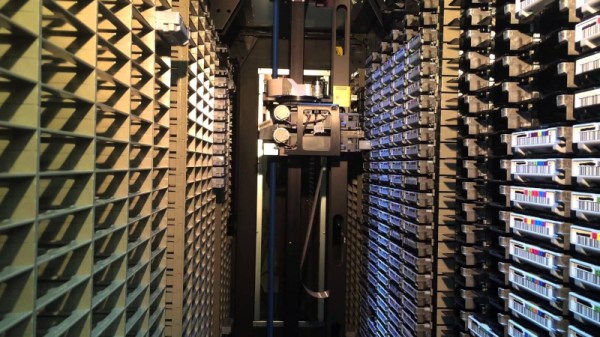
Bar bots, or robotized bartenders, are a fun feature of events in our community, because there’s nothing like a cocktail untouched by human hand. Usually they have a row of bottles and a slide on which you put the glass, but [SecurityWriter] relates a tale of an altogether much grander affair. Given a weekend with a group of friends and an enterprise-grade IBM tape library robot, they did what any sensible engineer would do. They turned it into a bar bot.

Most readers probably won’t have seen a consumer grade data tape for decades, but in the enterprise space they’re very much the most cost effective backup solution. Large corporations have vast numbers of them, and IBM sells robots which retrieve them automatically from huge storage racks. When a group of young techs were given the tedious task of cataloging the whole thing and found themselves stuck in an empty data center for a weekend, of course they produced what was probably the world’s most expensive automated drinking game. Stocking the shelving system with booze and using the command line control for the robot they were able to have it deliver their beverages, and shockingly they managed to do so without the whole thing breaking.

It’s a hack, even if it’s one of which by necessity no evidence remains. Sadly Hackaday doesn’t have a tape library, or you can bet we’d be tempted to give it a try ourselves. Never mind, we can continue to sample more conventional bar bots from time to time.

Probably The Most Over-Specified Calculator To Ever Be Manufactured

It’s possible quite a few of our older readers will remember the period from the 1960s into the ’70s when an electronic calculator was the cutting edge of consumer-grade digital technology. By the 1980s though, they were old hat and could be bought for only a few dollars, a situation that remains to this day. But does that mean calculator development dead?

Perhaps not, as [Li Zexi] writes for CNX Software, when he reviews a simple non-scientific calculator that packs an Alwinner A50 tablet SoC and the Android operating system. As shipped they lack the Android launcher, so they aren’t designed to run much more than the calculator app. Of course that won’t stop somebody who knows their way around Google’s mobile operating system for very long — at the end of the review, there’s some shots of the gadget running Minecraft and playing streaming video.

These devices can be had for not a lot on the Chinese second-hand electronics market, and after an extensive teardown he comes to the conclusion that besides their novelty they’re an older specification so not really worth buying.

But it does beg the question as to why such a product was put into production when the same task could have been performed using very cheap microcontroller. Further, having done so they make it a non-scientific machine, not even bestowing it with anything that could possibly justify the hardware. Is there a use case he, and us, have missed? We’d love to know.

We cover a lot of calculator stories here at Hackaday. Sometimes they’re classic machines, but more often they’re modern takes on an old idea.