A Live ISO For Those Vibe Coding Experiments

Vibe coding is all the rage at the moment if you follow certain parts of the Internet. It’s very easy to dunk upon it, whether it’s to mock the sea of people who’ve drunk the Kool-Aid and want the magic machine to make them a million dollar app with no work, or the vibe coded web apps with security holes you could drive a bus through.

But AI-assisted coding is now a thing that will stick around whether you like it or not, and there are many who want to dip a toe in the water to see what the fuss is about. For those who don’t quite trust the magic machines in their inner sanctum, [jscottmiller] is here with Clix, a bootable live Linux environment which puts Claude Code safely in a sandbox away from your family silver.

Physically it’s a NixOS live USB image with the Sway tiling Wayland compositor, and as he puts it: “Claude Code ready to go”. It has a shared partition for swapping files with Windows or macOS machines, and it’s persistent. The AI side of it has permissive settings, which means the mechanical overlord can reach parts of the OS you wouldn’t normally let it anywhere near; the point of having it in a live environment in the first place.

We can see the attraction of using an environment such as this one for experimenting without commitment, but we’d be interested to hear your views in the comments. It’s about a year since we asked you all about vibe coding, has the art moved forward in that time?


Success With FreeDOS On A Modern Platform

Last summer we took a look at FreeDOS as part of the Daily Drivers series, and found a faster and more complete successor to the DOS of old. The sojourn into the 16-bit OS wasn’t perfect though, as we couldn’t find drivers for the 2010-era network card on our newly DOS-ified netbook. Here’s [Inkbox] following the same path, and bringing with it a fix for that networking issue.

The video below is an affectionate look at the OS alongside coding a TRON clone in assembler, and it shows a capable environment within the limitations of the 16-bit mode. The modern laptop here can’t emulate a BIOS as it’s UEFI only, and after trying a UEFI-to-BIOS emulator with limited success, he hits on a different approach. With just enough Linux to support QEMU, he has a lightweight and extremely fast x86 BIOS platform with the advantage of legacy emulation of network cards and the like.

The point of Daily Drivers is wherever possible to use real hardware and not an emulator, as it’s trying to be the machine you’d use day to day. But we can see in a world where a BIOS is no longer a thing it becomes ever more necessary to improvise, and this approach is better than just firing up an emulator from a full-fat Linux desktop. If you fancy giving it a try, it seems less pain than the route we took.

You can read our look at FreeDOS 1.4 here.

Continue reading “Success With FreeDOS On A Modern Platform”

The Perfect Cheat’s Racing Bicycle

One of the ongoing rumors and scandals in professional cycle sport concerns “motor doping” — the practice of concealing an electric motor in a bicycle to provide the rider with an unfair advantage. It’s investigated in a video from [Global Cycling Network], in which they talk about the background and then prove its possible by creating a motor doped racing bike.

To do this they’ve recruited a couple of recent graduate engineers, who get to work in a way most of us would be familiar with: prototyping with a set of 18650 cells, some electronics, and electromagnets. It uses what they call a “Magic wheel”, which features magnets embedded in its rim that engage with hidden electromagnets. It gives somewhere just under 20 W boost, which doesn’t sound much, but could deliver those crucial extra seconds in a race.

Perhaps the most interesting part is the section which looks at the history of motor doping with some notable cases mentioned, and the steps taken by cycling competition authorities to detect it. They use infra-red cameras, magnetometers, backscatter detectors, and even X-ray machines, but even these haven’t killed persistent rumors in the sport. It’s a fascinating video we’ve placed below the break, and we thank [Seb] for the tip. Meanwhile the two lads who made the bike are looking for a job, so if any Hackaday readers are hiring, drop them a line.

Continue reading “The Perfect Cheat’s Racing Bicycle”

Examining A World’s Record From The Age Of Steam

There aren’t many speed records that remain unbroken for the greater part of a century, but one of them is that of the fastest steam locomotive. As with so many such things, there’s a bit of controversy and more than one contender, but the one in the record books is the A4 Pacific, Mallard. In 1938, this locomotive thundered down an incline on the London & North Eastern Railway’s mainline in the north of England at 126 MPH. But can that number be taken as reliable? The Institute of Mechanical Engineers has a video in which they investigate.

It’s a fascinating look at the science of railway speed measurement as it existed in 1938, the record itself, and the paper dynamometer roll which recorded it. We’ve placed the video below the break, and in it, we see an in-depth analysis of the noise and inconsistencies in the recording, and see them come to the conclusion that a safer figure to quote would be 124 MPH.

Our assessment is that, of course, the LNER wanted to squeeze every morsel of publicity from it in a game of one-upmanship with their arch-rivals in the London Midland and Scottish railway, so it’s likely that their use of a momentary figure makes sense in that light. Even the best-laid 1930s jointed track would have been bumpy compared to modern continuous rail, and we are guessing that the ancient clerestory dynamometer car would hardly be as smooth-riding as a modern express coach. The achievement of measuring at all with mechanical instruments in such an environment at those speeds would have been tricky, to say the least. It leaves us wondering whether 1930s electronics could have produced some kind of trackside measurement device, but perhaps the LNER trusted their mechanical instruments more. Perhaps the Pennsylvania Railroad should have followed its example.

Continue reading “Examining A World’s Record From The Age Of Steam”

The Long Afterlife Of The Console Modchip

For a late-1990s engineer with good soldering skills, many a free pint of beer could be earned by installing modchips on the game consoles of the day. Modchips were usually a small microcontroller connected with a few wires to selected pins on the chips or pads on the board that masked or overrode the copy protection and region locking. This scene was brought back for us by a recent [Modern vintage gamer] video looking at the history of console hardware mods, and it’s worth a watch (see the video, below).

The story starts in 1996 with the original PlayStation, largely the source of those free pints for a nascent Hackaday scribe back in the day. Along the way, as he expands the story, we find other memories, for example, the LPC bus-based hijacks of the first XBox console, and the huge modding scenes on both that machine and Sony’s PS2. The conclusion is that this community left its mark on today’s consoles even though the easy hardware hacks may be a thing of the past on the latest hardware, and as past Hackaday articles can attest, jailbreaking older consoles still has a way to go.

In the early days, our recollection is that the PlayStation modchips were driven by the region locking rather than piracy, for the simple reason that Sony used 80-minute ISOs which wouldn’t fit on the then-available consumer 74-minute CD-R. We also remember them being used by people who couldn’t afford a blue debuugging PlayStation,. or the rare black developer model.

Continue reading “The Long Afterlife Of The Console Modchip”

Reflections On Ten Years With The Wrencher

An auspicious anniversary passed for me this week, as it’s a decade since I started writing for Hackaday. In that time this job has taken me all over  Europe, it’s shown me the very best and most awesome things our community has to offer, and I hope that you have enjoyed my attempts to share all of that with you. It’s worth a moment to reflect on the last ten years in terms of what has made our world during that time. Continue reading “Reflections On Ten Years With The Wrencher”

CSS, Now It’s Got Your 8086

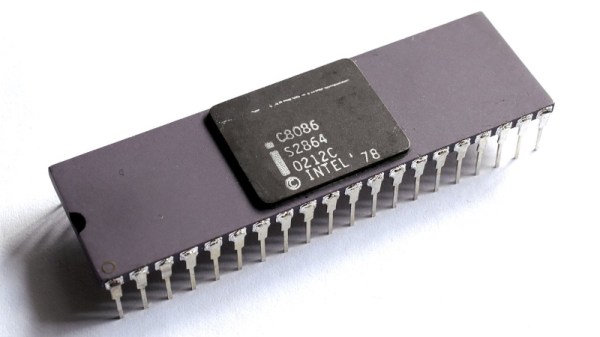
The modern web browser is now far more than a thing for rendering web pages, it’s a multi-faceted environment that can provide a home for almost any application you could imagine. But why should JavaScript or Wasm have all the fun? CSS is Turing complete now, right? Why not, as [Lyra Rebane] has done, write an 8086 emulator in pure CSS?

The web page at the link above may contain an 8086, but missing MMU aside, don’t expect it to run Linux just yet. Instead it has limited resources, just enough to run a demo program. It needs a Chrome-adjacent browser because it uses some CSS functions not available in for example Firefox, but we’ll forgive it that oddity. Its clock is provided by a small piece of JavaScript not because CSS can’t provide one, but because the JS version is more stable.

On one hand this is of little practical use, but to dismiss it as such is to entirely miss the point. It’s in the fine spirit of experimentation, and we love it. Perhaps a better way to look at it is to see what could be done more efficiently with the same idea. A 1970s CISC microprocessor might not be the best choice, but would for example a minimalist and optimized RISC design be more capable? We’re looking forward to where others take this thread.

It’s not the first unexpected computing environment we’ve found, who could forget the DOOM calculator!


Header: Thomas Nguyen, CC BY-SA 4.0.