Is There A Simpler Aircraft Than This Electric Paramotor?

The dream of taking to the air has probably ensnared more than a few of us, but for most it remains elusive as the safety, regulatory, and training frameworks surrounding powered flight make it not an endeavour for the faint-hearted. [Justine Haupt] has probably delivered the simplest possible powered aircraft with her Blimp Drive, a twin-prop electric add-on for her paragliding rig that allows her to self-launch, and to sustain her flights while soaring.

It takes the form of a carbon-fibre tube with large drone motors and props U-bolted to each end, and a set of brackets in the centre of laid carbon fibre over 3D-printed forms to which the battery and paraglider harness are attached. The whole thing is lightweight and quiet, and because of the two contra-rotating propellers it also doesn’t possess the torque issues that would affect a single propeller craft.

We’re not fliers or paragliders here at Hackaday, so our impression of the craft in use doesn’t come from the perspective of a pilot. But its simplicity and ease of getting into the air looks to be unmatched by anything else, and we have to admit a tinge of envy as in the video below the break she flies over the beach that’s her test site.

If you recognise Justine from past Hackaday articles, you’re on the right track. Probably most memorable is her rotary cellphone.

Continue reading “Is There A Simpler Aircraft Than This Electric Paramotor?”

Farewell Sir Clive Sinclair; Inspired A Generation Of Engineers

It is with sadness that we note the passing of the British writer, engineer, home computer pioneer, and entrepreneur, Sir Clive Sinclair, who died this morning at the age of 81 after a long illness. He is perhaps best known among Hackaday readers for his ZX series of home computers from the 1980s, but over a lifetime in the technology industry there are few corners of consumer electronics that he did not touch in some way.

Sinclair’s first career in the 1950s was as a technical journalist and writer, before founding the electronics company Sinclair Radionics in the 1960s. His output in those early years was a mixture of miniature transistor radios and Hi-Fi components, setting the tone for decades of further tiny devices including an early LED digital watch at the beginning of the 1970s, miniature CRT TVs in the ’70s and ’80s, and another tiny in-ear FM radio which went on sale in the ’90s.

Continue reading “Farewell Sir Clive Sinclair; Inspired A Generation Of Engineers”

Ask Hackaday: What’s The Best Way To Heat A Tent With A Laptop?

For Europeans, August is usually a month of blistering heatwaves, day after day of cloudless skies and burning sun that ripens fruit and turns we locals a variety of shades of pink. Hacker camps during this month are lazy days of cool projects and hot nights of lasers, Club-Mate, and techno music, with tents being warm enough under the night sky to dispense with a sleeping bag altogether.

Sometimes though, the whims of the global weather patterns smile less upon us hackers, and our balmy summer break becomes a little more frigid. At BornHack 2021 for example we packed for a heatwave and were met with a Denmark under the grip of the Northern air mass. How’s a hacker to keep warm?

Continue reading “Ask Hackaday: What’s The Best Way To Heat A Tent With A Laptop?”

An RF Remote Is No Match For A Logic Analyser!

The Neewer NL660-2.4 Video Keylight has a handy remote control, which for [Tom Clement] has a major flaw in that it can’t restore the light to the state it had during its last power-on. He’s thus taken the trouble to reverse engineer it and create his own remote using a suitably-equipped Arduino clone.

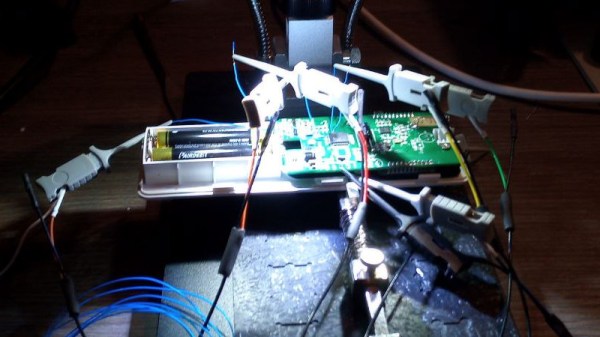
The write-up is a step through primer for the would-be RF remote hacker, identifying the brains as an STM8 and the radio as an NRF24 clone before attempting to dump the firmware of the STM8. As might be expected the STM is protected, which only leaves the option of sniffing the connection between the two chips. The SPI pins are duly probed with a logic analyser, and the codes used by Neweer are extracted. As luck would have it there is a handy board called the RF Nano which is an Arduino Nano and an NRF24 in an Arduino Nano form factor, so a proof of concept remote could be written on an all-in-one module. You can find the result as a GitHub Gist, should you be curious.

We’ve seen Tom a few times before, particularly in his European BadgeLife work, as part of which he’s put a lot of effort into bringing browser-based WebUSB and WebSerial development to his work.

Overengineering A Smart Doorbell

Fresh from the mediaeval splendour of the Belgian city of Gent, we bring you more from the Newline hacker conference organised by Hackerspace Gent. [Victor Sonck] works at the top of his house, and thus needed a doorbell notifier. His solution was unexpected, and as he admits over engineered, using machine learning on an audio stream from a microphone to detect the doorbell’s sound.

Having established that selling his soul to Amazon with a Ring doorbell wasn’t an appropriate solution, he next looked at his existing doorbell. Some of us might connect directly to its power to sense when the button was pressed, but we’re kinda glad he went for the overengineered route because it means we are treated to a run-down how machine learning works and how it can be applied to audio. The end result can sometimes be triggered by a spoon hitting a cereal plate, but since he was able to demonstrate it working we think it can be called a success. Should you wish to dive in further you can find more in his GitHub repository.

How would you overengineer a doorbell? Use GNU radio and filters? Or maybe a Rube Goldberg machine involving string and pulleys? As always, the comments are open.

Continue reading “Overengineering A Smart Doorbell”

Hey, MiSTer Emulator, Gimme Almost Any Classic Platform!

I’m back with another of the talks from Hackerspace Gent’s NewLine conference, fresh from my weekend of indulgence quaffing fine Belgian food and beers while mixing with that country’s hacker community. This time it’s an overview from [Michael Smith] of the MiSTer project, a multi-emulator using an FPGA to swap out implementations of everything from an early PDP minicomputer to an 80486SX PC.

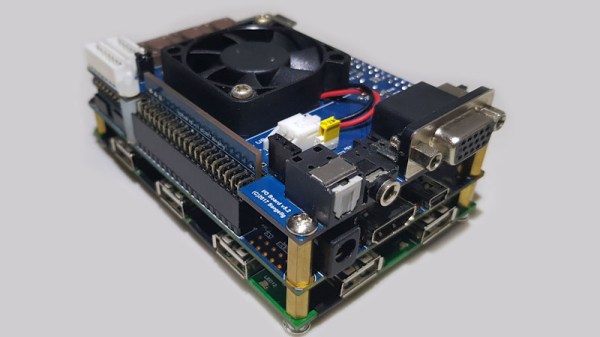
At its heart is a dev board containing an Intel Cyclone SoC/FPGA, to which a USB hub must be added, and then a memory upgrade to run all but the simplest of cores. Once the hardware has been taken care of it almost seems as though there are no classic platforms for which there isn’t a core, as a quick browse of the MiSTer forum attests. We are treated to seamless switching between SNES and NED platforms, and even switching different SID chip versions during a running Commodore 64 demo.

There are many different routes to a decent emulator set-up be they using hardware, software, or a combination of both. It’s unlikely that there are any as versatile as this one though, and we’re guessing that as it further evolves it will become a fixture below the monitor or TV of any gamer.  It’s a step up from single-platform FPGA emulators, that’s for certain!

Continue reading “Hey, MiSTer Emulator, Gimme Almost Any Classic Platform!”

EM-Glitching For Nintendo DSi Boot ROMs

Some hacker events are muddy and dusty affairs in distant fields, others take place in darkened halls, but I went to one that can be experienced as a luxury break in a European city steeped in culture and history. Newline takes place at Hackerspace Gent, in the Belgian city of that name, and I was there last weekend to catch the atmosphere as well as the programme of talks and workshops. And of those a good start was made by [PoroCYon], whose fascinating introduction to the glitching techniques involved in recovering the boot ROMs from a Nintendo DSi taught us plenty of things we hadn’t seen before.

The talk which you’ll find below the break starts by describing the process of glitching — using power supply interference to interrupt the operation of a microprocessor and avoid certain instructions — to bypass security code. It then moves on to some of the protection mechanisms used in the various generations of Nintendo consoles and handhelds, before moving on to the work on the DSi at which point the talk moved onto a field which may be old hat in glitching circles but was new to me; that of EM glitching.

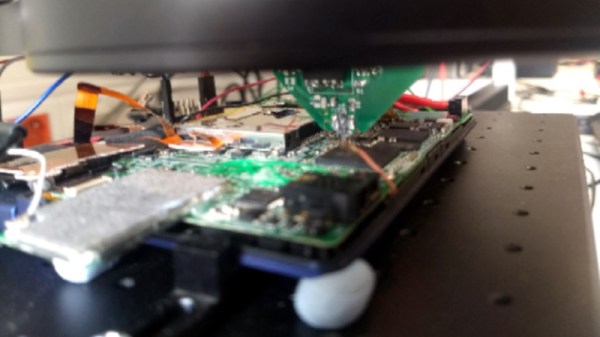
EM glitching involves using a small coil to generate precisely timed electromagnetic pulses which induce the glitch voltages in the chip. The fascinating part is that the EM probe can be made small enough to target individual areas of the chip, so using it involves a brute-force technique trying all combinations of timing and position with the probe held in a computer-controlled X-Y mount.

The DSi has two processors on board, this achieves success with the ARM7 but leaves its companion ARM9 as yet untapped. There are a promising set of attack vectors left to try, of which the ARM7 placing the ARM9 into a state from which it can be glitched seems to be the most promising. It’s fairly obvious that there’s plenty more to come from this quarter.

More details of the talk can be found in this repository, and for those interested in EM glitching you can find out more in this video and in this project using it to attack a Gecko microcontroller.

Continue reading “EM-Glitching For Nintendo DSi Boot ROMs”