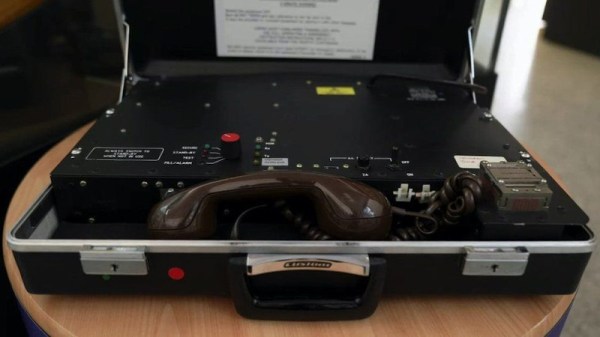
The curtain of state secrecy which surrounds the type of government agency known primarily by initialisms is all-encompassing and long-lived, meaning that tech that is otherwise in the public domain remains top secret for many decades. Thus it’s fascinating when from time to time the skirts are lifted to reveal a glimpse of ankle, as has evidently been the case for a BBC piece dealing with the encrypted phones produced by GCHQ and used by Margaret Thatcher in the early 1980s. Sadly, it’s long on human interest and short on in-depth technology, but nevertheless from it can be deduced enough to work out how it most likely worked.
We’re told that it worked over a standard phone line and transmitted at 2.4 kilobytes per second, a digital data stream encoded using a paper tape key that was changed daily. If we were presented with this design spec to implement in a briefcase using 1980s components, we’d probably make an ADPCM (Adaptive Differential Pulse Code Modulation) system with an XOR encryption against the key, something we think would be well within the capabilities of early 1980s digital logic and microprocessors. We’re wondering whether the BBC have made a typo and that should be kilobits rather than kilobytes to work on a standard phone line.
No doubt there are people in the comments who could tell us if they were willing to break the Official Secrets Act, but we’d suggest they don’t risk their liberty by doing so. It’s worth noting though, that GCHQ have been known to show off some of their past glories, as in this 2019 exhibition at London’s Science Museum.
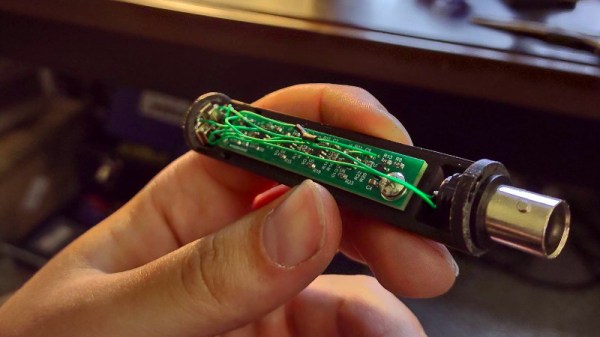
The quality of any measurement can only be as good as the instrument used to gather it, and for acoustic measurements, finding a good enough instrument can be surprisingly difficult. Commonly available microphones can be of good quality, but since they are invariably designed for speech or music, they need not have the flat or wide enough response and low noise figure demanded of an instrumentation microphone.
The result is both an extremely interesting project for those of us with an interest in audio, and a thorough delve into some aspects of its design for those who are merely curious. It uses four capsules in an effort to cancel out induced electrical noise, and boasts some impressive comparative measurements when tested against a commercial measurement microphone. We could almost see ourselves building this project.
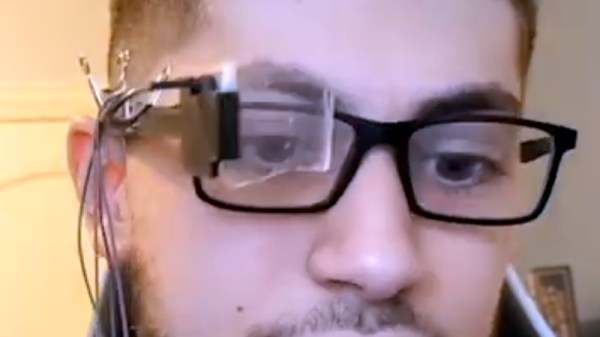
Personal head-up displays are a technology whose time ought by now to have come, but which notwithstanding attempts such as the Google Glass, have steadfastly refused to catch on. There’s an intriguing possibility in [Basel Saleh]’s CaptionIt project though, a head-up display that provides captions for everyday situations.
The hardware is a tiny I²C OLED screen with a reflector and a 3D-printed mount attached to a pair of glasses, and it’s claimed that it will work with almost any ARM v7 SBC, including more recent Raspberry Pi boards. It uses the vosc speech recognition toolkit to read audio from a USP audio device, with the resulting text being displayed on the screen.
The device is shown in action in the video below the break, and without trying it ourselves we can’t comment on its utility, but aside from the novelty we can see it could have a significant impact as an accessibility aid. But it’s as an electronic Babel fish coupled with translation software that we’d like to see it develop, so that inadvertent but hilarious international misunderstandings can be shared by all.
Regular readers will know that we’ve brought you plenty of HUD tomfoolery in the past.
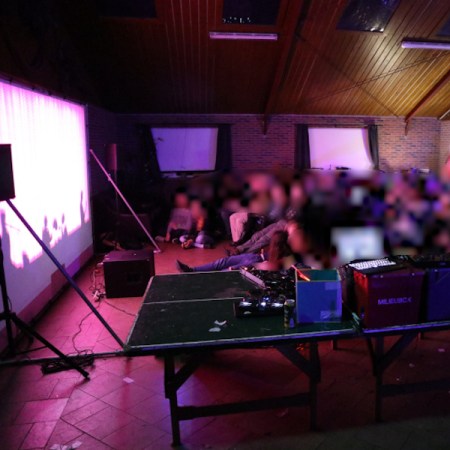
The community of Hackaday readers is diverse and talented, and supplies us with plenty of motivation, feedback, knowledge, and of course cool stuff to show you. There are many interest streams within it, but it’s safe to say that we’re more directed towards the hardware scene here. One of those parallel streams which has much overlap is the demoscene, that area in which programming, art, and music come together and push computer hardware to the limit of its abilities in pursuit of the most eye-catching works. I took a road trip with a friend to Outline, a small demo party held on a farm in the eastern Netherlands, to take a look at the world of demos up-close as a hardware-focused outsider.
Like A Hacker Camp, But The Music’s Better
A still from Thrive, a 256 byte demo for the TIC-80 fantasy console.
If I wanted to sum up the flavour of Outline, I’d describe it as very similar to a small hacker camp, but with better music and partying. The hackerspaces are replaced by demo groups and awesome graphics take the place of robots and electronics, but the vibe of people with a passionate interest in the low-level understanding of technology is exactly the same. Even some of the same faces make an appearance. On the benches sit modern high-spec PCs alongside classic consoles and microcomputers, on the projector screen are live coding shaders or some of the most recognisable demos past and present, and in the air is an eclectic mix of live-DJ EDM and chiptunes.
As an outsider at a first demoscene event it’s difficult to appreciate the work from a comparative perspective, while like most of us I’m familiar with quite a few demos that have become popular I’m not well-equipped enough to talk about the code and techniques behind them But I can run through the various sections of the competition, and since everything is online I can link to a few of them. The competition is split up into several sections, which are loosely for all-out technology-no-object demos, space-limited 256 byte and 128 byte demos, and old-school demos for retrocomputing hardware. Each is a test of the programmer’s skill in fitting the most into the least of resources, and for those who appreciate such things it’s the cleverness of the technique which produces the demo that’s as much a draw as the look of the thing. I don’t think I have ever exercised such mastery over any of the computers I have owned. So browse the entries, and marvel at their ingenuity. My personal aesthetic favourites were Thrive by [Agenda] for the TIC-80 fantasy console and It’s about time by [Guideline] for Windows, but you may have different tastes.
Don’t Forget The Hardware
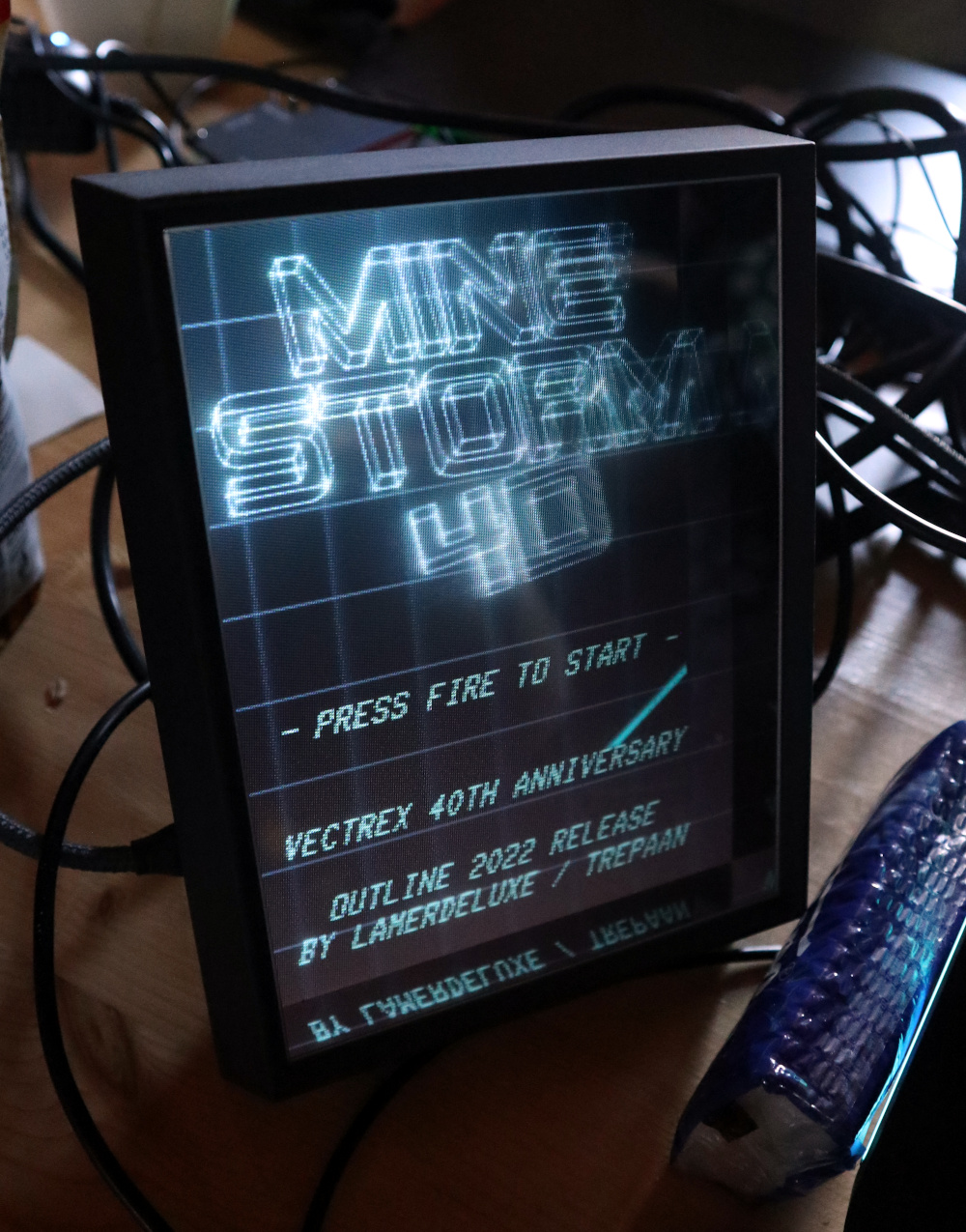
Mine Storm 4D, on a lenticular holographic display.
Beyond the atmosphere and the demos themselves, there was a bit of hardware for the retrocomputer enthusiast. The Atari Falcon and Jaguar were neither destined to set the world on fire when they appeared, but there they were for those of us who drooled over them back in the day to lust for once more.
If the original hardware wasn’t enough then there was some newly minted retrocomputing hardware making a showing, with a couple of minimig Amiga FPGA boards showing Workbench. Star of the hardware show though went to Mine Storm 4D, a version of the classic Vectrex game Mine Storm running on a PC, for the Looking Glass Factory holographic portrait display. With my visual superpower I didn’t quite get a 3D effect, but I definitely got the holographic effect when moving my head.
Having never been to a demo party I didn’t know quite what to expect, but I can safely say I had a fantastic time, saw a lot of really cool stuff, and made some friends along the way. If you’ve never been to a demo party because it’s not quite your scene then all I can say is that you should give it a go. Every hardware hacker should go to a demo party!
In the world of PC graphics, the early standards followed the various video cards of the day. There was MDA, familiar through the original text-based DOS prompt, CGA, then EGA, and the non-IBM Hercules along the way. Finally in 1987 IBM produced the VGA, or Video Graphics Array standard for their PS/2 line of computers, which became the bedrock on which all subsequent PC graphics cards, even those with digital outputs, have been built. It’s interesting then to read an account from [Dave Farquhar] of the other now-forgotten video standard that made its debut with the PS/2, MCGA, or Multicolor Graphics Array. This was intended as an entry-level graphics system to compete with the more multimedia-oriented home computers of the day such as the Commodore Amiga and Atari ST.
Offering 320×200 graphics at 256 colors but only two colors at 640×480 it’s difficult to see how it could have been a viable competitor to the Amiga’s 4096-color HAM mode, but it did offer the ability to drive an RGB monitor through its VGA-like socket. The story goes that IBM intended it to provide an upgrade incentive for PS/2 customers to buy a more powerful model with VGA, but in the event a host of third-party VGA-compatible cards emerged and allowed more traditional ISA computers from third parties to retain a competitive edge and eventually sideline the PS/2 line entirely.
We called time on VGA back in 2016, and it’s fair to say that it’s disappeared from PC hardware since then even if much of its technologies still lurk within. It’s pleasing to see though that it remains a stalwart of hacked-together display interfaces, with efforts such as this 7400-based VGA card continuing to impress us.
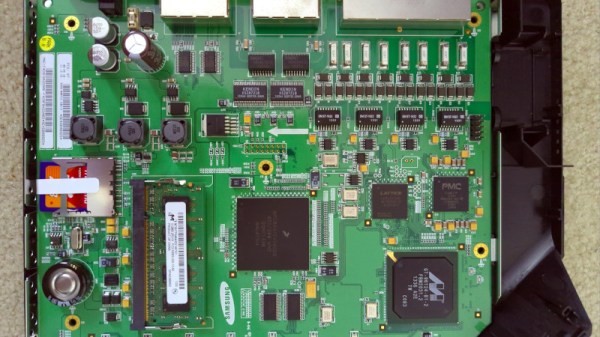
When it comes to internet connections, here in 2022 so many of us have it easy. Our ISP provides us with a fibre, cable, or DSL line, and we just plug in and go. It’s become ubiquitous to the extent that many customers no longer use the analogue phone line that’s so often part of the package. But before there was easy access to DSL there were leased lines, and it’s one of these that [Old VCR] is dissecting. The line in question is a T1 connection good for 1.536 Mbit/s and installed at great cost in the days before his cable provider offered reliable service, but over a decade later is now surplus to requirements. The ISP didn’t ask for their router back, so what else to do but give it the hacking treatment?
In a lengthy blog post, he takes us through the details of what a T1 line is and how it’s installed using two copper lines, before diving into the router itself. It’s an obsolete Samsung device, and as he examined the chips he found not the MIPS or ARM processors we’d expect from domestic gear of the period, but a PowerPC SoC from Freescale. Connecting to the serial port reveals it as running SNOS, or Samsung Network Operating System from an SD card, and some experimentation finds a default password reset procedure through the bootloader commands. The rest of the piece is dedicated to exploring this OS.
There was a time before the advent of the Raspberry Pi and similar cheap Linux-capable boards, that hacking a router was the way to get a cheap embedded Linux system, but now it’s much more done to liberate a router from the clutches of manufacturer and telco. Still, it’s very much still part of the common fare here at Hackaday.
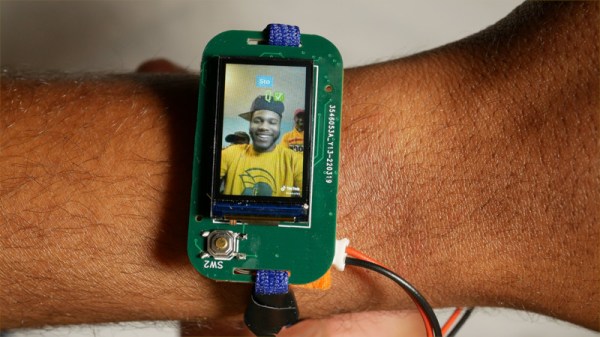
One of the ultimate objects of desire in the early 1980s was the Seiko TV wristwatch. It didn’t matter that it required a bulky external box in your pocket for its electronics, it was a TV on your wrist, and the future was here! Of course, now we have the technology to make wrist-mounted video a practical reality, but it’s sad to see we’ve opted to use our phones for video and never really followed up on the promise of a wrist-mounted television. There’s always hope though, and here it is in the form of [Dave Bennett]’s ESP32-powered TikTok wristwatch.
On the wrist is the ESP32 itself with an audio DAC and amplifier, LCD screen, and battery, but sadly this combo doesn’t have quite the power to talk to TikTok directly. Instead that’s done using Python on a companion PC with the resulting videos uploaded to the device over WiFi. It’s not the bulky electronics of the Seiko TV, so we’ll take it. All the info can be found on GitHub, and there’s a YouTube video below the break.
So the viral videos of a generation can now be taken on the move without resorting to a slightly less portable mobile phone. It may not be the most unobtrusive of timepieces, but it’ll certainly get you noticed.