ReactOS Is Going Places, With More Stable AMD64, SMP, And Multi-Monitor Support

In the crowd of GNU/Linux and BSD users that throng our community, it’s easy to forget that those two families are not the only games in the open-source operating system town. One we’ve casually kept an eye on for years is ReactOS, the long-running open-source Windows-compatible operating system that is doing its best to reach a stable Windows XP-like experience. Their most recent update has a few significant advances mentioned in it that hold the promise of it moving from curiosity to contender, so is definitely worth a second look.

ReactOS has had 64-bit builds for a long time now, but it appears they’ve made some strides in both making them a lot more stable, and moving away from the MSVC compiler to GCC. Sadly this doesn’t seem to mean that this now does the job of a 64-bit Windows API, but it should at least take advantage internally of the 64-bit processors. In addition they have updated their support for the Intel APIC that is paving the way for ongoing work on multiprocessor support where their previous APIC driver couldn’t escape the single processor constraint of an original Intel 8259.

Aside from these its new-found support for multiple monitors should delight more productive users, and its improved support for ISA plug-and-play cards will be of interest to retro enthusiasts.

We took a close look at the current ReactOS release when it came out last year, and concluded that its niche lay in becoming a supported and secure replacement for the many legacy Windows XP machines that are still hanging on years after that OS faded away. We look forward to these and other enhancements in their next release, which can’t be far away.


The Magnetosphere Has A Ton Of Energy. Can A Guitar Amp Company Tap Into It?

Researching a piece on vacuum tubes, we stumbled on something unexpected from Electro-Harmonix, best known for guitar amplifiers and audio tube manufacture. In a break from their core business, they plan to tap energy from the magnetosphere. This came as something of a surprise to their guitarist customers who were no doubt expecting a fancy new effects pedal, but it seems they’re serious.

The magnetosphere is the region of space surrounding the earth in which the earth’s magnetic field has most influence, and unlike the tidy pattern of magnetic field surrounding a bar magnet that you might have seen with iron filings at school, it’s distorted by the constant buffeting of the solar wind. This means that a significant quantity of potential energy is stored in its compression, and it’s this energy that Electro-Harmonix have their eye on.

Like Fox Mulder: we want to believe. Unfortunately the trouble with such ideas is readily visible with a quick web search; they attract a significant number of what one might charitably call cranks, and there is no shortage of unsubstantiated claims surrounding conspiracy theories, silenced genus inventors, and their mystery devices. Weird and wonderful descriptions and cryptic circuit diagrams abound, so separating the wheat if there is any from the inevitable chaff becomes a challenge. We respect that the Electro-Harmonix team are professional engineers who we hope are unlikely to become caught up in the weirder part of the Internet, but we’ll reserve our judgement until they provide more technical details of what they propose.

Header: NASA, Public domain.

MULTICS Gets A New Release… 52 Years After Launch

If you have ever read anything about the history of UNIX, you may remember that its early development was influenced by an older operating system. MULTICS was developed in the 1960s by MIT and General Electric as a commercial operating system, and had been the system which UNIX writers [Thompson] and [Ritchie] had used. It became a Honeywell product, and the source code for its final commercial version was eventually released to the public. Has it become a dusty relic of interest only to historians? Seemingly not, because a new version has been released. It’s intended for us on the dps8m Honeywell mainframe simulator rather than physical hardware, so perhaps while it’s not such a dusty relic it remains something only for the enthusiast.

We won’t pretend to be experts on the architectures of 1960s mainframe operating systems, but it’s interesting to read for a moment about what it was in MULTICS that caused UNIX to be written. For something described by [Ken Thompson] as “Close to unusable”, with a fresh release in its 52nd year it isn’t doing badly.

We’ve traced the UNIX story in the past, without realising that MULTICS never entirely went away. Shame on us for the omission!

[Via Hacker News]

A Trio Of Photodiodes Make A Radiation Detector

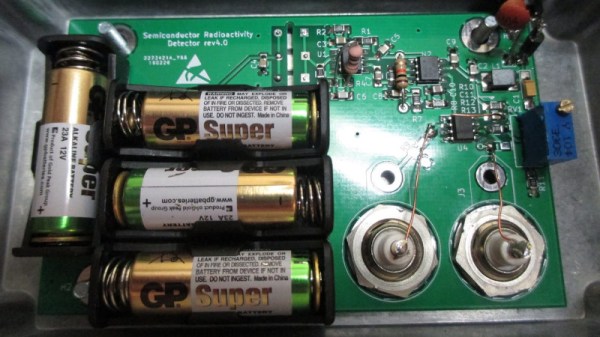
The instinctive reaction when measuring nuclear radiation is to think of a Geiger counter, as the low-pressure gas tube detectors have entered our popular culture through the Cold War. A G-M tube is not the only game in town though, and even the humble photodiode can be pressed into service. [Robert] gives us a good example, with a self-contained radiation detector head that uses a trio of BPW34s to do the job.

At its heart is a transimpedance amplifier, a not-often-seen op-amp configuration that serves as a very high gain current-to-voltage converter. This produces a spike for every radiation event detected by the diodes, which is fed to a comparator to produce a logic pulse. The diodes require a significant bias voltage, for which he’s used 48 V from a stack of 12 V photographic dry cells rather than a boost converter or other potentially noisy power supply. Such a sensitive high-gain device needs to be appropriately shielded, so the whole circuit is contained in a diecast box with a foil window to allow radiation to reach the diodes.

This isn’t the first BPW34-based radiation detector we’ve seen, so perhaps before looking for a Cold War era relic for our radiation experiments we should be looking in a semiconductor catalogue instead.

New Part Day: An ESP With ZigBee

It seems that the folks at Espressif are doing their best to produce chips to fit every possible niche in the microcontroller-with-radio market, because here comes news of their latest chip bearing the ESP32 name: a single-core 96MHz RISC-V part with built-in IEEE 802.15.4 to support ZigBee 3.x and Thread 1.x. The ESP32-H2 is not the most powerful of the Espressif line-up, but it will find its place in home automation products and projects.

The ESP32-H2 joins a multitude of other IEEE 802.15.4 devices from manufacturers such as Microchip, ST, NXP, and Nordic in an increasingly crowded marketplace, so what can if offer that the others can’t? If previous ESP chips are anything to go by we’d expect it to compete on price as well as the obvious attraction for developers used to working with other Espressif products. We look forward as always to seeing what you do with it.

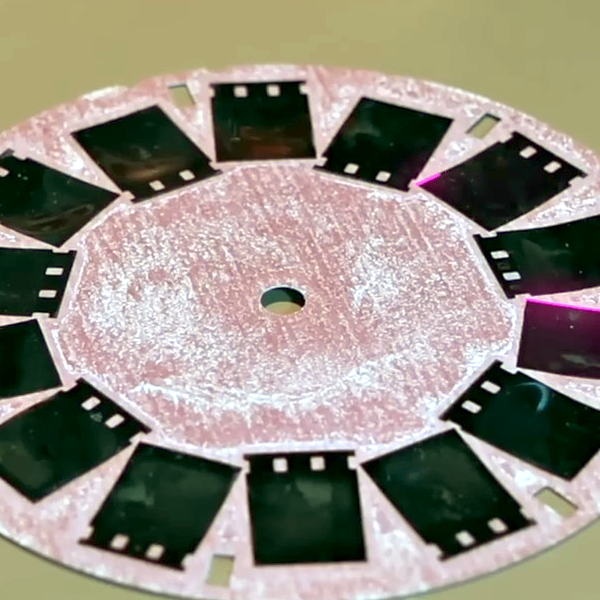
Semiconductor Shortage? Never Mind That, There’s A Vacuum Shortage!

As those of us who work in electronics are grappling with a semiconductor shortage making common devices unobtainable and less common ones very expensive, it’s worth noting that there’s another supply crunch playing out elsewhere in the electronics industry. It’s not one that should trouble most readers but it’s a vexing problem in the guitar amp business, as guitar.com reports. At its root is the Chinese Shuguang factory, which it is reported has been forced to close down and move its operations. There’s nothing about this on the Shuguang website, so we hope that the plant has been relocated successfully and production will resume.

The specialist audio market that forms the lion’s share of tube customers in 2021 is a relatively tiny corner of the electronics business, but it’s interesting to note that the three major plants which supply it, in Slovakia, Russia, and China, are still not enough to prevent it being vulnerable when one of them fails. The likelihood of a fourth tube plant emerging somewhere else in the 2020s to take up the slack is not high, but it’s evident that the demand remains healthy enough.

If you’d like to know more about the supply of new vacuum tubes, we went into the subject in greater detail last year.

Ostrich Robot Machine-Learns Itself To 5K

Ever since humanity has grasped the idea of a robot, we’ve wanted to imagine them into walking humanoid form. But making a robot walk like a human is not an easy task, and even the best of them end up with the somewhat shuffling gait of a Honda Asimo rather than the graceful poise of a balerina. Only in recent years have walking robots appeared to come of age, and then not by mimicking the human gait but something more akin to a bird.

We’ve seen it in the Boston Dynamics models, and also now in a self-balancing two-legged robot developed at Oregon State University that has demonstrated its abilities by completing an unaided 5 km run having used its machine learning skills to teach itself to run from scratch. It’s believed to be the first time a robot has achieved such a feat without first being programmed for the specific task.

The university’s PR piece envisages a time in which walking robots of this type have become commonplace, and when humans interact with them on a daily basis. We can certainly see that they could perform a huge number of autonomous outdoor tasks that perhaps a wheeled robot might find to be difficult, so maybe they have a bright future. Decide for yourself, after watching the video below the break.

Continue reading “Ostrich Robot Machine-Learns Itself To 5K”