Stereo Recording Made Easy With A 3D-Printed Mount

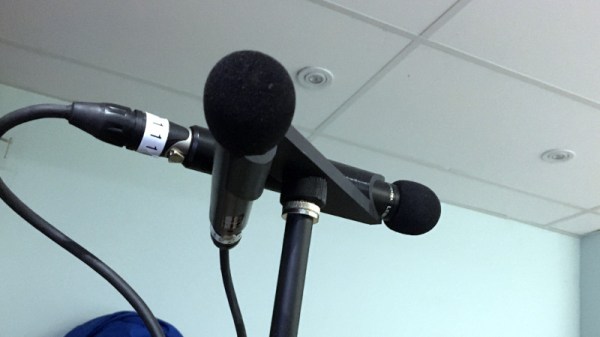
When making a recording it can be surprisingly difficult to capture a good stereo image. A well-known technique is the ORTF microphone arrangement in which two cardoid microphones sit at 110 degrees to each other and 17cm apart, and thus pick up a readily reproducible stereo separation. It’s something that we’ve been known to do in our student days with a pair of Shure SM58s and a stack of Post Office elastic bands, but [marsairforce] has done a much nicer job with a very neat 3D-printed microphone clip.

Designed in OpenSCAD, the first iteration printed on a resin printer proved to be too brittle for the task, so a second version was printed on an FDM machine. This incorporated significant strengthening, as well as a screw mount for a microphone stand. The result is an extremely useful and cheap addition to any recording set-up, and anyone who has wrestled with achieving a good stereo image will appreciate it. You can see some of what went into it in the video below the break.

If this is your field of interest, you might also wish to look at a binaural microphone.

Continue reading “Stereo Recording Made Easy With A 3D-Printed Mount”
An Epic Tale Of Reset Line Detective Work

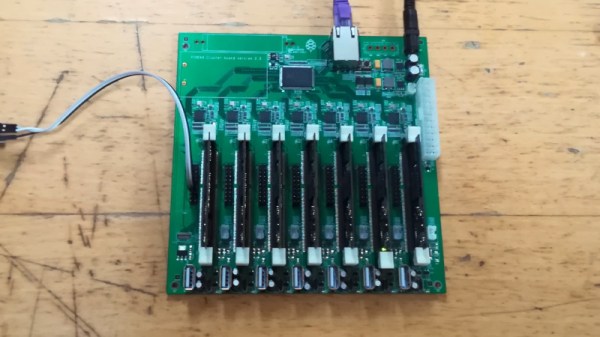
The Pine64 folks have given us so many tasty pieces of hardware over the last few years, but it’s fair to say that their products are for experimenters rather than consumers and can thus be a little rough around the edges at times. Their Clusterboard for example is a Mini-ITX PCB which takes up to seven of their SOPINE A64 compute modules, and networks them for use as a cluster by means of an onboard Gigabit Ethernet switch. It’s a veritable powerhouse, but it has an annoying bug in that it appears reluctant to restart when told. [Eric Draken] embarked upon a quest to fix this problem, and while he got there in the end his progress makes for a long and engrossing read.

We journey through the guts of the board and along the way discover a lot about how reset signals are generated. The eventual culprit is a back-EMF generated through the reset distribution logic itself causing the low-pulled line to never quite descend into logic 0 territory once it has been pulled high, and the solution an extremely simple application of a diode. For anyone who wishes to learn about logic level detective work it’s well worth a look. Meanwhile the board itself with its 28 ARM cores appears to have plenty of potential. It’s even a board we’ve mentioned before, in a personal supercomputer project.

A Satellite Upconverter Need Not Be Impossible To Make

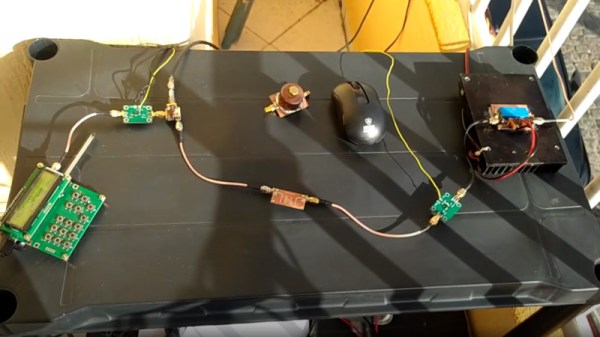
Those readers whose interests don’t lie in the world of amateur radio might have missed one of its firsts, for the last year or two amateurs have had their own geostationary satellite transponder. Called Es’hail-2 / AMSAT Phase 4-A / Qatar-OSCAR 100, it lies in the geostationary orbit at 25.9° East and has a transponder with a 2.4 GHz uplink and a 10.489 GHz downlink. Receiving the downlink is possible with an LNB designed for satellite TV, but for many hams the uplink presents a problem. Along comes [PY1SAN] from Brazil with a practical and surprisingly simple solution using a mixture of odd the shelf modules and a few hand-soldered parts.

An upconverter follows a simple enough principle, the radio signal is created at a lower frequency (in this case by a 435 MHz transmitter) and mixed with a signal from a local oscillator. A filter then picks out the mixer product — the sum of the two — and amplifies it for transmission. [PY1SAN]’s upconverter takes the output from the transmitter and feeds it through an attenuator to a MiniCircuits mixer module which takes its local oscillator via an amplifier from a signal generator module. The mixer output goes through a PCB stripline filter through another amplifier module to a power amplifier brick, and thence via a co-ax feeder to a dish-mounted helical antenna.

The whole thing is a series of modules joined by short SMA cables, and could probably be largely sourced from a single AliExpress order without too much in the way of expenditure. It’s by no means easy to get on air via Es’hail-2, but at least now it need not be impossibly expensive. Even the antenna can be made without breaking the bank.

We covered Es’hail-2 when it first appeared. May it long provide radio amateurs with the chance to operate worldwide with homebrew microwave equipment!

Continue reading “A Satellite Upconverter Need Not Be Impossible To Make”

Retrotechtacular: Mechanical TV From The People Who Made It Happen

If we have a television in 2021 the chances are that it will be a large LCD model, flat and widescreen, able to display HD images in stunning clarity. Before that we’d have had a CRT colour TV, them maybe our parents grew up with a monochrome model. Before those though came the first TVs of all, which were mechanical devices that relied on a spinning disk to both acquire and display the image. The BBC Archive recently shared a vintage clip from 1970 in which two of the assistants of [John Logie Baird], the inventor of the first demonstrable television system, demonstrated its various parts and revealed its inner workings.

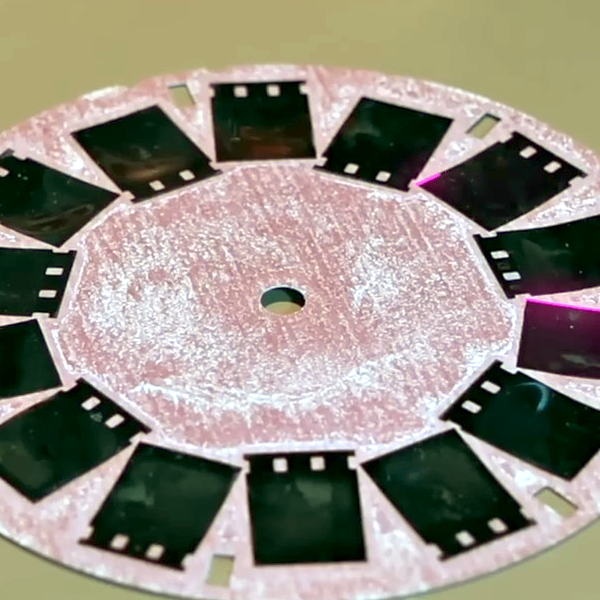
We’ve covered the Nipkow scanning disk in a previous article, with its characteristic spiral of holes. We see the original Baird Televisor, but the interesting part comes as we move to the studio. Using the original equipment they show a dot of light traversing the presenter’s face to scan a picture before taking us to a mock-up of the original studio. Here there’s a surprise, because instead of the camera we’d expect today there is a Nipkow disk projector which traverses the subject sitting in the dark. A bank of photocells above the projector senses the reflected light, and returns a video signal.

The resulting low-resolution pictures had a low enough bandwidth to be broadcast over an AM radio transmitter, and for a tiny 30-line picture in the glowing pink of a neon light they provide a surprising amount of detail. With such a straightforward principle it’s not surprising that they’ve appeared in a few projects on these pages, including an Arduino driven colour video monitor, and a POV clock. Take a look at the video below the break.

Continue reading “Retrotechtacular: Mechanical TV From The People Who Made It Happen”

One Of The Largest Large Format Cameras You Will Ever Have Seen

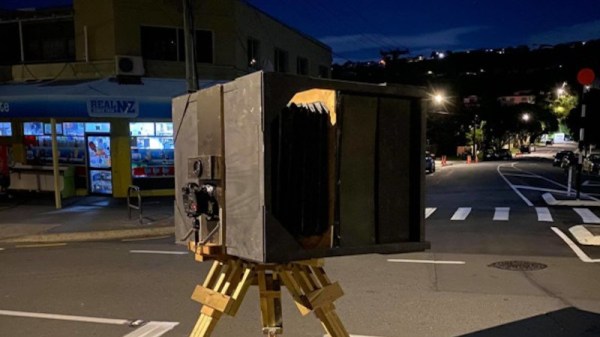
When fate lands a very high quality lens in front of you, what do you do with it? If you are [Tim Hamilton], the solution is obvious. Use it in a huge large-format camera.

The lens came from a newspaper magnifier made redundant by digitalisation and used as a paperweight. It’s an extremely high quality piece of optical equipment so seeing it wasted in this way was a source of distress. So after characterising it an enormous scaled-up box and bellows was constructed, and set upon a suitably substantial wheeled tripod.

Instead of a huge piece of film or some unobtainable giant electronic sensor, the image is projected onto a large screen at the rear of the camera. A modern digital camera is mounted inside the box just beneath the lens and photographs the screen, resulting in the feel of the largest of large format cameras with the convenience of a digital format. The resulting images have a special quality to them that recalls pictures from the past, and definitely makes the camera a special if slightly inconvenient device.

This may be one of the larger cameras we’ve featured, but it’s not the first that uses a similar technique.

British Big Rigs Are About To Go Green

An increasing fact of life over the coming years will be the decarbonisation of our transport networks, for which a variety of competing solutions are being touted. Railways, trucks, cars, and planes will all be affected by this move away from fossil fuels, and while sectors such as passenger cars are making great strides towards electric drive, there remain some technical hurdles elsewhere such as with heavy road freight. To help inform the future of road transport policy in the UK then, the British government are financing a series of trials for transportation modes that don’t use internal combustion. These will include a battery-electric fleet for the National Health Service and a hydrogen-powered fleet in Scotland, as well as a trial of the same overhead-wire system previously given an outing in Germany, that will result in the electrification of a 12.4 mile section of the M180 motorway in Lincolnshire.

We’ve written about the overhead electrification project in Germany in the past and subjected it to a back-of-envelope calculation that suggested the total costs for a country such as the UK might be surprisingly affordable. The M180 is something of a backwater in the UK motorway network though, so it will be interesting to see how they approach the problem of finding real-world loads for their tests that ply such a short and isolated route. We’d expect the final picture to include all three technologies in some form, which can only be a good thing if it increases the available electric and hydrogen infrastructure. We’ll follow this story, though sadly we may not be able to blag a cab ride on the M180 in one of the trucks.

A LiPo Cell Makes A 4AA Pack For A GameBoy

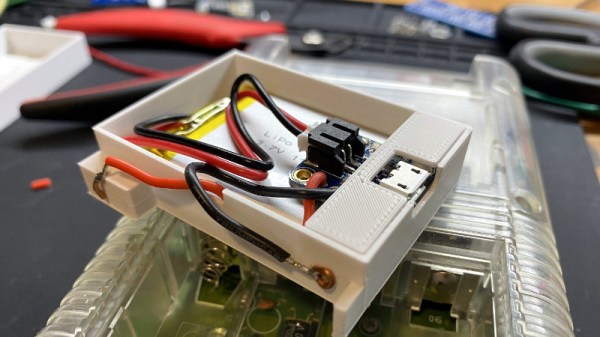
Electronic toys of yesteryear were fantastic objects of desire, but came with the fatal flaw of requiring batteries. Batteries that cost more than the average youngster’s pocket money and for which the pestered parent were usually unwilling to fork out every couple of days to support an incessant playing habit. It’s something [Sen] has addressed for the Nintendo Game Boy, and rather than cutting the device up and soldering wires, the result is a unit that neatly slots into the existing 4AA battery enclosure.

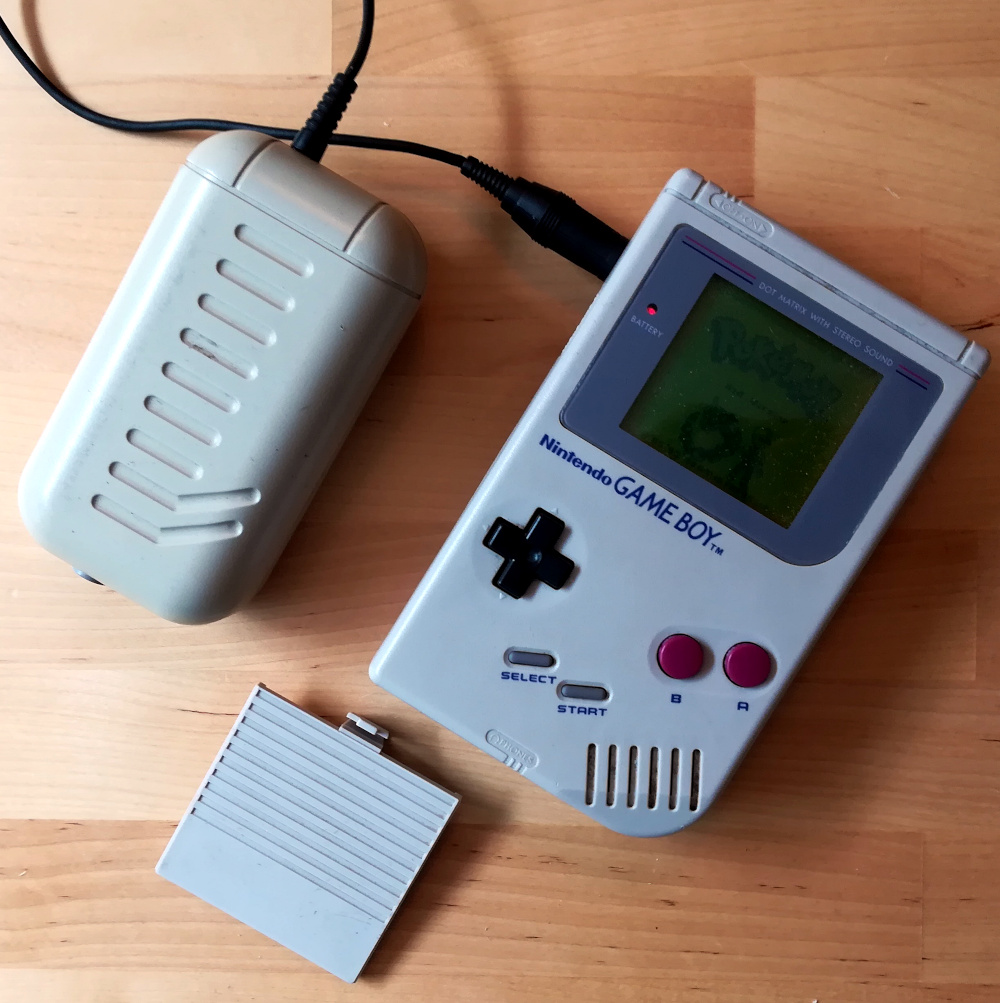
The Nintendo rechargable Game Boy pack.
Much more convenient than Nintendo’s own effort!

Electrically it’s a simple case of wiring up an Adafruit module and a pouch cell, but that’s not the essence of the job in this case. Instead a huge quantity of work and iteration has gone into CAD design to the perfect-fitting pack. It’s sure to be a boon for today’s Game Boy player, but much more than that it should be of interest to owners of far more devices that take four AA cells. Most of us probably keep a few packs of AAs for just those moments, perhaps meanwhile something like this could be a handy thing to have instead.

More traditional conversions resort to extreme measures, as with this Game Boy Color.