Radio Amateurs & Skywatchers Rejoice, Sat Operators Worry: Solar Storm Incoming

How do you look back over your life and divide it up? Maybe by decades, cultural moments, or geopolitical events. For radio amateurs with older callsigns there’s a temptation to do so by solar cycles, as the roughly 11-year period of the Sun’s activity had a huge effect on radio propagation through the charge it creates in the upper atmosphere. We’re now in solar cycle 25, numbered since the 18th century when the science of solar observation began, and as never before we’re surrounded by information from experts such as [Dr. Tamitha Skov], the so-called [Space Weather Woman]. When she says something is on the way we listen, so a recent Tweet predicting a direct hit from a solar storm with a good probability of auroras in lower latitudes is very much worth sharing.

We must extend our commiserations to readers in equatorial climes and ever through the lower half of the USA, southern Europe, the Middle East, India, Japan, and China. You won’t see the aurora we’ll catch in Europe along with our friends in New Zealand, Canada, Russia, and northern USA. But even then to those of us at moderate latitudes an aurora is a pretty rare event, so we’re hoping for clear skies on the 2nd of February and would advise you to look out too if you’re in the likely zone even if they won’t be quite as impressive as those in our header picture. Meanwhile radio amateurs everywhere don’t have to see pretty lights in the sky to reap the benefits in terms of propagation, so happy DX hunting! The Tweet is embedded below the break, so you can play the timeline for yourselves.

Continue reading “Radio Amateurs & Skywatchers Rejoice, Sat Operators Worry: Solar Storm Incoming”
Planar PCB Coils As An Alternative To Winding Transformers

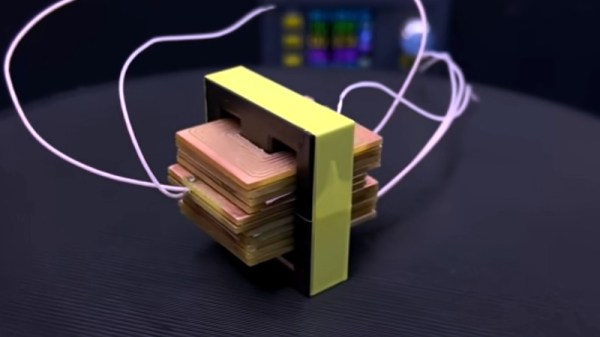
Those readers who have experimented with winding their own inductors will know that it’s not an easy task, and when those inductors are handling high voltages it can be especially tricky to maintain adequate insulation between layers of windings. [Open Frime TV] has a video addressing this in a novel way, by creating the windings for a switch-mode power supply transformer using stacked PCB coils instead of wire (Russian language; you’ll have to enable YouTube’s subtitle auto-translation).

The video below the break makes for a handy primer on PCB coil construction, reminding the viewer that the turns need all to lie in the same direction as well as the importance of insulation between windings. There’s a discussion of the properties of a PCB coil in relation to the switching frequency, and once the transformer has been assembled, we see it hooked up to a power supply board for a test. What happens next may be familiar to seasoned transformer-winders; nothing works, and the transformer gets hot. In making the PCB he’s left some copper on each board which amounts to a shorted turn — cutting these allows the transformer to work perfectly.

This technique might not be the solution to all transformer woes, but makes for an interesting option if your work takes you in the direction of winding transformers. If PCB coils take your interest, how about a Tesla coil using them?

Continue reading “Planar PCB Coils As An Alternative To Winding Transformers”

The Air Multiplier Fan Principle, Applied To A Jet Engine

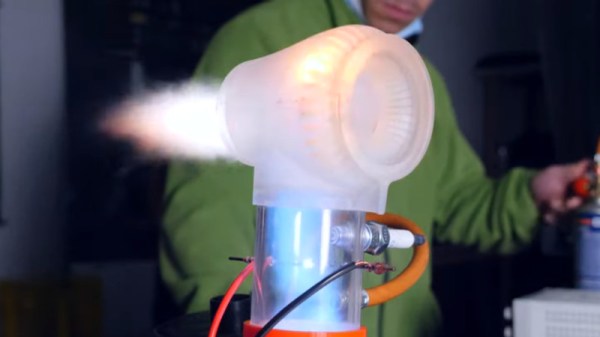
Many readers will be familiar with the Dyson Air Multiplier, an ingenious bladeless fan design in which a compressor pushes jets of air from the inside edge of a large ring. This fast-moving air draws the surrounding air through the ring, giving the effect of a large conventional fan without any visible moving parts and in a small package. It’s left to [Integza] to take this idea and see it as the compressor for a jet engine, and though the prototype you see in the video below is fragile and prone to melting, it shows some promise.

His design copies the layout of a Dyson with the compressor underneath the ring, with a gas injector and igniter immediately above it. The burning gas-air mixture passes through the jets and draws the extra air through the ring, eventually forming a roaring jet engine flame exhaust behind it. Unfortunately the choice of 3D print for the prototype leads to very short run times before melting, but it’s possible to see it working during that brief window. Future work will involve a non-combustible construction, but his early efforts were unsatisfactory.

It’s clear that he hasn’t created the equivalent of a conventional turbojet. Since it appears that its operation happens when the flame has passed into the center of the ring, it has more in common with a ramjet that gains its required air velocity with the help of extra energy from an external compressor. Whether he’s created an interesting toy or a useful idea remains to be answered, but it’s certainly an entertaining video to watch.

Meanwhile, this isn’t the first project we’ve seen inspired by the Air Multiplier.

Continue reading “The Air Multiplier Fan Principle, Applied To A Jet Engine”

An Up-To-Date Development Environment For The Nokia N-Gage

One of the brave but unsuccessful plays from Nokia during their glory years was the N-Gage, an attempt to merge a Symbian smartphone and a handheld game console. It may not have managed to dethrone the Game Boy Advance but it still has a band of enthusiasts, and among them is [Michael Fitzmayer] who has produced a CMake-based toolchain for the original Symbian SDK. This is intended to ease development on the devices by making them more accessible to the tools of the 2020s, and may serve to bring a new generation of applications to those old Nokias still lying forgotten in dusty drawers.

In much of the public imagination, the invention of the smartphone came with the release of the first Apple iPhone in 2007. Hackaday readers will of course trace the smartphone back much further than that to an original IBM prototype, and will remind any doubters that the Nokias which the iPhone vanquished were very successful smartphones without any of Cupertino’s magic in sight. Nokia’s tragedy was that they appeared not to understand what they had in Symbian, and released a bewildering array of devices intended to satisfy every possible market without recognizing that the market they needed to serve was their customers being easily able to run the apps of their choice on the things.

Symbian itself has long ago become a piece of abandonware, but during its chequered history there was a period in which an open-source version was released. It would be nice to think that projects such as this one might revive interest in this capable yet forgotten operating system, as with the passage of a decade the cost of hardware which might run it has fallen to the point of affordability. Does anyone want to relive the 2000s?

Header image: Evan-Amos, Public domain.

The SHA2017 Badge Just Keeps On Giving, This Time It’s A Solar Monitor

Regular readers will know that we have covered the world of electronic badges for many years, and nothing pleases us more than seeing an event badge having a life afterwards rather than becoming a piece of e-waste. Thus we were especially pleased to see [Angus Gratton]’s use of a SHA2017 badge as a solar output monitor, over four years after the event.

The SHA badge used an ESP32 as its processor, and paired it with a touch keypad and an e-ink screen. Its then novel approach of having a firmware that could load MicroPython apps laid the groundwork for the successful open source badge.team firmware project, meaning that it remains versatile and useful to this day.

The solar monitor simply grabs time-series information from the database used by his web graphing system and displays it on the e-ink screen in graph form, but the interest apart from the use of the badge in his treatise on MicroPython coding. He makes the point that many of us probably follow unconsciously, writing for full-fat Python and then fixing the parts which either don’t work or use too many resources on its slimmer cousin. Finally he powers the device from an old phone charger, and shares some tips on controlling its tendency to reboot on power spikes.

It’s almost a year ago that we showed you a SHA badge being used as an environmental sensor.

Thanks [Sebastius] for the tip.

An Entire Computer In ICMP Packets

The earliest stored program computer in the modern sense was not one of the names such as ENIAC or Colossus that you might expect, but the Manchester Baby, an experimental prototype computer built at the University of Manchester in 1948. Its 550 tubes gave it the multi-rack room-filling size common to 1940s machines, but its architecture makes it a comparatively simple processor by the standards of today. So simple in fact, that [Hrvoje Čavrak] has recreated it using ICMP packets as its storage, and a custom packet filter as its processor emulation. It’s a project that’s simultaneously both elegant and gloriously pointless, but as he says, “It’s still better than doing drugs or JavaScript”.

The result simulates the Baby’s combined storage and display tube in a dump of the network traffic, and gives an excellent excuse to read up about its operation. The tiny instruction set brings to mind today’s RISC architectures, but this is illusory as the designers of 1948 would have had less of an eye towards clock cycles than they would have towards the machine working at all in the first place.

If early computers tickle your fancy it may be worth taking a while to read about the UK’s National Museum of Computing, and then about Colossus, the primordial electronic computer.

Header: Geni, CC BY-SA 4.0.

Flying Sausage Rescues Pooch, Drone Pilots Save The Day

When we write about drone stories from the United Kingdom, they often have a slightly depressing air to them as we relate tales of unverified air proximity reports closing airports or bungled official investigations that would make the Keystone Kops look like competent professionals.

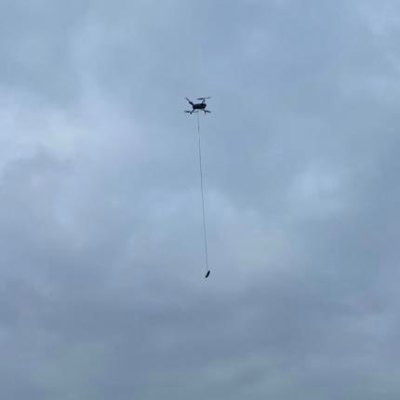
But here’s a drone story from this rainswept isle sure to put a smile on the face of multirotor enthusiasts worldwide, as Denmead Drone Search And Rescue, an organisation who locate missing pets using drones, enticed lost dog Millie from a soon-to-be-engulfed tidal mudflat by the simple expedient of dangling a sausage from a drone for the mutt to follow (Facebook).

Lest you believe that Hackaday have lost their marbles and this isn’t worthy of our normal high standards, let us remind you that this is not our first flying sausage story. Behind the cute-puppy and flying meat product jokes though, there’s a serious side. Drones have received such a bad press over recent years that a good news story concerning them is rare indeed, and this one has garnered significant coverage in the general media. Maybe it’s too late to reverse some of the reputational damage from the Gatwick fiasco, but at this point any such coverage is good news.

For anyone wondering what lies behind this, let us take you back to Christmas 2018.