First Hacks: The Brand New Nokia 5G Gateway Router

Aside from being the focus of a series of bizarre conspiracy theories, 5G cellular networks offer the promise of ultra-fast Internet access anywhere within their range. To that end there are a new breed of devices designed to provide home broadband using 5G as a backhaul. It’s one of these, a Nokia Fastmile, that [Eddie Zhang] received, and he’s found it to be an interesting teardown and investigation. Spoiler: it runs Android and has exploitable bugs.

A privilege escalation bug in the web administration tool led to gaining the ability to export and modify configuration files, but sadly though a telnet prompt can be opened it’s not much use without the password. Uncovering some blocked-off ports on the base of the unit revealed a USB-C port, which was found to connect to an Android device. Via ADB a shell could be opened on Android, but on further  investigation it was found that the Fastmile is not a single device but two separate ones. Inside is a PCB with an Android 5G phone to handle the connection, and another with a completely separate home router.

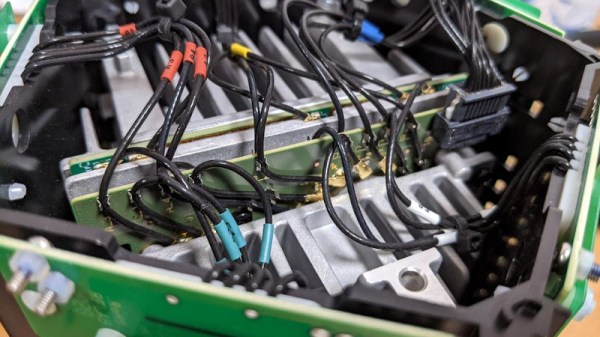
With access to the Android side and a login prompt on the router side that was as far as he was prepared to go without risking bricking his Fastmile. It only remained to do a teardown, which reveals the separate PCBs with their own heatsinks, and an impressive antenna array. Perhaps these devices will in time become as ubiquitous as old routers, and we’ll see them fully laid bare.

It’s a shame that we’ve had to write more about the conspiracy theories surrounding 5G than real 5G devices, but maybe we’ll see more teardowns like this one to make up for it.

Belgian Railway Time For Your Home

Some of the 20th century’s most iconic design and typography came to us through public signage in the various national railways of Europe. Were you to think of a Modernist clock face for example, the chances are that the prototype for your image hangs somewhere in one of the continent’s great railway terminals. If you don’t fancy getting on a train to see your favourite public timepiece, then maybe [EBP Controller] has a treat for you, with a 3D-printed double-faced Belgian railway station clock.

Behind the scenes the mechanism is simpler than appearances might lead the observer to believe, with each set of hands driven through a single gear to a motor. Controlling it all is an ESP8266, which is able to synchronise the clock exactly to an NTP server. It appears at first sight to have an unnecessarily large quantity of motors, but considering that there are two faces each with three hands the six motors each have a use. So while the real thing might require a heist from the SNCB, at least modernist clock fans can now have their own.

Mini Linear Actuators From DVD Drive Parts

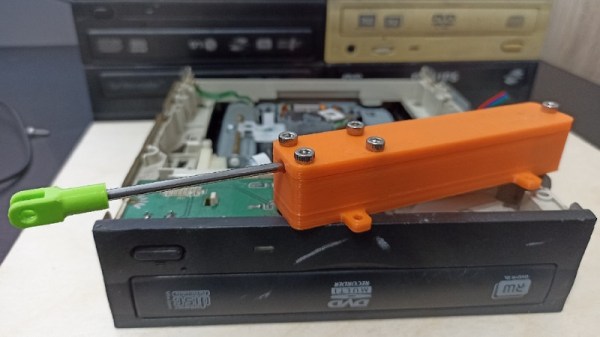
For many years now a source for some of the smallest and cheapest home made CNC mechanisms has been the seemingly never-ending supply of surplus CD and DVD-ROM drives. The linear actuator that moves the laser may not be the longest or the strongest, but it’s free, and we’ve seen plenty of little X-Y tables using CD drives. It’s these mechanisms that [Nemo404] has taken a little further, freeing the lead screw and motor from the drive chassis and placing them in a 3D-printed enclosure for a complete linear actuator that can be used in other projects. (Video, embedded below.)

There seems to be no positional feedback, not even the limit switch that would grace a typical CD drive, but aside from that it makes for a compact unit. There are two versions, one for a linear bearing and the other for the brass bushes found in CD drives. It’s unclear how strong the result is, but it appears to be strong enough to demonstrate lifting a small container of screws.

Should you need to make your own actuator then aside from the easy-to-obtain old CD drive the files can be found on Thingiverse. And introduce yourself to the world of CD drives for CNC machines by taking a look at this mill.

Thanks [BaldPower] for the tip!

Continue reading “Mini Linear Actuators From DVD Drive Parts”

A CMOS Ring Modulator Pedal

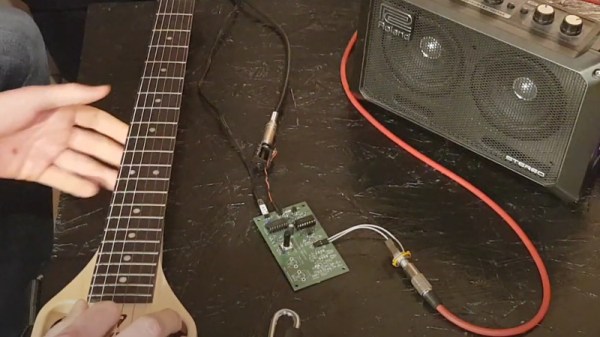
Earlier this year, we featured an unusual radio receiver that took the very traditional superhetrodyne design and implemented it in an unexpected fashion without any inductors, using instead a combination of 74HC logic chips and op-amps. Its designer [acidbourbon] remarks that the circuit bears a striking resemblance to a ring modulator,so has taken it down that path by producing a 74HC based ring modulator guitar pedal.

In both circuits, a 74HC4046 phase-locked loop chip serves as an oscillator, driving a 74HC4051 analogue switch chip that performs the mixer task. The extra-op-amp filter and demodulator circuitry from the radio is omitted, and the oscillator frequency moved down to the audio range. The result can be heard in the video, and we probably agree with him that it’s not quite the same as a classic ring modulator. This lies in the type of mixer, the diodes used in a traditional circuit have a forward voltage to overcome before they start or end conducting, while the CMOS switch chip does so immediately on command.

The 4000 series CMOS and their descendants are a fascinating family with many unexpected properties that our colleague Elliot Williams has gone into detail with for his Logic Noise series. Meanwhile take a look at our coverage of the original radio.

Continue reading “A CMOS Ring Modulator Pedal”

Know Audio: Mixtapes, Tape Loops, And Razor Blades

In our no-nonsense journey through the world of audio technology we’ve so far have looked at digital audio and the vinyl disk recording. What’s missing? Magnetic tape, the once-ubiquitous recording medium that first revolutionised the broadcast and recording industries in the mid-20th-century, and went on to be a mainstay of home audio before spawning the entire field of personal audio. Unless you’re an enthusiast or collector, it’s likely you won’t have a tape deck in your audio setup here in 2021 and you’ll probably be loading your 8-bit games from SD card rather than cassette, but surprisingly there are still plenty of audio cassettes released as novelties or ephemeral collectables.

The Device That Made The Sound Of The Latter Half Of The 20th Century

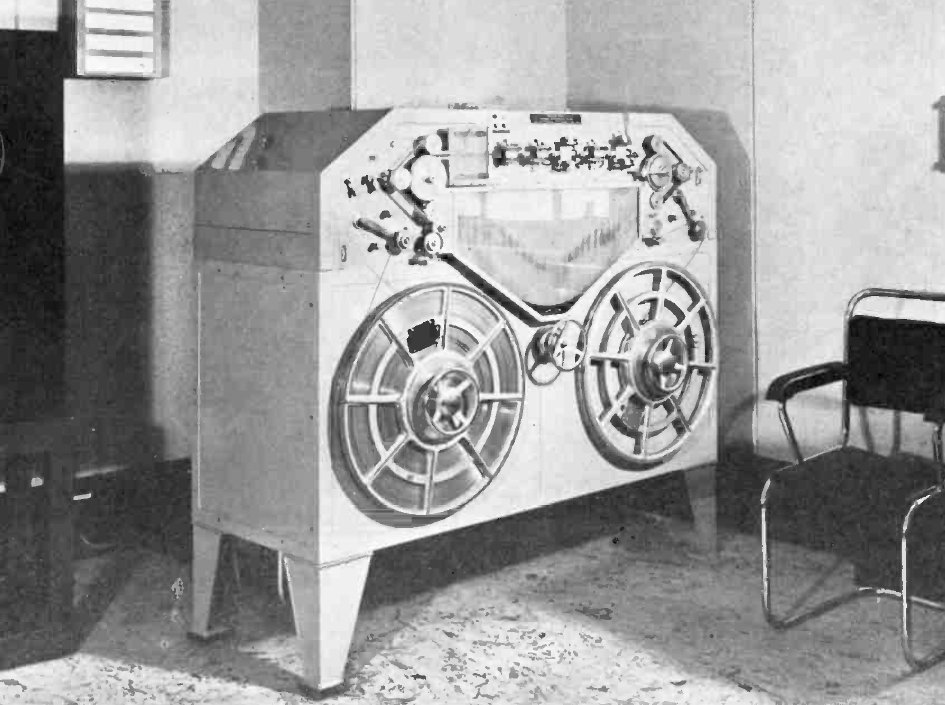
"Like a travelling razor blade", a Blattnerphone steel-strip tape recorder at the BBC in 1937. Douglas Hallam, Jr., Public domain.
“Like a travelling razor blade”, a Blattnerphone steel-strip tape recorder at the BBC in 1937. Douglas Hallam, Jr., Public domain.

The first magnetic recordings were made directly on metal wires, but metal fatigues as it bends. By coating a flexible plastic tape in ferrous particles, the same simple technique of laying down an audio signal as variations in the magnetic field could be made smaller, lighter, and more robust. But the key to the format’s runaway success is the technical advancements that differentiate those 1950s machines from their wire recorder ancestors.

Whether it is a humble cassette recorder or a top-end studio multitrack, all tape recorders are very similar. There are two reels that hold the tape: the playback reel that houses the recording, and the take-up reel that stores the tape as it plays in the machine. The take-up reel is lightly driven to run faster than the tape speed, and the playback reel has a slight braking force to keep the tape under tension at all times. Continue reading “Know Audio: Mixtapes, Tape Loops, And Razor Blades”

An All In One Cube PC For A 1990s That Never Quite Happened

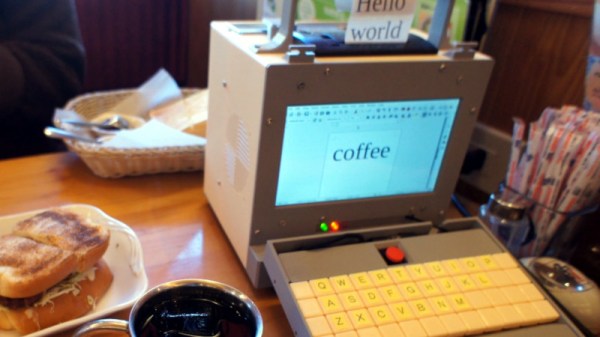
When a particular device or appliance is evoked, there comes with it a set of expectations over what it might look like. A toaster, a camera, a washing machine, or a PC, will all have their own accepted form factors, and it’s rare that a manufacturer is adventurous enough to venture outside them. In the world of PCs there was a brief flowering of this type of creativity through the 1990s, and it’s that time which [ikeji]’s cube PC squarely fits in. It’s a 3D printed PC with a built-in display, keyboard, and printer, and while some might categorize it as a cyberdeck we’d say it goes further, we could easily imagine a slightly more polished version being an object of desire back when a powerful machine carried an 80486.

Inside it’s no slouch, packing an AMD Ryzen 7 Pro on a Mini-ITX motherboard, and while the display is a mere 7-incher it fits neatly behind the fold-down keyboard. The thermal printer is maybe more of a toy, but it’s good to find that even a bleeding-edge motherboard still has a serial port on it somewhere that it can talk to.

While the build undoubtedly has a few home-built rough edges we like the idea, echoing as it does those all-in-ones from the CRT era. Unless you have a handy Minitel terminal you won’t find much like it.

A Particularly Festive Chip Decapping

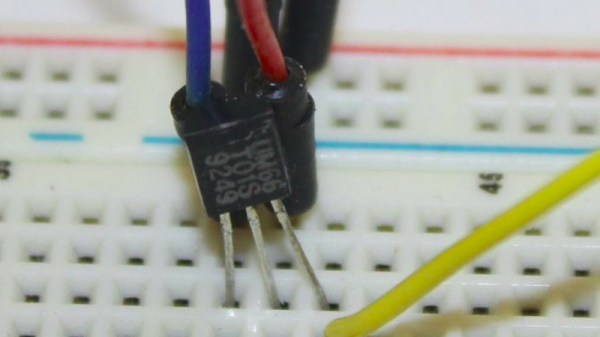
As we approach the moment in the year at which websites enter a festive silly season of scrambling to find any story with a festive angle, we’re pleased to see the ever-reliable [Ken Shirriff] has brought his own take on Christmas tech to the table with a decapping of the UM66T melody chip that has graced so many musical greeting cards.

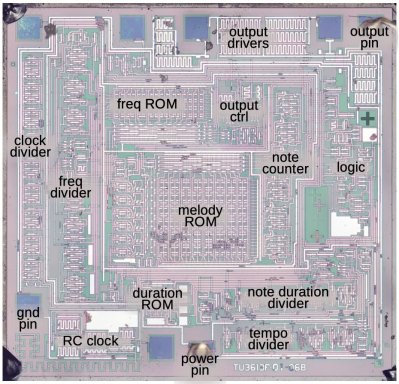
The surprise in this age of ubiquitous microcontrollers is that this is not a smart device; instead it’s a single-purpose logic chip whose purpose is to step through a small ROM containing note values and durations, driving a frequency generator to produce the notes themselves. The frequency generator isn’t the divider chain from the RC oscillator that we might expect, instead it’s a shift register arrangement which saves on the transistor count.



Although the UM66 is a three-pin device, there are a few other pins on the die. These are likely to be for testing. As a 30+ year old product its design may be outdated in 2021, but it’s one of those chips that has survived without being superseded because it does its task without the need for improvement. So when you open a card and hear the tinny tones of a piezo speaker this holiday season, spare a thought for the ingenuity of the design behind the chip that makes it all possible.