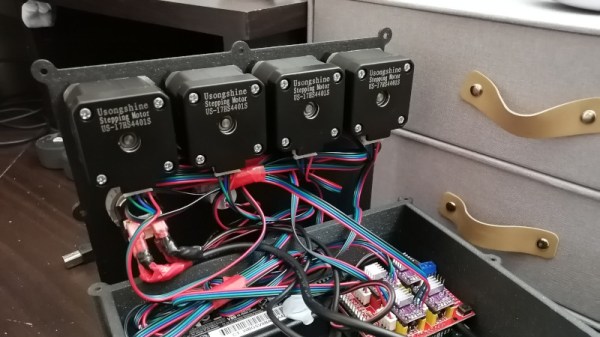
Four Steppers Make A Four-Voice MIDI Instrument

Any owner of a budget 3D printer will tell you that they can be pretty noisy devices, due to their combinations of stepper motors and drives chosen for cost rather than quiet. But what if the noise were an asset, could the annoying stepper sound be used as a musical instrument? It’s a question [David Scholten] has answered with the Stepper Synth, a device that takes an Arduino Uno and four stepper motors to create a four-voice MIDI synthesiser.

Hardware-wise it’s as simple as you’d expect, a box with four stepper motors each with a red 3D-printed flag on its shaft to show rotation. Underneath there is the Arduino, plus a robot control shield and a set of stepper driver boards. On the software side it uses MIDI-over-serial, so as a Windows user his instructions for the host are for that operating system only. The Arduino makes use of the Arduino MIDI library, and he shares tips on disabling the unused motors to stop overheating.

You can hear it in action in the video below the break, and we’re surprised to say it doesn’t sound too bad. There’s something almost reminiscent of a church organ in there somewhere, it would be interesting to refine it with an acoustic enclosure of some kind.

This isn’t the first such instrument we’ve brought you, for a particularly impressive example take a look at the Floppotron.

Continue reading “Four Steppers Make A Four-Voice MIDI Instrument”

Automatic Cat Weighing Machine Knows Which Pet It Is Feeding

Have you ever tried to weigh a cat? For that matter, have you ever tried to get a cat to do anything they don’t want to do? The wilful independence of our feline companions is a large part of what endears them to us, and must have done ever since the ancient Egyptians first had a hybrid wildcat that became domesticated

No wonder it’s so hard to care for multiple cats with different dietary needs. But the mere act of weighing the cats just might be the key to automating their diets while giving them the choice of when they want to eat. It’s a task that [Psy0rz] has cracked with the Meowton, a weighing machine/feeder combo designed to regulate the diets of his various moggies.

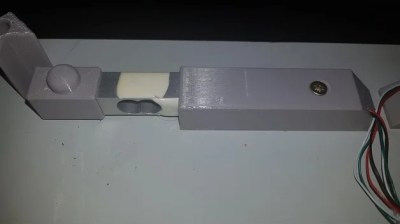
Cat scale uses a load sensor under each corner of the platform

The multi-faceted system involving a scale to weight the cat, a food hopper with dispenser, and a scale for the food bowl. The cat has to stand on the scale to eat, and the dispenser doles out some food when it detects this. It identifies each cat by weight, and controls the quantity dispensed accordingly to spread that cat’s allotted diet over the course of the day.

Behind it all is an ESP32, which delivers the stats to a web interface and makes them available for import to a database. He’s identified a flaw in the system, that two cats of the same weight could cause misidentification. To that end he has an RFID reader under way, but it’s still a work in progress. There is even a live stream of the unit in action.

We’re suckers for cats here, and while the various Hackaday Cats provide plenty of companionship and entertainment we’re always up for more. Over the years we’ve featured plenty of cat feeders, but only one cat elevator.

Our Trucks Won’t Need No Batteries! Electric Trucks Look To Overhead Wires For Power

As the world grapples with the spectre of the so-called “hockey stick” graph of climate change, there have been a variety of solutions proposed to the problem of carbon emissions from sectors such as transport which have become inseparable from the maintenance of 21st century life. Sometimes these are blue-sky ideas that may just be a little bit barmy, while other times they make you stop and think: “That could just work!”.

Such an idea is that of replacing the diesel engines in trucks with electric motors powered not by batteries but from overhead cables. An electric tractor unit would carry a relatively small battery for last-mile transit, but derive its highway power by extending a pantograph from its roof to a high-voltage cable above the road. It’s extremely seductive to the extent that there have even been trials of the system in more than one country, but does it stack up to a bit of analysis?

Time’s Up For Those Big Rigs

Siemens and Scania are justifiably proud of their electrified stretch of autobahn and electric trucks in Germany.

One thing that should be obvious to all is that moving our long-distance freight around by means of an individual fossil-fuel-powered  diesel engine for every 38 tonne or so freight container may be convenient, but it is hardly either fuel-efficient or environmentally friendly The most efficient diesel engines on the road are said to have a 43% efficiency, and when hauling an single load they take none of the economies of scale afforded to the diesel engines that haul for example a freight train. Similarly they spread any pollution they emit across  the entirety of their route, and yet again fail to benefit from the economies of scale present in for example a power station exhaust scrubber. However much I have a weakness for the sight of a big rig at full stretch, even I have to admit that its day has passed.

The battery technology being pursued for passenger cars is a tempting alternative, as we’ve seen with Tesla Semi. But for all its technology that vehicle still walks the knife-edge between the gain in cost-effectiveness versus the cost of hauling around enough batteries to transport that quantity of freight. Against that the overhead wire truck seems to offer the best of both worlds, the lightness and easy refueling of a diesel versus the lack of emissions from an electric. In the idealised world of a brochure it runs on renewable wind, sun, and water power, so all our problems are solved, right? But does it really stack up?

Continue reading “Our Trucks Won’t Need No Batteries! Electric Trucks Look To Overhead Wires For Power”

The Zero Terminal 3: A Pop-Out Keyboard Linux Computer In Your Pocket

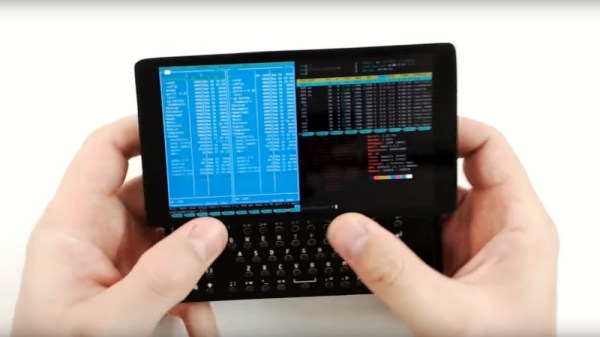
The mobile phone revolution has delivered us attractively packaged and convenient computing in our pockets, but without the easy hackability we like in our community. Meanwhile the advent of single board computers has given us affordable super-powerful hardware that can run a very capable GNU/Linux operating system and fulfill all our hackable computing needs. Combine the two though? Plenty have tried, few have succeeded in making something as slick as the former with the open power of the latter. Fine if you like your portable devices to have a cyberdeck vibe, but maybe not something you’d take into the boardrooom. Never fear though, for [N-O-D-E] have the solution, in version 3 of the Zero Terminal. It’s the ultimate in Raspberry Pi based handheld computing, and it resembles a slightly chunky mobile phone.

At its heart is a Waveshare OLED 5.5″ touch screen, on the back owhich is mounted a PCB that carries a USB hub and power circuitry. A Pi Zero is mounted directly to this, and a cleverly designed HDMI adapter board interfaces it to the display. The power board is a generic one, the one designed for the PCB proved difficult to hand solder. There’s a very smartly designed case to give it that mobile phone feel, and on the back are a set of sockets with all the relevant Pi connections. This opens the possibility of some exciting add-ons, the first of which is a sliding keyboard similar to those on early Android phones. The ‘board is based on a [Bobricius] design, though sadly isn’t quite working yet.

As you can see in the video below the break, this is about as slick a mobile Pi as it’s possible to get. [N-O-D-E], we want one. Just take our money!

Continue reading “The Zero Terminal 3: A Pop-Out Keyboard Linux Computer In Your Pocket”

Animal Crossing IRL With Nova Lights To Mark The Passage Of Time

We feature a lot of clocks here at Hackaday, but it’s not often that one comes along and makes us stop in our tracks and reconsider the fundamental question: just what is a clock? [Charlyn] has managed it though, with her Nova Light clock, which doesn’t so much measure the passing of time, but mark it.

The clock itself is a set of origami pieces in the shape of the Nova lights and a star fragment from the popular Animal Crossing New Horizons game, and each has a multicolour LED underneath. The star fragment pulses, while the two Nova lights imperceptibly slowly change colour, one over the course of the day and the other over the course of the week. Except for Fridays, when in celebration of the end of the work week they pulsate with different colours. Under the hood is an Adafruit Feather with a real-time clock module, and since all the code is there for your enjoyment you can have a go at making your own. Below the break is a video showing the clock in action.

[Charlyn] is no stranger to these pages, in fact we’ve featured her exquisite use of origami before. It’s probably her rideable rocking horse that’s the most memorable among her projects though.

Continue reading “Animal Crossing IRL With Nova Lights To Mark The Passage Of Time”

Print With Plasma!

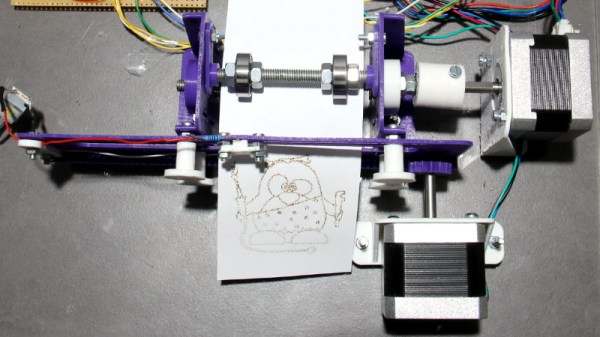
Over the years there have been a variety of methods for a computer to commit its thoughts to paper. Be it a daisy wheel, a dot matrix, a laser, or an inkjet, we’ve all cursed at a recalcitrant printer. There’s another type of printer that maybe we don’t think of quite as often but is workhorse in a million cash registers and parking ticket machines: the thermal printer. These mechanisms can be readily found as surplus items and have made their way into more than one project here over the years. [HomoFaciens] has taken thermal printing a step further by building a plasma printer from scratch that makes use of the thermal paper.

A thermal printer does its job as its name suggests, by burning the image into the paper. It may not deliver the best quality print, but scores on not needing ink ribbons, cartridges, or toner. This DIY version uses an off-the-shelf battery-powered plasma lighter to do the job, mounted on a 3D printed XY printer mechanism driven by two stepper motors. Behind the scenes is an Arduino Uno, which receives its instructions via USB from a command-line program on a Linux box. It’s admitted that this is hardly the pinnacle of printing technology, but it does at least make for a fascinating project. You can see it in action in the video below the break.

This isn’t [HomoFaciens]’ first printer, we’re instantly reminded of this ink drop printer from a few years ago.

Continue reading “Print With Plasma!”

Wood-Fired Hot Tub For The End Of The World

It’s one of the idyls of our age, to imagine oneself lounging in a hot tub watching a golden sunset, glass of wine in hand and the love of your life at your side. Along the way though it’s one that’s become diverted from the original, instead of a Scandinavian style wood fired tub in the forest we’re more likely to be thinking of an electric whirlpool spa made from fibreglass, as much a status symbol as a leisure item. It’s refreshing then to see [sirClogg]’s home made hot tub, a simple wooden tub with associated wood stove to heat its water. We can’t wait to step in!

The tub is simplicity itself, being made from softwood planks held together under tension by some steel cables. He admits though that he made a mistake using green wood, as it has now contracted leaving the tub with some gaps. But it’s a simple enough build that he can contemplate dismantling and rebuilding it to correct for that oversight.

Heat meanwhile is provided by a pipe that circulates water from the bottom of the tub through a heat exchanger coil inside a brick-built wood stove adjacent to the tub. The fabrication of the heat exchanger is detailed in the video below, we enjoyed seeing the copper piping filled with salt to ensure it doesn’t collapse when being bent around a five-gallon bucket. It doesn’t get much simpler than this, and the reward of a hot tub must be a sweet one indeed.

For hot tub enthusiast hackers, it’s always worth remembering that the excellent Danish hacker camp BornHack has a hot tub as part of its wellness area.

Continue reading “Wood-Fired Hot Tub For The End Of The World”