Though many of us will never have experimented with it, most readers should be familiar with DTMF as the tones used by the telephone system for dialling. If your youth was not misspent mashing 4-4-2-6-4-6-2, 4-4-2-6-4-1 into a keypad, then you haven’t lived!
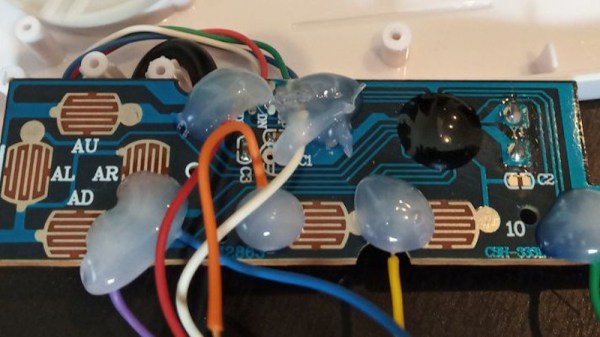
As you might expect there are a variety of chipsets to handle DTMF, and one of them has been used by [ackerman] in a slightly unusual way. Many desktop computers do not have a convenient array of GPIOs upon which to hang a piece of hardware, but a constant among them is to support some form of gaming controller. Hence he’s taken a commodity joypad and interfaced a MT8870 DTMF decoder to its switch lines with a simple transistor buffer, and is able to pull the resulting information out in the host operating system. So far there are versions for Windows, DOS, Amstrad CPC, Arduino, and even PSX ( the original PlayStation console ).
One might ask why on earth you might want a DTMF input for your desktop PC, but to do so is to miss the point. We are surrounded by computing devices from our mobile phones upwards that do not have any form of interface that can easily be used by our electronic projects, and this serves as an example of how with a bit of ingenuity that can be overcome. It’s a subject we’ve touched upon before, when we asked why people aren’t hacking their cellphones.
The SDR revolution has brought a bonanza of opportunities for experimentation to the radio enthusiast, but with it has come a sometimes-confusing array of software for which even installation can be a difficult prospect for an SDR novice. If you’re bamboozled by it all then help may be at hand courtesy of [Luigi Cruz], who has packaged a suite of ready-to-go popular SDR software in an OS image for the Raspberry Pi.
On board the Raspbian-based OS image are SDR Angel, Soapy Remote, GQRX, GNURadio, LimeUtil, and LimeVNA. In hardware terms the RTL-SDR is supported, along with the LimeSDR, PlutoSDR, Airspy, and Airspy HF. All are completely ready-to-go and even have desktop shortcuts, so if the CLI scares you then you can still dive in and play. More importantly it’s designed for use with SDR transmitters as well as receivers, so the barrier for full SDR operation for radio amateurs has become significantly lower too.
This year has seen the seven-year anniversary of the RTL-SDR hack that probably did most to kickstart the use of SDRs in our community. Our colleague [Tom Nardi] wrote a retrospective that’s worth a look for its overview of some SDR tricks that have evolved over that time. Meanwhile if you don’t mind restricting your outlook somewhat, it’s possible to turn the Raspberry Pi 3 into an SDR all without any extra hardware.
By now we are all used to the role of the printed circuit board in artwork, because of the burgeoning creativity in the conference and unofficial #BadgeLife electronic badge scenes. When the masters of electronic design tools turn their hand to producing for aesthetic rather than technical reasons, the results were always going to be something rather special.
Nick Poole is an ace wrangler of electrons working for SparkFun, and as such is someone with an impressive pedigree when it comes to PCB design. Coming on stage sporting a beret with an awesome cap badge, his talk at the recent Hackaday Superconference concerned his experience in pushing the boundaries of what is possible in PCB manufacture. It was a primer in the techniques required to create special work in the medium of printed circuit boards, and it should be essential viewing for anybody with an interest in this field.
Though he starts with the basics of importing graphics into a PCB design package, the meat of his talk lies in going beyond the mere two dimensions of a single PCB into the third dimension either by creating PCBs that interlock, or by stacking boards.
Last month we carried a piece looking at the development of the 8-bit home computer market through the lens of the British catalogue retailer Argos and their perennial catalogue of dreams. As an aside, we mentioned that the earliest edition from 1975 contained some of the last mechanical calculators on the market, alongside a few early electronic models. This month it’s worth returning to those devices, because though they are largely forgotten now, they were part of the scenery and clutter of a typical office for most of the century.
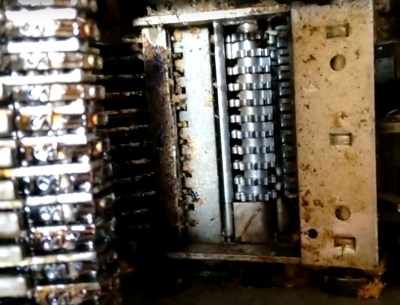
The Summa’s internals, showing the register on the right and the type wheels on the left.
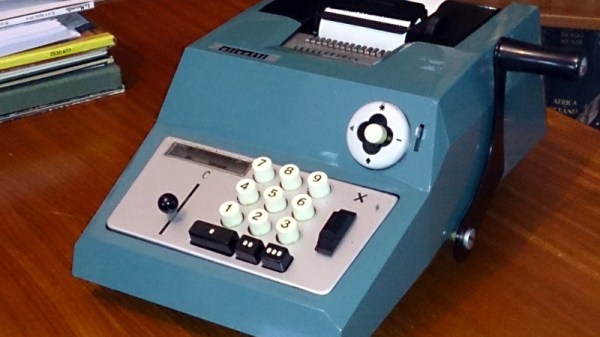
Somewhere in storage I have one of the models featured in the catalogue, an Olivetti Summa Prima. I happened upon it in a dumpster as a teenager looking for broken TVs to scavenge for parts, cut down a pair of typewriter ribbon reels to fit it, and after playing with it for a while added it to my store of random tech ephemera. It’s a compact and stylish desktop unit from about 1970, on its front is a numerical keypad, top is a printer with a holder for a roll of receipt paper and a typewriter-style rubber roller, while on its side is a spring-loaded handle from which it derives its power. It can do simple addition and subtraction in the old British currency units, and operating it is a simple case of punching in a number, pulling the handle, and watching the result spool out on the paper tape. Its register appears to be a set of rotors advanced or retarded by the handle for either addition or subtraction, and its printing is achieved by a set of print bars sliding up to line the correct number with the inked ribbon. For me in 1987 with my LCD Casio Scientific it was an entertaining mechanical curiosity, but for its operators twenty years earlier it must have represented a significant time saving.
The history of mechanical calculators goes back over several hundred years to Blaise Pascal in the 17th century, and over that time they evolved through a series of inventions into surprisingly sophisticated machines that were capable of handling financial complications surprisingly quickly. The Summa was one of the last machines available in great numbers, and even as it was brought to market in the 1960s its manufacturer was also producing one of the first desktop-sized computers. Its price in that 1975 Argos catalogue is hardly cheap but around the same as an electronic equivalent, itself a minor miracle given how many parts it contains and how complex it must have been to manufacture.
We’ve put two Summa Prima videos below the break. T.the first is a contemporary advert for the machine, and the second is a modern introduction to the machine partially narrated by a Brazilian robot, so consider translated subtitles. In that second video you can see something of its internals as the bare mechanism is cranked over for the camera and some of the mechanical complexity of the device becomes very obvious. It might seem odd to pull a obsolete piece of office machinery from a dumpster and hang onto it for three decades, but I’m very glad indeed that a 1980s teenage me did so. You’re probably unlikely to stumble upon one in 2019, but should you do so it’s a device that’s very much worth adding to your collection.
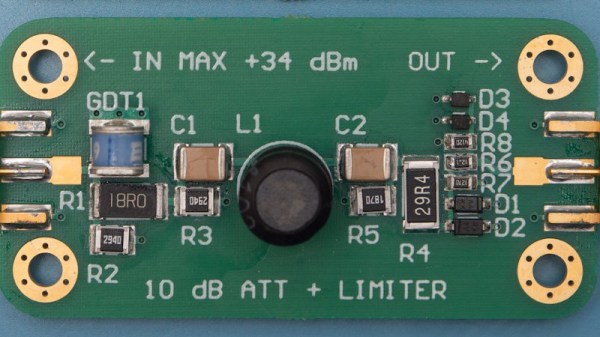
The HP 11947A is something of a footnote in the back catalogue of Hewlett Packard test equipment. An attenuator and limiter with a bandwidth in the megahertz rather than the gigahertz. It’s possible that few laboratories have much use for one in 2019, but it does have one useful property: a full set of schematics and technical documentation. [James Wilson] chose the device as the subject of a clone using surface mount devices.
The result is very satisfyingly within spec, and he’s run a battery of tests to prove it. As he says, the HP design is a good one to start with. As a device containing only passive components and with a maximum frequency in the VHF range this is a project that makes a very good design exercise for anyone interested in RF work or even who wishes to learn a bit of RF layout. At these frequencies there are still a significant number of layout factors that can affect performance, but the effect of conductor length and stray capacitance is less than the much higher frequencies typically used by wireless-enabled microcontrollers.
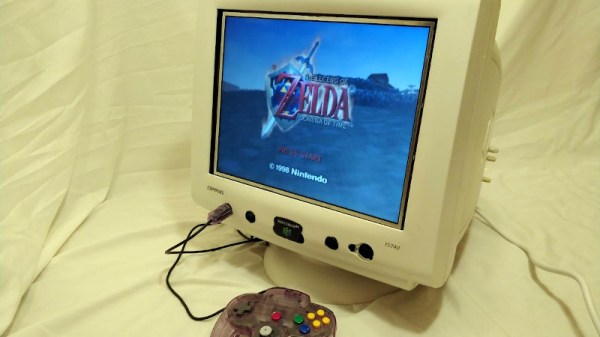
In 1997, chances are that if you didn’t have a Nintendo 64 already, you wanted one. (Never mind that the games cost the GDP of a small country.) It gave you both the supreme game designing talent of Shigeru Miyamoto and graphics that left the Sony behind. The trouble, though, was that like all consoles, the N64 required a large TV set and a load of wires. There was never a compact all-in-one version that integrated console, display, and speakers in the same package, and that was something [Mason Stooksbury] evidently considered to be a shame. A couple of decades late, he’s created the all-in-one Nintendo 64 appliance that the games giant never made in the ’90s, and we’re lucky enough to be able to take a look at it.
The starting point for the build is entirely in-period, the shell of a late-1990s Compaq CRT monitor. In the front goes a laptop display panel with a monitor conversion board, leaving plenty of space behind for a pair of full-size speakers. On top of the speakers sits a bare N64, with the controller ports brought out to the front panel below the screen. It’s not all retro though, there is also an HDMI converter and an HDMI output to drive a modern TV if desired. The N64 itself has an interesting backstory, it was his original console from back in the day that died following a lightning strike, and he brought it back to life decades later after some research revealed that the N64 PSU has a fuse.
Would an all in one ’64 have sold like hot cakes in ’97? Probably, and we’d be featuring all sorts of hacks on them today. As it is, portable N64s seem to feature most often here.
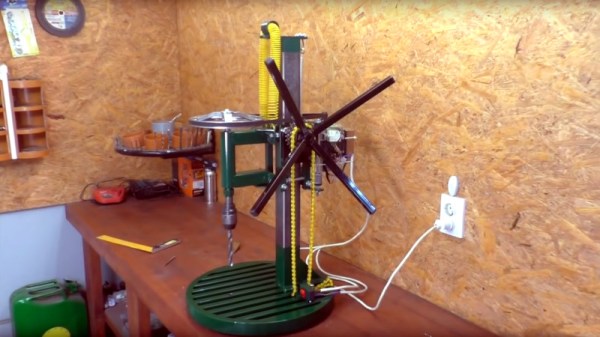
We are lucky to live in an age when tools have almost never been so affordable, when if we’d like a drill press on our benches we can pick one up for not a lot from our nearest discount store. If the cheapest tools aren’t very good quality then even the better ones aren’t that much more expensive. It’s evident that [Workshop DIY] has the resources to buy a decent drill press if he wanted one, but we’re fortunate that instead he’s taken the time to build one of his own from scratch (Russian language audio, Anglophones will have to enable YouTube subtitle translation).
The press itself is made entirely from box section steel tube, with what looks like 25mm square used for the base and 50mm for the vertical shaft. Instead of a rack and pinion to raise and lower the tool it has a slider that runs on a set of bearings and is lifted with a bicycle chain. The chuck itself is mounted to a shaft that runs through another set of bearings to the large pulley and motor from a washing machine. The result is a beautifully made drill press that seems to work very effectively. It may lack an adjustable table or selectable speeds, but we certainly couldn’t build it better than he has. Take a look, the video is below the break.
It shouldn’t be surprising what can be made in a well-appointed metalworking shop, perhaps we have been blinded by the convenience of readily available tools. If you’d like to see more, take a look at this DIY engine crane.