Is A Cheap Inverter Welder Worth It?

We’ve all seen cheap welders for sale from the usual online sources, small inverter stick welders for a very tempting price. But are they any good? When my local supermarket had one in its offers aisle, I took the plunge and placed it in my cart alongside the usual week’s supply of Marmite. That was some time around the start of the year.

Does Your Supermarket Sell Welders?

My Workzone welder from the supermarket.

What I’d bought from my local Aldi was a Workzone WWIW-80, an 80 A unit that had cost me somewhere just over £60 (about $75), and came with welding leads and a rather poor quality face shield. The German discount supermarket chains specialise in periodic offers on all kinds of interesting things, so a very similar unit has also been for sale with a Parkside brand from their competitor Lidl. These small inverter welders are fairly generic, so they can be found with a variety of brands and specifications at a lower price online if you don’t mind forgoing the generous Aldi 3 year guarantee. The cheapest I’ve seen was about £35, or $44, but that price included only the inverter, without welding leads.

As a working blacksmith my dad has had a high-quality inverter welder since the 1990s, so my frame of reference is based upon that. He tried one of the first tiny inverters when they originally came to market in the last decade, but it couldn’t take the demands of a professional welder and packed up. I thus didn’t have high expectations of this unit, but I needed one of my own and for the price it was worth the punt. I’ve used it for occasional general purpose heavy welding tasks, repairing bits of farm machinery and fittings, and rebuilding some steps on a narrowboat in 7 mm plate. It’s acquitted itself well in those tasks, in that I am not a skilled welder and my work isn’t the tidiest, but it’s allowed me to do a satisfactory job.

Continue reading “Is A Cheap Inverter Welder Worth It?”

The Miniware TS100 As A USB-C Soldering Iron

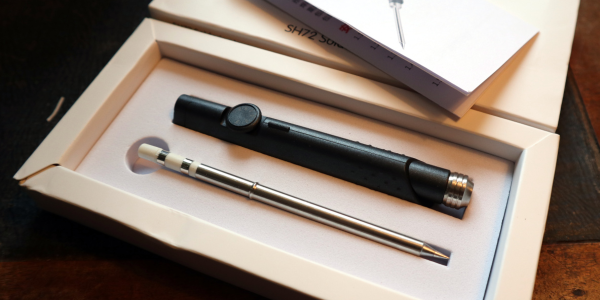
Many readers will be familiar with the Miniware TS100 soldering iron, a lightweight temperature-controlled iron that is giving significantly more expensive soldering tools a run for their money. There is another model in the range, the TS80, which though it uses different tips than its sibling has the main distinguishing feature of USB-C power rather than a DC barrel jack. A cadre of users still prefer the TS100 for this reason, as an iron that can run from almost any low voltage DC power source. Any except USB-C, that is, an omission that [thinkl33t] has rectified with a USB-C adapter for the older model.

To achieve this, he’s used a readily-available ZYPDS USB-to-DC module and attached it to a barrel jack. For now, it’s simply held on by solder with a bit of heat-shrink over the top. [Thinkl33t] observes that this may not prove to be strong enough and he’ll eventually have to put it on a bit of cable. It’s a simple enough hack, but it serves as a quick introduction to these parts which perform the necessary USB-C magic to deliver a DC supply, as well as to highlight the relative scarcity of higher-power USB supplies.

At the moment there’s an inevitable move to USB-C All The Things, but it’s a trend that it seems many manufacturers of power sources have yet to catch up with. When a typical TS-80 owner finds their shiny new USB-C battery bank is, in reality, an older 5V USB bank with a USB-C connector fitted, it’s no wonder that their friends prefer the TS100. We hope that coming years will see a greater range of USB-C power options, but until then we like the versatility of the barrel jack on the TS100. Especially now that it can so readily be made to take USB-C power.

We reviewed the TS100 back in 2017, and two years of using it since then have not changed our opinion of it.

Thanks to the several tipsters including [thinkl33t]  himself who sent us this.

An Arduino Enhances This 7400 CPU

How quickly could you make an entire computer from 74 series logic, from scratch? [Richard Grafton had only 30 days until the UK’s Retro Computer Festival and set out to design and build his Cambridge-1 computer in that time. The result is a machine spread across several breadboards, with neatly placed wiring and unexpectedly an Arduino Micro sitting in the corner. Isn’t the little Italian board a cheat? Not so, he says, because instead of being part of the computer itself it serves as a program loader to make putting software onto the machine from a PC as easy as possible.

The machine itself is simple enough, a 4-bit design with 8-bit data and address busses. There are only 16 instructions, and the clock speed is a relatively pedestrian 40Hz. This does, however, allow the many blinkenlights to show the machine’s state in a more visible manner. There’s a video which we’ve placed below the break, and if you have further questions you might like to look at the GitHub repository.

We like the Cambridge-1, and we see no problem with the Arduino being part of it. It doesn’t take away from the 74-driven nature of the machine. Instead, it enhances the usefulness of the device by facilitating coding on it. We’ve had huge quantities of TTL computers here over the years so it’s difficult to pick one to send you towards, however you may want to consider the 7400 as the original in the series.

Continue reading “An Arduino Enhances This 7400 CPU”

Intelligent Control For That Cheap Diesel Heater

If you own a caravan or a boat, you’ll know that keeping it warm can present something of a struggle. Open-flame gas heaters carry a risk of carbon monoxide poisoning, while solid fuel stoves are heavy and require safe flues. The prospect of a diesel heater then is enticing, bringing as they use a safer fuel and allow for easy external exhaust. Unfortunately they’ve been something of an expensive option, but the arrival of cheap imported heaters in recent years has made them an attractive choice. [Ray Jones] has improved upon their sometimes basic control electronics with the Afterburner, an intelligent controller that packs both ESP32 and HC-05 modules to both enhance the feature set and the connectivity of the devices.

The full list of capabilities is somewhat exhaustive but has a few stand-outs such as the ability to connect 1-wire temperature sensors to the system. It’s not compatible with all the heaters on the market, but there is a comprehensive guide to those models with which it can work. Meanwhile, all the code and other resources are available on GitLab should you wish to try it for yourself.

Diesel is something of a dirty word in 2019, but maybe biodiesel will save devices like this one.

Thanks [Bob] for the tip!

Flux Gate Magnetometers Make A Special Current Probe

There are moments when current measurement is required on conductors that can’t be broken to insert a series resistor, nor encircled with a current transformer. These measurements require a completely non-invasive technique, and to satisfy that demand there are commercial magnetometer current probes. These probes are however not for the light of wallet, so [ensgoldmine] has created a much cheaper alternative.

The Texas Instruments GRV425 flux gate magnetometer integrated circuit on its TI evaluation module provides the  measuring element placed at the tip of a probe as close as possible to the conductor to be measured, with another GRV425 module at the head of the probe to measure ambient magnetic field for calibration purposes.  An Arduino Due measures and processes the readings, chosen due to its higher-resolution ADC than the more ubiquitous Arduino Uno.

The write-up is interesting even if you have no need for a current probe, because of its introduction to these sensing elements. Because it’s a rare first for Hackaday, we’ve never taken a close look at them before other than as an aside when talking about a scientific instrument on Mars.

British Cops Catch Shooter-Printing Villain

It’s a perennial of breathless British tabloid scare reporting that 3D printers will unleash a tide of weapons upon the streets. But perhaps it might actually be time for Brits lock up their children, because London’s Metropolitan Police have announced their first prosecution for 3D printing a handgun. The gun pictured appears to be a Repringer 5-shot .22 revolver, and was found by police during a drugs raid.

The UK has significantly restrictive firearms legislation and shooting incidents are extremely rare in the country, so while this might not raise any eyebrows on the other side of the Atlantic it’s an extremely unusual event for British police. It appears that the builder was not the type of libre firearms enthusiast who has made the news with similar work in the USA, so it has to be assumed that it was printed purely as a means to secure an illegal firearm however rough-and-ready or indeed dangerous it might be.

Stepping aside from the firearm aspect of the story, it should be of concern for any British 3D printer enthusiasts. As we’ve reported over the years with respect to drone incidents they can sometimes throw reason to the wind when faced with unfamiliar technology, indeed we’ve already seen them imagining RepRap parts to be for a firearm. We’d counsel all parties to keep sane heads, and hope that both the sentence for today’s criminal proves to be a suitable deterrent, and that no clueless fool decides to download and print another weapon for the hell of it. As always, we’ll bring you developments as they happen.

3D Print A Complete Wind Generator

For many of us our landscapes are dotted with wind turbines, the vast majority of which are horizontally aligned as if they were giant aircraft propellers. A much rarer sight is the vertical wind turbine, which remains a staple of the wind power experimenter. [Troy] and his brother have posted a video showing a small wind 3D printed vertical turbine, which unusually includes an alternator made from scratch as well as the rotor itself.

The machine adopts a Savonius rotor design with three scoops, which offers simplicity and high torque at a lower rotational speed than some of the alternatives. The scoops are assembled from a number of 3D-printed sections, and directly drive the generator which uses a large number of coils on a stator encircled by a rotor containing an array of magnets. A simple rectifier and three-terminal regulator produces a 5-volt output.

Sadly there was not enough wind to give it a decent test for the video, but they demonstrate it with a very large fan standing in. We like the alternator design but we’d be interested to see how the sectional rotors hold up in outdoor conditions, and perhaps that regulator could benefit from a switch-mode component. If you fancy a go he says he’ll release the files as open source if there’s enough interest. We’re interested [Troy], please do!

Many wind turbines have passed through these pages over the years, and for contrast here’s a horizontal 3D printed example.

Continue reading “3D Print A Complete Wind Generator”