The Primordial Sinclair ZX Spectrum Emerges From The Cupboard

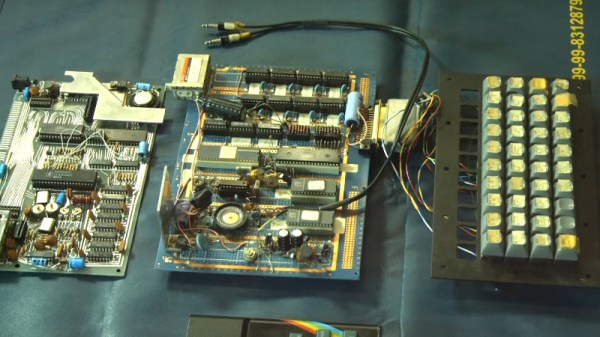
The Centre for Computing History in Cambridge, UK, receive many donations from which they can enrich their collection and museum displays. Many are interesting but mundane, but the subject of their latest video is far from that. The wire-wrapped prototype board they reveal with a flourish from beneath a folded antistatic mat is no ordinary computer, because it is the prototype Sinclair ZX Spectrum.

It came to the museum from Nine Tiles, a local consultancy firm that had been contracted by Sinclair Research in the early 1980s to produce the BASIC ROM that would run on the replacement for their popular ZX81 home microcomputer. The write-up and the video we’ve placed below the break give some detail on the history of the ROM project, the pressures from Sinclair’s legendary cost-cutting, and the decision to ship with an unfinished ROM version meaning that later peripherals had to carry shadow ROMs with updated routines.

The board itself is a standard wire-wrap protoboard with all the major Spectrum components there in some form.  This is a 16k model, there is no expansion connector, and the layout is back-to-front to that of the final machine. The ULA chip is a pre-production item in a ceramic package, and the keyboard is attached through a D connector. Decent quality key switches make a stark contrast to the rubber keys and membrane that Spectrum owners would later mash to pieces playing Daley Thompson’s Decathlon.

This machine is a remarkable artifact, and we should all be indebted to Nine Tiles for ensuring that it is preserved for those with an interest in computing to study and enjoy. It may not look like much, but that protoboard had a hand in launching a huge number of people’s careers in technology, and we suspect that some of those people will be Hackaday readers. We’ll certainly be dropping in to see it next time we’re in Cambridge.

If you haven’t been to the Centre for Computing History yet, we suggest you take a look at our review from a couple of years ago. And if prototype home computers are your thing, this certainly isn’t the first to grace these pages.

Continue reading “The Primordial Sinclair ZX Spectrum Emerges From The Cupboard”
The Cat, The Aircraft, And The Tiny Computer

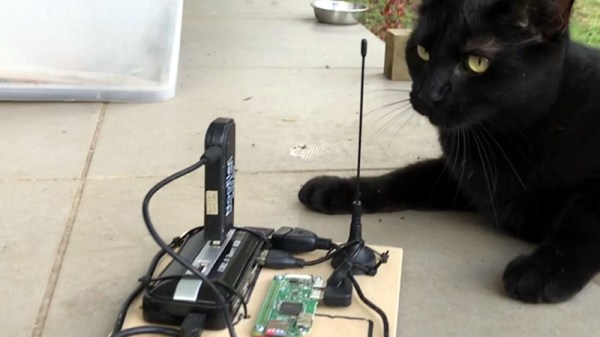
Sharing your life with a cat is a wonderful and fulfilling experience. Sharing your life with an awake, alert, and bored cat in the early hours when you are trying to sleep, is not. [Simon Aubury] has just this problem, as his cat [Snowy] is woken each morning by a jet passing over. In an attempt to identify the offending aircraft, he’s taken a Raspberry Pi and a software-defined radio, and attempted to isolate it by spotting its ADS-B beacon.

The SDR was the ubiquitous RTL chipset model, and it provided a continuous stream of aircraft data. To process this data he used an Apache Kafka stream processing server into which he also retrieved aircraft identifying data from an online service. Kafka’s SQL interface for interrogating multiple streams allowed him to untangle the mess of ADS-B returns and generate a meaningful feed of aircraft. This in turn was piped into an elasticsearch search engine database, upon which he built a Kibana visualisation.

The result was that any aircraft could be identified at a glance, and potential noise hotspots forecast. Whether all this heavy lifting was worth the end result is for you to decide, however it does provide an interesting introduction to the technologies and software involved. It is however possible to monitor ADS-B traffic considerably more simply.

Thanks [Oleg Anashkin] for the tip.

Talk To Your ‘Scope, And It Will Obey

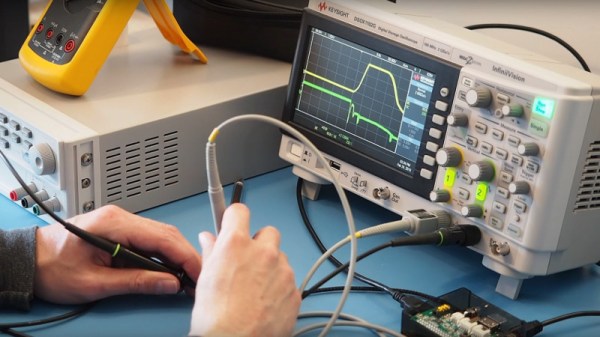
An oscilloscope is a device that many of us use, and which we often have to use while our hands are occupied with test probes or other tools. [James Wilson] has solved the problem of how to control his ‘scope no-handed, by connecting it to a Raspberry Pi 3 running the snips.ai voice assistant. This is an interesting piece of software that runs natively upon the device in contrast to the cloud service provided by the likes of Alexa or Google Assistant.

The ‘scope in question is a Keysight 1000-X that can be seen in the video below the break, but looking at the Python code we could imagine the same technique being brought to other instruments such as the Rigol 1054z we looked at controlling via USB a year or two ago. The use of the snips.ai software provides a pointer to how voice-controlled projects in our community might evolve beyond the cloud services, interestingly though they do not make a big thing of it their software appears to be open-source.

Oscilloscopes do not have to be remotely controlled by voice alone. It seems to be a common desire to take measurements no-handed — one project we’ve featured in the past did the job with a foot switch.

Continue reading “Talk To Your ‘Scope, And It Will Obey”

This Vintage Op-Amp Opens A Fascinating Window Into Semiconductor History

We have covered enough of the work of [Ken Shirriff] on these pages to know that when he publishes something, it will be a fascinating read and work of the highest quality. And so it is with his latest, a very unusual op-amp on which he performs his usual reverse engineering. Not only does it lead us directly to some of the seminal figures in the early years of the semiconductor industry, it turns out to have been a component manufactured to a NASA specification and of which there is an example on the Moon.

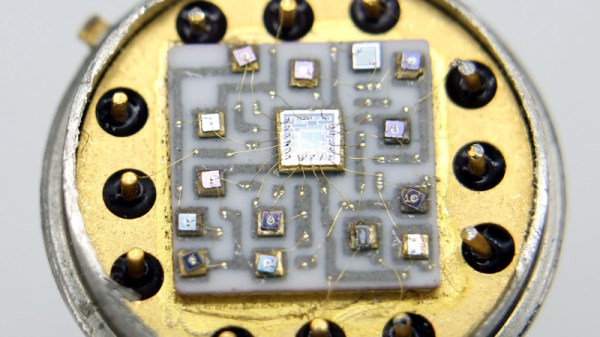
The metal can revealed a hybrid circuit when the lid was removed, one in which individual transistors were wired together with a single block containing a group of thin-film resistors. At the start of the 1960s the height of consumer electronics would have been your domestic TV which would have been an all-tube affair, so while it sounds archaic this would truly have been a space-age piece of technology. The designer is revealed as the legendary [Bob Pease], and the transistors take us back to the semiconductor physicist [Jean Hoerni], inventor of the planar transistor and one of the famous eight defectors from Shockley Semiconductor in the 1950s who kick-started the semiconductor boom.

The op-amp itself is a relatively simple design without the compensation capacitor you might expect in a modern device, but what makes it unusual for its time is the use of [Hoerni]’s planar JFETs at its input. [Ken]’s analysis is as usual extremely thorough, and the bit of Silicon Valley history it gives us is the icing on the cake.

If you have a thirst for ancient op-amps, you might like our look at the first commercially available fully-integrated design, the Fairchild μA702.

The FAA Mandates External Registration Markings For Drones

Drone fliers in the USA must soon display their registration markings on the exterior of their craft, rather than as was previously acceptable, in accessible interior compartments. This important but relatively minor regulation change has been announced by the FAA in response to concerns that malicious operators could booby-trap a craft to catch investigators as they opened it in search of a registration. The new ruling is effective from February 25th, though they are inviting public comment on it.

As airspace regulators and fliers across the world traverse the tricky process of establishing a safe and effective framework for multirotors and similar craft we’ve seen a variety of approaches to their regulation, and while sometimes they haven’t made complete sense and have even been struck down in the courts, the FAA’s reaction has been more carefully considered than that in some other jurisdictions. Rule changes such as this one will always have their detractors, but as an extension of a pre-existing set of regulations it is not an unreasonable one.

It seems inevitable that regulation of multirotor flight will be a continuing process, but solace can be taken at the lower end of the range. A common theme across the world seems to be a weight limit of 250 g for otherwise unrestricted and unregistered craft, and the prospects for development in this weight category in response to regulation are exciting. If a smaller craft can do everything our 2 kg machines used to do but without the burden of regulation, we’ll take that.

An ATtiny Metal Detector

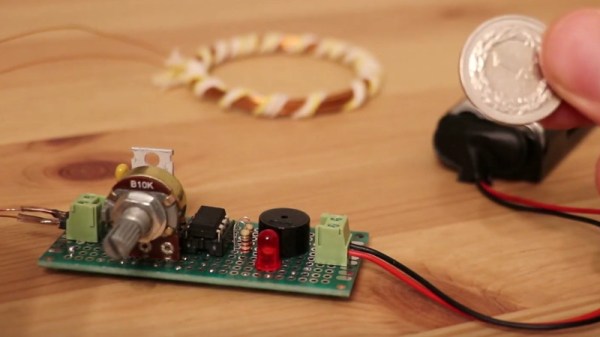
A metal detector used to be an entirely analogue instrument, an oscillator whose frequency changed with the inductance of its sense coil when a piece of metal approached. [Łukasz Podkalicki] shows us a more sophisticated machine, but with judicious use of an ATtiny 13 it is not a complex one.

A pulsed induction metal detector induces a current spike in its search coil, and times the decay of the resulting oscillation. The coil is part of a resonant circuit with a capacitor, and any metal in its field will change its resonant frequency. In [Łukasz]’s design the ATtiny13 fires a pulse at his coil using a MOSFET, and the voltages at the coil are sensed by an analogue pin through an appropriate clamp circuit. His software does the timing, and sounds a buzzer upon metal detection. It’s a deliciously simple implementation, and while as he shows us in the video below the break its relatively small coil is more suited to detecting coins or wires behind the drywall than locating lost hoards, there is probably ample scope for further experimentation.

This isn’t the first project from [Łukasz] that has found its way into these pages, his history with the ATtiny13 goes back a few years.

Continue reading “An ATtiny Metal Detector”

Hands-on: Hacker Hotel 2019 Badge Packs ESP32, E-Ink, And A Shared Heritage

When you go to a hacker conference, you always hope there’s going to be a hardware badge. This is an interactive piece of custom electronics that gets you in the door while also delighting and entertaining during the con (and hopefully far beyond it).

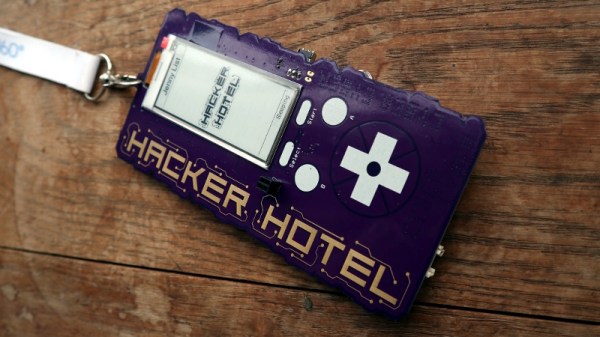
Hot off the presses then is the Hacker Hotel badge, from the comfortable weekend hacker camp of that name in a Netherlands hotel. As we have already noted, this badge comes from the same team that created the SHA2017 hacker camp’s offering, and shares that badge’s display, ESP32 processor, battery, and firmware. The evolution of that firmware into the badge.team platform is an exciting development in its own right, but in the context of this badge it lends a very familiar feel to the interface for those attendees who were also at the 2017 event.

Continue reading “Hands-on: Hacker Hotel 2019 Badge Packs ESP32, E-Ink, And A Shared Heritage”