Speak Your WiFi

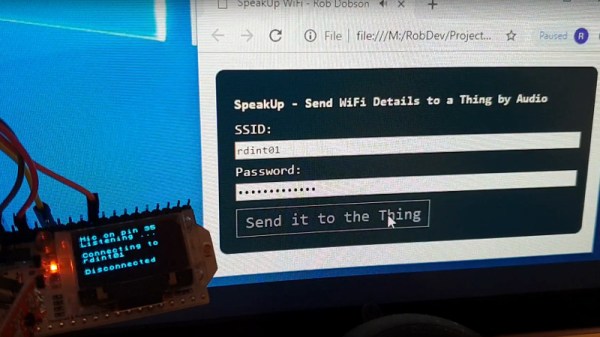
When you create a Thing for the Internet of Things, you’ve made a little computer that does a simple job and which probably has a minimal interface. But minimal interfaces leave little room for configuration, such as entering WiFi details. Perhaps if you made the Thing yourself you’ve hard-coded your WiFi credentials in your code, but that hardly translates to multiple instances. So, how to put end-user WiFi credentials easily on more than one Thing? Perhaps [Rob Dobson] has the answer with his technique of sending them as a sequence of audible tones.

There is a piece of Javascript code in a browser into which you enter your WiFi credentials, which are then expressed through the speaker as a set of FSK tones to be picked up by a microphone on the Thing. They can then be decoded into the credentials, and the Thing can connect. All the code is available, on GitHub, should you fancy it yourself.

Of course, this is nothing new, as any owner of an 8-bit machine that had a cassette interface will tell you. And on the face of it it’s much easier than those awkward impromptu hotspots with a web interface to which you connect and pass on your credentials. But while we quite like the convenience, we can’t help wondering whether expressing the credentials in audible free space might be a bit too insecure for many readers. The technique however remains valid, and we’re sure that other less sensitive applications might be found for it. Meanwhile we hope he hasn’t inadvertently shared his WiFi password in the video below the break.
Continue reading “Speak Your WiFi”

A Bluetooth Upgrade For An Unusual Set Of Headphones

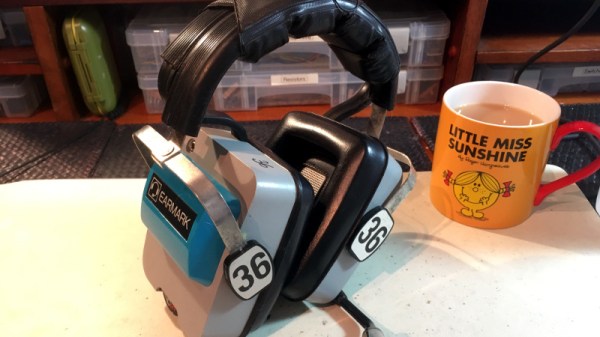
We will have all picked up something from a junk pile or swap meet in our time that caught our eye not because we needed it but because it looked cool. [Quinn Dunki] did just that with an irresistible set of 1980s air traffic control headphones. What did she do with them? Turn them into a set of Bluetooth headphones of course!

The ‘phones in question are particularly interesting, as they turned out upon inspection to be a two-way radio in disguise. Cracking them open revealed a radio board and a logic board, and what makes them particularly interesting to this Hackaday scribe’s eye is their choice of frequency. She finds a crystal with a VHF airband frequency multiplier and concludes that they must operate there, but a look at the photos reveals all the ingredients of a classic AM or low HF receiver. There is a ferrite rod antenna and a variable capacitor, if we didn’t know that these were very high-end professional ‘phones we’d almost suspect they were a novelty AM radio from Radio Shack. If any readers can shed any light on the frequency and purpose of this device, we’re all ears.

The conversion involved a Sparkfun Bluetooth module breakout board paired with a little audio power amplifier. The original drivers were high-impedance and one of them had died, so she replaced them with a modern pair of identical size. The control buttons were mounted in the headphone’s external housing, after a wrong turn into attempting to create a custom enclosure. The result is a rather novel but high-quality set of ‘phones, and one we rather wish we’d found ourselves.

EMMC Data Recovery From A Bricked Phone

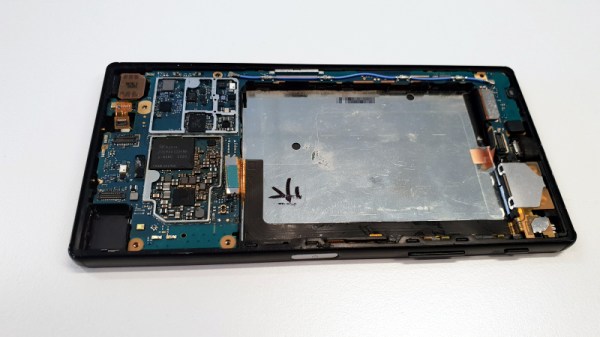
We’ve probably all got at least one old cell phone lurking somewhere around our bench. In most cases they’ll still work, but their  batteries may be exhausted and their OS could be an ancient version. But sometimes there will be a phone that just died. One minute the flagship model, the next a useless slab of plastic and glass with the added annoyance of those priceless photos of Aunty May’s 80th forever locked in its memory.

[Andras Kabai] had just such a device land on his desk, a high-end Sony whose screen had gone blank. Others had tried, he was the last hope for the data it contained. He zoomed in on the eMMC chip on its motherboard, desoldered it and hooked it up via a specialist eMMC reader to recover those files. That was a very simple description of a far more involved process that he sets out in his post about it, a post that is fascinating reading and serves as a handy primer for any reader who might like to try it for themselves. We learn about the MMC interface and how simple it can be in its serial form, how with some fine soldering you can use a cheap USB reader, and that eMMC chips have a pinout conforming to a JEDEC standard.

Finally we see the software side as he takes the various SQLite databases and extracts the data for the user. It shows, all is not necessarily lost, however dead a phone may be.

We’ve seen [Andras] before, using an old scanner in his PCB fab.

Shedding A Bit Of Light On Some Logic

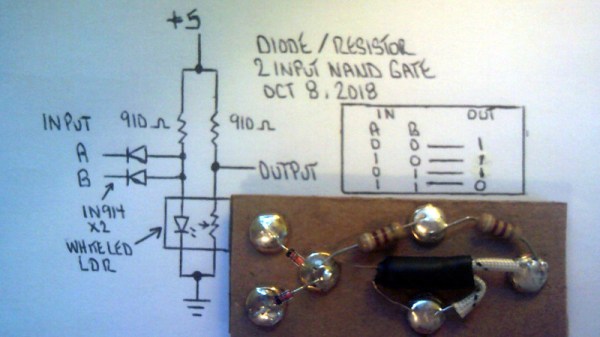
When it comes to logic technologies, we like to think we’ve seen them all here at Hackaday. But our community never ceases to surprise us with its variety and ingenuity, so it should be a surprise that [Dr Cockroach] has delivered one we’ve not seen before. Light logic doesn’t use the conventional active devices you’d expect such as transistors, tubes, or even relays. Instead, it uses LEDs and CdS cells to make rudimentary switches. So far there is a NAND, a NOR, and a set-reset latch that appears in the video below the break, and it is not inconceivable that much more complex devices could be crafted.

The CdS cell switch is not too far different in operation to a transistor, with the CdS cell forming half of a potential divider as a rough equivalent of a collector-emitter circuit, and the LED feeding its light to the cell and forming a rough equivalent of a base circuit. It would probably not form a very good analog of a transistor and it seems likely that is will not be the fastest of devices, but we applaud the ingenuity in coming up with it.

CdS cells are a component that seems almost to come from another era, redolent of childhood electronic kits from days of yore. It’s no surprise we don’t see them too often, though, they pop up in the occasional automatic sunglasses.

Continue reading “Shedding A Bit Of Light On Some Logic”

Tiny Telescope For Simple Radio Astronomy

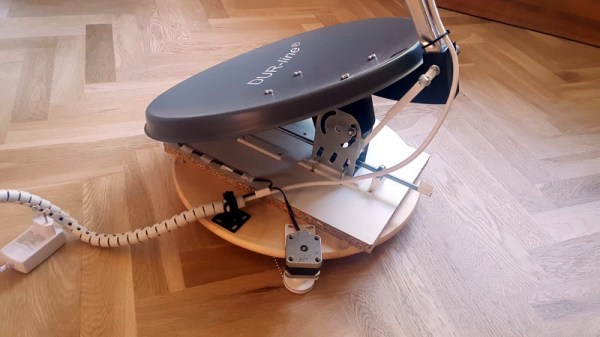
We are used to imagining radio telescopes as immense pieces of scientific apparatus, such as the Arecibo Observatory in Puerto Rico, or the Lovell telescope in the UK. It’s a surprise then that they can be constructed on a far more modest sale using off-the-shelf components, and it’s a path that [Gonçalo Nespral] has taken with his tiny radio telescope using a satellite dish. It’s on an azimuth-elevation mount using an Ikea lazy susan and a lead screw, and it has a satellite TV LNB at the hot end with a satellite finder as its detector.

So far he’s managed only to image the wall of his apartment, but that clearly shows the presence of the metal supporting structure within it. Taking it outdoors has however not been such a success. If we wanted to hazard a guess as to why this is the case, we’d wish to look at the bandwidth of that satellite finder. It’s designed to spot a signal from a TV broadcast bird over the whole band, and thus will have a bandwidth in the hundreds of MHz and a sensitivity that could at best be described as a bit deaf. We hope he’ll try a different path such as an RTL-SDR in the future, and we look forward to his results.

This isn’t the first simple radio telescope we’ve seen here, aside from at least one other LNB-based one we’ve also shown you a WiFi device.

Save A Linotype Machine For Future Generations

The journalist’s art is now one of the computer keyboard and the internet connection, but there was a time when it involved sleepless nights over a manual typewriter followed by time spent reviewing paper proofs freshly inked from hot lead type. Newspapers in the golden age of print media once had entire floors of machinery turning text into custom metal type on the fly, mechanical masterpieces in the medium of hot lead of which Linotype were the most famous manufacturer.

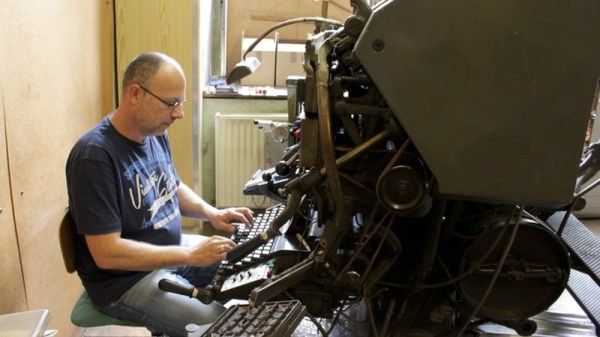
Computerised desktop publishing might have banished the Linotype from the newsroom in the 1970s or 1980s, but a few have survived. One of the last working Linotypes in Europe can be found in a small print workshop in Vienna, and since its owner is about to retire there is a move to save it for posterity through a crowdfunding campaign. This will not simply place it in a museum as a dusty exhibit similar to the decommissioned Monotype your scribe once walked past every day in the foyer of the publishing company she then worked for, instead it will ensure that the machine continues to be used on a daily basis producing those hot metal slugs of type.

Fronting the project is [Florian Kaps], whose pedigree in the world of resurrecting analogue technologies was established by his role in saving the Polaroid film plant in Enschede, Netherlands. There are a variety of rewards featuring Linotype print, and at the time of writing the project is 46% funded with about four weeks remaining. If you are curious about the Linotype machine and its operation, we’ve previously brought you an account of the last day of hot metal printing at the New York Times.

A New Kid On The Mini ARM Block

The breadboard microcontroller experimenter has a host of platforms to work with that can be had in the familiar DIP format. Old-school people can still find classic 8-bit platforms, the Ardunisti have their ATMegas, and PIC lovers have a pile of chips to choose from. But ARM experimenters? Out of luck, because as we have previously reported, popular past devices such as the LPC810 in a DIP8 package are now out of production.

News comes from China though of a tiny ARM Cortex M0 for pennies that may not be in a DIP8, but is in almost the next best thing. The Synwit SWM050 can be had in a TSOP8, which though it’s not quite as friendly as its larger SOIC8 cousin, is still easily solderable onto a DIP8 adaptor for breadboard use. Spec-wise it’s 5 V tolerant, has an 8 kB FLASH and 1 kB of RAM, 6 GPIOs, and can clock away at a not incosequential 36 MHz.

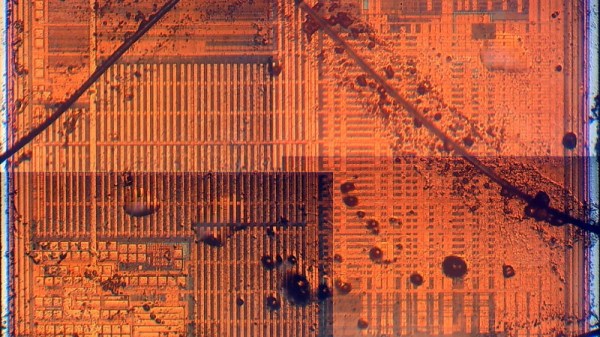
We have [Sjaak] to thank for the discovery of this device, and for doing a lot of work including getting some die shots taken to dig up and make sense of the Chinese documentation, and to provide some dev tools should anyone want to play with it.  There’s even a small breakout board for the experimenter unwilling to design their own.

Earlier this year we marked the passing of the DIP8 version of the LPC810 microcontroller, and for those mourning it we made an important point. It’s now normal to use one of the vast array of single board computers instead of a bare microcontroller, you might wish to ask yourself why you would do so.

Thanks [Ziew] for the tip.