Putting Crimpers To The Test: How Good Are Our Crimp Tools?

Almost every project of mine from the last quarter century, if it has contained any wiring, has featured somewhere at least one crimp connector. There are a multiplicity of different types of crimp, but in this case I am referring to the ubiquitous variety with a red, blue, or yellow coloured plastic sleeve denoting the wire size they are designed for. They provide a physically robust and electrically sound connection that is resistant to wire fatigue due to vibration, and that can carry hefty currents at high voltages without any problems.

You might expect this to now head off into the detail of crimp connection, but my colleague Dan has already detailed what makes a good or a bad crimp. Instead recently my constant searches for weird and wonderful things to review for your entertainment led me to a new crimp tool, and thence to a curiosity about the effectiveness of different styles of tool. So I’m going to evaluate the three different crimping methods available to me, namely my shiny new ratchet crimp pliers, my aged simple crimp pliers, and for comparison an ordinary pair of pliers. I’ll take a look at the physical strength of each crimping method followed by its electrical effectiveness, but first it’s worth looking at the tools themselves.

Continue reading “Putting Crimpers To The Test: How Good Are Our Crimp Tools?”

The Electric Vehicles Of EMF Camp

There is joy in the hearts of British and European hardware and software hackers and makers, for this is an EMF Camp year. Every couple of years, our community comes together for three summer days in a field somewhere, and thanks to a huge amount of work from its organizers and a ton of volunteers, enjoys an entertaining, stimulating, and engrossing hacker camp.

One of the features of a really good hacker camp are the electric vehicles. Not full-on electric cars, but personal camp transport. Because only the technically inept walk, right? From Hitchin’s Big Hak to TOG’s duck, with an assortment of motorized armchairs and beer crates thrown in, these allow the full creativity of the hardware community free rein through the medium of overdriven motors and cheap Chinese motor controllers.

This year at EMF Camp there will be an added dimension that should bring out a new wave of vehicles, there will be a Hacky Racers event. Novelty electric vehicles will compete for on-track glory, will parade around the camp, and will no doubt also sometimes release magic smoke. There is still plenty of time to enter, so if you’re going to EMF, get building!

We have an interest in these little electric vehicles, not least because there may well be a Hackaday-branded machine on the tarmac. We’d like to feature some of them over the weeks running up to the event, so if you are building one and have a write-up handy, please tell us about it in the comments. Charge your batteries, and we’ll see you there!

Header image: [Mark Mellors], with permission.

Is This The World’s Smallest Computer?

How small could you make a computer? In a way, that’s a question that requires that a computer be defined, because you could measure the smallest computer simply in terms of the smallest area of silicon required to create a microprocessor. So perhaps it’s better to talk about a smallest working computer. Recent entries in the race for the smallest machine have defined a computer as a complete computer system which holds onto its program and data upon power-down, but this remains one that is hotly debated. You might for instance debate as to whether that definition would exclude machines such as the crop of 1980s home computers that didn’t store their programs and data, was your Sinclair Spectrum not a computer?

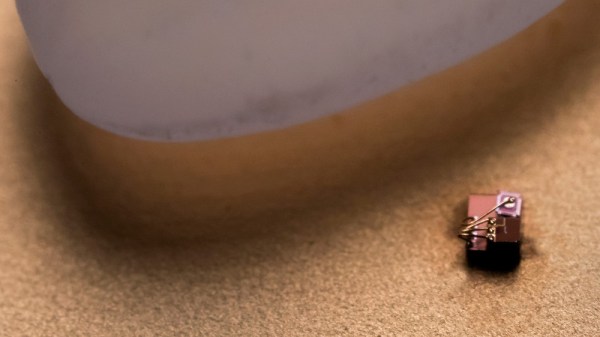
At the University of Michigan they have opted for the simpler definition with their latest entry in the race to be the tiniest. Their latest machine packs an ARM Cortex M0 into a 0.3mm cube, along with photoreceptors and LEDs for programming, data throughput, and power. It is designed to be a temperature sensor and logger for medical implantation, but it stands more as a demonstration of technological prowess than as a usable product.

Pictures of a tiny computer “dwarfed by a grain of rice” make for good mass media consumption but where’s the relevance for us? The interesting part comes from the tantalizing glimpse of its construction: this is a hybrid device upon which we can see the optoelectronic components have been wire-bonded. Unfortunately the paper, catchily titled “A 0.04mm3 16nW Wireless and Batteryless Sensor System with Integrated Cortex-M0+ Processor and Optical Communication for Cellular Temperature Measurement” does not appear to be free-to-view online, so we don’t have any more information. We wish that such feats were possible within our community, but suspect those days are still pretty far away.

ROPS Will Be The Board X86 Robot Builders Are Waiting For

If your robot has outgrown a Raspberry Pi and only the raw computing power of an x86 motherboard will suffice, you are likely to encounter a problem with its interfaces. The days of ISA cards are long gone, and a modern PC is not designed to easily talk to noisy robot hardware. Accessible ports such as USB can have interfaces connected to them, but suffer from significant latency in the process.

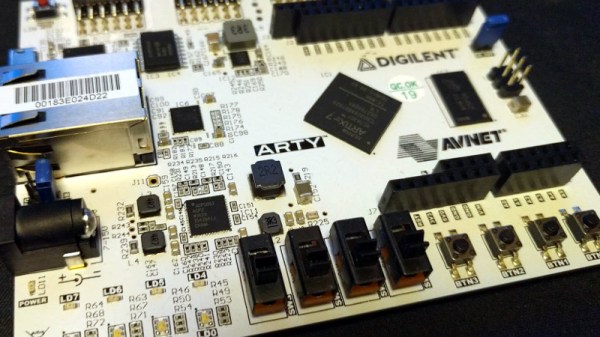
A solution comes from ROPS, or Robot on a PCI-e Stick, a card that puts an FPGA on a blazing-fast PCI-e card that provides useful real-world interfaces such as CAN and RS485 and a pile of I/O lines as well as an IMU, barometer, and GPS. If you think you may have seen it before then you’d be right, it was one of the first-round winners of the Open Hardware Design Challenge. They’re very much still at the stage of having an FPGA dev board and working out the software so there aren’t any ROPS boards to look at yet, but this is a project that’s going somewhere, and definitely one to watch.

A MIDI Sequencer To Be Proud Of

MIDI sequencers are surprisingly expensive, making them an excellent target for [RH Electronics] who has created a sixteen-step device. It supports up to eight playable parts per step, which can be either MIDI or drum triggers.

The case and front panel are built to a very high standard, and on a piece of stripboard within lies an ATmega644 which does all the MIDI work, an ATmega328 that runs the many LEDs, and an ATtiny85 that reads the front panel buttons. The whole is kept in sync by a timer on the 644 set to produce the required MIDI clock. There is an LCD display too, which carries the status and programming interface.

You can see the result in the video below the break, in which the sequencer is put through its paces alongside a tantalising glimpse of a matching synthesiser. Is this another project, or a commercial device on which Google fails us when we try to find it? Meanwhile this is certainly not the first MIDI sequencer we’ve brought you here at Hackaday, this Arduino one is another example of several also using Atmel parts.

Continue reading “A MIDI Sequencer To Be Proud Of”

A Cleverly Concealed Magnetic Loop Antenna

We’re sure all radio amateurs must have encountered the problem faced by [Alexandre Grimberg PY1AHD] frequently enough that they nod their heads sagely. There you are, relaxing in the sun on the lounger next to the crystal-blue pool, and you fancy working a bit of DX. But the sheer horror of it all, a tower, rotator, and HF Yagi would ruin the aesthetic, so what can be done?

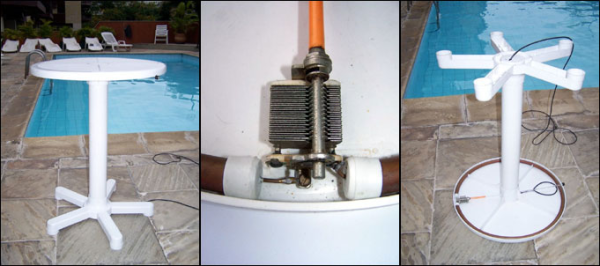
[Alexandre]’s solution is simple and elegant: conceal a circular magnetic loop antenna beneath the rim of a circular plastic poolside table. Construction is the usual copper pipe with a co-axial coupling loop and a large air-gapped variable capacitor, and tuning comes via a long plastic rod that emerges as a discreet knob on the opposite side of the table. It has a 10 MHz to 30 MHz bandwidth, and should provide a decent antenna for such a small space. We can’t help some concern about how easy to access that capacitor is, on these antennas there is induced a surprisingly large RF voltage across its vanes, and anyone unwary enough to sit at the table to enjoy a poolside drink might suffer a nasty RF burn to the knee. Perhaps we’d go for a remotely tuned model instead, for this reason.

[Alexandre] has many unusual loop projects under his belt, as well as producing commercial loops. Most interesting to us on his YouTube feed is this one with a capacitor formed from co-axial soft drink cans.

Thanks [Geekabit] for the tip.

There’s RC2014 Life In The TMS9918A Display Chip Yet

One of the outliers in the home computer wars of the early 1980s was the Texas Instruments TI99/4A. It may not have had the games library of its rivals and its TMS9900 processor may not have set the world on fire with its registers-in-RAM architecture, but its range of support chips included one whose derivatives would go on to delight subsequent generations. If you had an MSX or one of the 8 or 16-bit Sega consoles, the TMS9918A graphics chip provided the architecture that sat behind Sonic in his adventures.

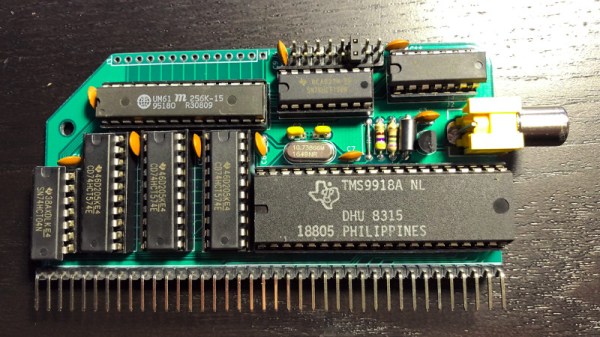
A few decades later, there is still significant interest in this classic chip. [J.B. Langston] has an RC2014 retrocomputer, and wishing to play MSX demos upon it, has created a TMS9918A-based graphics card for the RC2014 bus. The success of the board hinges upon a circuit showing how to interface the 9918A to SRAM, and since it is mapped to the same ports as its MSX equivalent it should in theory be compatible with Z80 demos written for that platform. He’s already achieved some success with that aim, as can be demonstrated by the video we’ve placed below the break of the Bold MSX demo running on an RC2014.

The RC2014 has gained a significant following in the retrocomputer scene, and has appeared here many times. We reviewed an early model in 2016. Surprisingly though the TMS9918A has only appeared here once, as part of a homebrew 6809-based system.

Continue reading “There’s RC2014 Life In The TMS9918A Display Chip Yet”