DIY CNC Sandblaster Writes Large

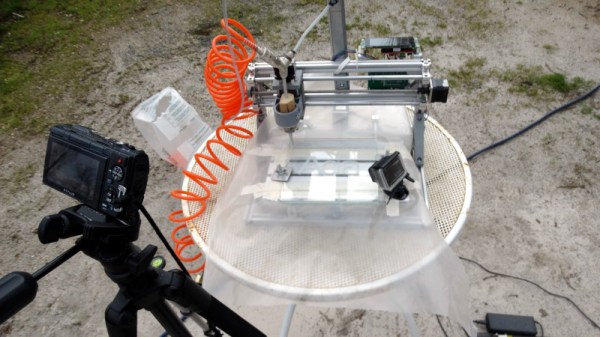
CNC machinery, once a piece of workshop exotica, has become such a staple of projects within our sphere as to have become relatively unremarkable. A decent 3D printer can be had without mortgaging a small country, and the honor roll of CNC router builders is long and distinguished. But there is still plenty to surprise us in CNC, and [Fabien Chouteau]’s project shows us this with surprising simplicity. He’s eschewed a router or extruder, and instead fit an off-the-shelf CNC machine kit with a sandblaster.

If you are used to a sandblaster as a means for removing rust from pieces of your motor vehicle, then it’s fair to say that this one isn’t of that ilk. Instead, it’s used in the manner of an engraver, to sandblast a pattern or text onto a surface. This is something he shows us in the video below the break, with a piece of metal and a sheet of glass.The sandblaster itself features a 1.5-litre soda bottle and is driven by an airline.

On the electronic side, he replaced the controller that came with the kit with an STM32F469 discovery board and an Arduino CNC shield. He has a G-code controller from a previous project, to which he’s added a board with a touch screen to create a simple control interface.

This is by no means the only sandblaster we’ve featured, if your interests lie in that direction we can show you everything from the simple to the extreme.
Continue reading “DIY CNC Sandblaster Writes Large”

Retrofit Temperature Control To A Soldering Station

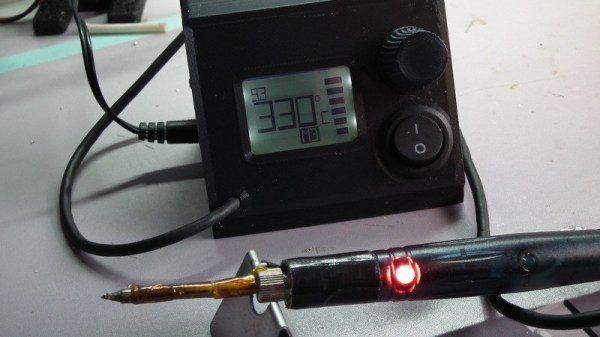
We’ve probably all seen USB soldering irons advertised for very little money, and concluded that they might not necessarily be the most useful of tools. The cheapest of these lack any real temperature regulation. Enter [Paulo Bruckmann], who has attached a thermistor to his iron with Kapton tape, added an Arduino Uno clone with rotary encoder and Nokia LCD, and put the result in a 3D printed case for a tiny and low powered temperature controlled soldering station. The claimed cost is only $10, which seems credible given the low price of Arduino clones.

The software provides the expected PID control, with the advantage of very quick warm-up due to the tip’s tiny size. The power source is 9 V rather than a USB 5 V, so the combination gives an iron capable of working on much larger joints than when unmodified. He therefore seems to have created what appears to be a significantly more capable iron from this unpromising start, something we find quite impressive. Take a look at his video below the break.

We reviewed one of these little irons last year, and found it to be a toy, but not a joke. Meanwhile we’ve seen some other mods for them, including a pair of desoldering tweezers.

Continue reading “Retrofit Temperature Control To A Soldering Station”

Won’t Somebody, Please, Think Of The Transistors!

At what age did you begin learning about electronics? What was the state of the art available to you at the time and what kinds of things were you building? For each reader these answers can be wildly different. Our technology advances so quickly that each successive generation has a profoundly different learning experience. This makes it really hard to figure out what basic knowledge today will be most useful tomorrow.

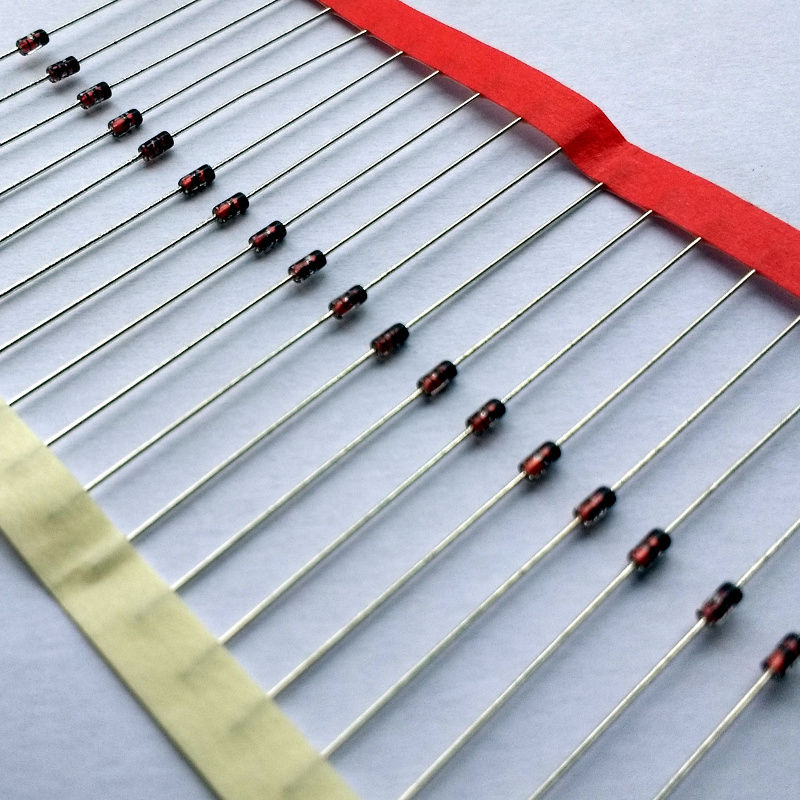
Go on, guess the diode!

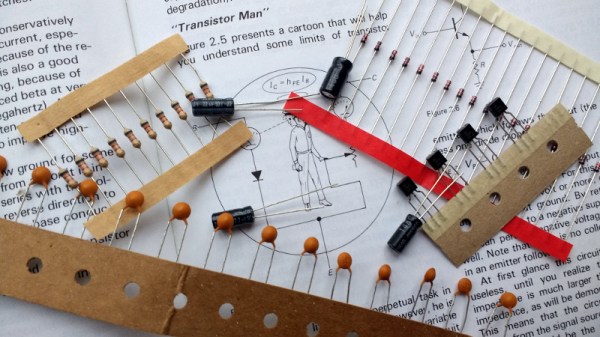
Do you know the forward voltage drop of a diode? Of course you do. Somewhere just below 0.7 volts, give or take a few millivolts, of course given that it is a silicon diode. If you send current through a 1N4148, you can be pretty certain that the cathode voltage will be that figure below the anode, every time. You probably also have a working knowledge that a germanium diode or a Schottky diode will have a lower forward voltage, and you’ll know in turn that a bipolar transistor will begin to turn on when the voltage between its base and emitter achieves that value. If you know Ohm’s Law, you can now set up a biasing network and without too many problems construct a transistor amplifier.

Continue reading “Won’t Somebody, Please, Think Of The Transistors!”

Firefox Reality, A Browser For VR Devices

The browser you are reading this page in will be an exceptionally powerful piece of software, with features and APIs undreamed of by the developers of its early-1990s ancestors such as NCSA Mosaic. For all that though, it will very probably be visually a descendant of those early browsers, a window for displaying two-dimensional web pages.

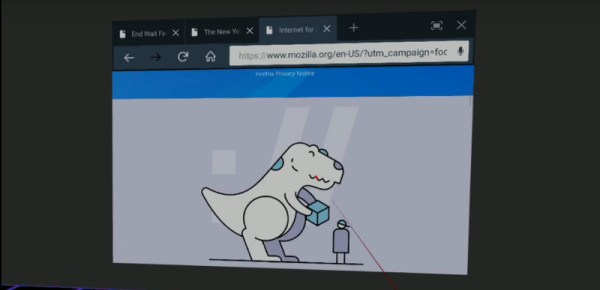
Some of this may be about to change, as in recognition of the place virtual reality devices are making for themselves, Mozilla have released Firefox Reality, in their words “a new web browser designed from the ground up for stand-alone virtual and augmented reality headset“. For now it will run on Daydream and GearVR devices as a developer preview, but the intended target for the software is a future generation of hardware that has yet to be released.

Readers with long memories may remember some of the hype surrounding VR in browsers back in the 1990s, when crystal-ball-gazers who’d read about VRML would hail it as the Next Big Thing without pausing to think about whether the devices to back it up were on the market. It could be that this time the hardware will match the expectation, and maybe one day you’ll be walking around the Hackaday WrencherSpace rather than reading this in a browser. See you there!

They’ve released a video preview that disappointingly consists of a 2D browser window in a VR environment. But it’s a start.

Continue reading “Firefox Reality, A Browser For VR Devices”

Upgrade Your Mac With A Touchscreen, For Only A Dollar

Imagine how hard it could be to add a touch screen to a Mac laptop. You’re thinking expensive and difficult, right? How could [Anish] and his friends possibly manage to upgrade their Mac with a touchscreen for only a dollar? That just doesn’t seem possible.

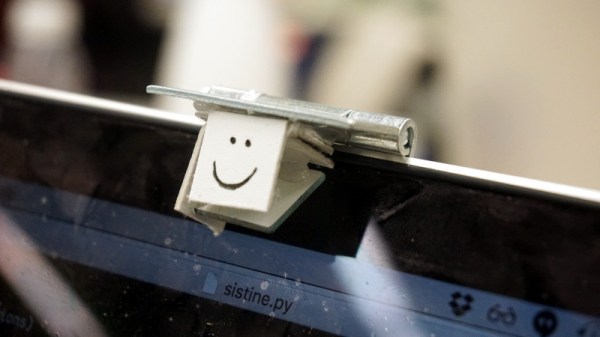
The trick, of course, is software. By mounting a small mirror over the machine’s webcam, using stiff card, hot glue, and a door hinge. By looking at the screen and deciding whether the image of a finger is touching its on-screen reflection, a remarkably simple touch screen can be created, and the promise of it only costing a dollar becomes a reality. We have to salute them for coming up with such an elegant solution.

They have a video which we’ve put below the break, showing a few simple applications for their interface. Certainly a lot less bother than a more traditional conversion.

Continue reading “Upgrade Your Mac With A Touchscreen, For Only A Dollar”

Is This The End For The C.H.I.P.?

There have been so many launches of very capable little single-board computers, that it is easy to forget an individual one among the crowd. You probably remember the C.H.I.P though, for its audacious claim back in 2015 to be the first $9 computer. It ran Linux, and included wireless connectivity, composite video output, and support for battery power. As is so often the case with ambitious startups, progress from the C.H.I.P’s creator Next Thing Co came in fits and starts.

In recent months there has been something of a silence, and now members of the community have discovered evidence that Next Thing CO are the subject of a Notice of General Assignment from Insolvency Services Group. This is followed up by the discovery that their office is available for rent.

A process called Assignment to the Benefit of Creditors is an alternative to bankruptcy proceedings yet still signals the end of a company as the service liquidates remaining assets. Despite the website and forum remaining online it appears that we may have seen the end of the C.H.I.P. and its stablemates. Hackaday has reached out to Next Thing Co for comment and will update this article if we hear back.

At the time it was launched, the C.H.I.P. was a pretty impressive product, and though it has since been eclipsed by products like the Raspberry Pi Zero, the board remains a useful item. The addition of the PocketCHIP all-in-one keyboard and display peripheral made it an instantly recognizable device, and it and its more powerful companion C.H.I.P. Pro module found their way into quite a few projects. For us the most impressive C.H.I.P. project is a retrocomputer, this miniature Apple II complete with monitor. If this really is the end for this particular little board, we’ll be sorry to see it go.

Thanks [smerrett79] for the tip.

Header image: Kiwamu Okabe [CC BY-SA 2.0].

Hackaday X Tindie Meetup In Dublin This Friday

Hackaday and Tindie are coming to Dublin at the end of this week. Join us on Friday night as we host a meetup in the company of our friends at TOG hackerspace. Please RSVP to tell us you’re coming.

This is a Bring-a-Hack style event, so come out for a casual meetup and bring a project to show off. It’s a great way to get conversation started and often the most amazing projects are the ones whose creators imagine them to be inconsequential. Keep them to a manageable size though, space may be at a premium.

We’ll supply beverages and light snacks to oil the wheels, and Hackaday Editors [Mike Szczys] and [Jenny List], Tindie Product Manager [Jasmie Brackett], and SupplyFrame Product Manager [Sophi Kravitz] will be on hand. It doesn’t matter what it is you’ve got to show us, whatever you have we’d love to see it. Thank you to TOG for opening their doors to this event!

Saturday is the Hackaday Dublin Unconference!

Act fast to grab one of the last five tickets to the Hackaday Dublin Unconference this Saturday. All tickets have been sold out, but a few people who had a ticket but are now unable to attend were nice enough to return them so that someone else may take their place. Everyone one who attends should be ready to give a 7-minute talk on what they’re excited about right now. We can’t get through everyone in one day so don’t worry if public speaking mortifies you (but still come prepared). We’ll do our best to get through a ton of presenters. We’ll have food and drink on hand and head to the pub afterward for those still standing that evening! Need proof that this is not to be missed? We did it in London last September and it was epic!

This is Hackaday’s first visit en masse to the Irish capital, and we’re looking forward to correcting that oversight and meeting the masses of our Irish readership. Thanks to the generous support of DesignSpark, the innovation arm of RS Components and the exclusive sponsor of the event, we hare happy to offer Hackaday Dublin Unconference free of charge to all who attend.

We’re excited about what will come from this weekend and are looking forward to it. See you soon!