Hardware Heroes: Isambard Kingdom Brunel

There are some notable figures in history that you know of for just one single thing. They may have achieved much in their lifetimes or they may have only been famous for Andy Warhol’s fifteen minutes, but through the lens of time we only know them for that single achievement. Then on the other hand there are those historic figures for whom there is such a choice of their achievements that have stood the test of time, that it is difficult to characterize them by a single one.

[Isambard Kingdom Brunel], in front of the launching chains for the Great Eastern. [Public domain]
Isambard Kingdom Brunel, in front of the launching chains for the Great Eastern. [Public domain]
Such is the case of Isambard Kingdom Brunel, the subject of today’s Hardware Heroes piece. Do we remember him for his involvement in the first successful tunnel to pass beneath a river, as a builder of some of the most impressive bridges on the 19th century, the innovator in all aspects of rail engineering, the man behind the first screw-driven ocean-going iron ship, or do we remember him as all of those and more?

It is possible that if you are not British, or in particular you are not from the West of England, this is the first you’ve heard of Brunel. In which case he is best described as a towering figure of many aspects of engineering over the middle years of the 19th century. His influence extended from civil engineering through the then-emerging rail industry, to shipbuilding and more, and his legacy lives on today in that many of his works are still with us.

Engineering: The Family Trade

Brunel’s father, Marc Brunel, was an engineer and refugee from the French Revolution who found success in providing the British Navy with a mass-production system for wooden pulley blocks as used in the rigging of sailing ships. He enters this story for his grand project, the world’s first tunnel to be dug under a navigable river, beneath London’s River Thames from Rotherhithe to Wapping, and for his patented tunneling shield which made it possible to be dug.


Continue reading “Hardware Heroes: Isambard Kingdom Brunel”

This Coin Cell Can Move That Train!

[Mike Rigsby] has moved a train with a coin cell. A CR2477 cell to be exact, which is to say one of the slightly more chunky examples, and the train in question isn’t the full size variety but a model railroad surrounding a Christmas tree, but nevertheless, the train moved.

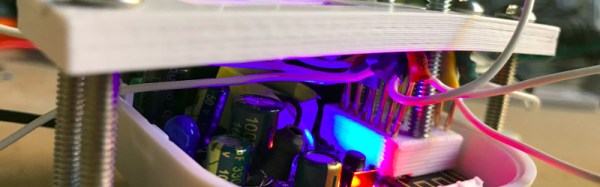
A coin cell on its own will not move a model locomotive designed to run on twelve volts. So [Mark] used a boost converter to turn three volts into twelve. The coin cell has a high internal resistance, though, so first the coin cell was discharged into a couple of supercapacitors which would feed the boost converter. As his supercaps were charging, he meticulously logged the voltage over time, and found that the first one took 18 hours to charge while the second required 51 hours.

This is important and useful data for entrants to our Coin Cell Challenge, several of whom are also going for a supercap approach to provide a one-off power boost. We suspect though that he might have drawn a little more from the cell, had he selected a dedicated supercap charger circuit.

Continue reading “This Coin Cell Can Move That Train!”

The Zombie Rises Again: Drone Registration Is Back

It’s a trope of horror movies that demonic foes always return. No sooner has the bad guy been dissolved in a withering hail of holy water in the denoeument of the first movie, than some foolish child in a white dress at the start of the next is queuing up to re-animate it with a careless drop of blood or something. If parents in later installments of popular movie franchises would only keep an eye on their darn kids, it would save everybody a whole lot of time!

The relevant passage can be found in section 1092(d) of the National Defense Authorization Act, on page 329 of the mammoth PDF containing the full text, and reads as follows:

(d) RESTORATION OF RULES FOR REGISTRATION AND MARKING OF UNMANNED AIRCRAFT
.—The rules adopted by the Administrator
of the Federal Aviation Administration in the matter of registration
and marking requirements for small unmanned aircraft (FAA-2015-
7396; published on December 16, 2015) that were vacated by the
United States Court of Appeals for the District of Columbia Circuit
in Taylor v. Huerta (No. 15-1495; decided on May 19, 2017) shall
be restored to effect on the date of enactment of this Act.

This appears to reverse the earlier decision of the court, but does not specify whether there has been any modification to the requirements to prevent their being struck down once more by the same angle of attack. In particular, it doesn’t change any of the language in the FAA Modernization Act of 2012, which specifically prevents the Agency from regulating hobby model aircraft, and was the basis of Taylor v. Huerta. Maybe they are just hoping that hobby flyers get fatigued?

We took a look at the registration system before it was struck down, and found its rules to be unusually simple to understand when compared to other aviation rulings, even if it seemed to have little basis in empirical evidence. It bears a resemblance to similar measures in other parts of the world, with its 250 g weight limit for unregistered machines. It will be interesting both from a legal standpoint to see whether any fresh challenges to this zombie law emerge in the courts, and from a technical standpoint to see what advances emerge from Shenzhen as the manufacturers pour all their expertise into a 250 g class of aircraft.

Thanks [ArduinoEnigma] for the tip.

The Tiniest Of 555 Pianos

The 555 timer is one of that special club of integrated circuits that has achieved silicon immortality. Despite its advanced age and having had its functionality replicated and superceded in almost every way, it remains in production and is still extremely popular because it’s simply so useful. If you are of A Certain Age a 555 might well have been the first integrated circuit you touched, and in turn there is a very good chance that your project with it would have been a simple electric organ.

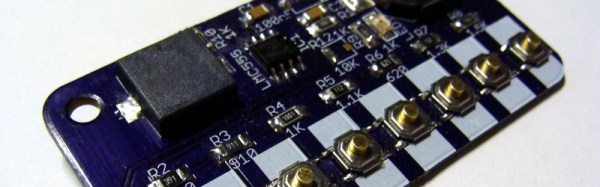
If you’d like to relive that project, perhaps [Alexander Ryzhkov] has the answer with his 555 piano. It’s an entry in our coin cell challenge, and thus uses a CMOS low voltage 555 rather than the power-hungry original, but it’s every bit the classic 555 oscillator with a switchable resistor ladder you know and love.

Physically the piano is a tiny PCB with surface-mount components and physical buttons rather than the stylus organs of yore, but as you can see in the video below the break it remains playable. We said it was tiny, but some might also use tinny.

Continue reading “The Tiniest Of 555 Pianos”

How Mini Can A Mini Lamp Be?

If there is one constant in the world of making things at the bench, it is that there is never enough light. With halogen lamps, LEDs, fluorescent tubes, and more, there will still be moments when the odd tiny part slips from view in the gloom.

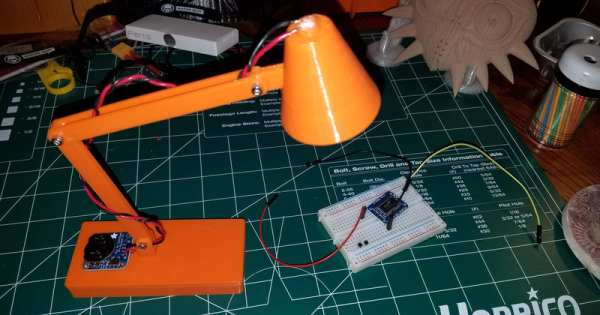
It’s fair to say that [OddDavis]’ articulated mini lamp will not provide all the solutions to your inadequate lighting woes, as its lighting element is a rather humble example of a white LED and not the retina-searing chip you might expect. The lamp is, after all, an entry in our coin cell challenge, so it hardly has a huge power source to depend upon.

What makes this lamp build neat is its 3D-printed articulated chassis. It won’t replace your treasured Anglepoise just yet, but it might make an acceptable alternative to that cheap IKEA desk lamp. With the coin cell LED you’d be hard pressed to use it for much more than reading even with its aluminium foil reflector, but given a more substantial lighting element it could also become a handy work light.

If 3D printed articulated lamps are your thing, take a look at this rather more sophisticated example.

Pogo Pins Make Light Work Of IoT Switches

Living in a condo with inadequate opportunity for fresh light wiring presented a problem for [Raphael Luckom], which he solved by taking a few off-the-shelf ESP8266-based IoT mains switches. That in itself is nothing particularly new these days, but what makes his switches special is that when faced with fiddly soldering to reprogram them, instead he fabricated a pogo pin jig to make the required contacts.

He took inspiration for his work from a Hackaday.io project hacking some Chinese switched outlets. They contain a standard ESP-12 module, so identifying the correct pins to program them was easy enough. He simply had to create a jig for his pogo pins, which he did with his 3D printer. Of course, “simply” is not an appropriate word, because along the way he had to pass through many iterations of the print, but eventually he had his jig secured to the boards with a clamp.

The result: a successful relay, and without the tricky soldering. We know many of our readers will have no problems with a bit of solder, but for those of you that don’t there might be a bit of interest here.

We’ve shown you many ESP8266 switches over the years. This all-in-one socket system was rather clever, but we’ve had some simple switches too.

Ask Hackaday: Prove Santa Exists

There is no question, that Santa Claus exists. He’s real, with the sleigh, the beard, and the reindeer and everything. He distributes gifts to billions of children in an evening, squeezes down a billion chimneys without getting that stylish red outfit dirty, and gets back home to the North Pole before sunrise. What more proof do you need, after all the missile defence folks track his progress over the icy wastes every Christmas Eve!

Well, the previous paragraph is the story you’ll get from the average youngster in countries where St. Nick is a cultural fixture, and who are we to disabuse them of this notion. Certainly not [Dave Barrett], who has the task of coming up with some ideas for a Santa Proof Of Existence for a kids’ Christmas party. In a previous year he’s thrilled them with a view of the sleigh taking off (in reality a remote-controlled model rocket launch complete with fake air traffic control clearance for Santa via CB radio), but this year the party isn’t somewhere with the space to do that trick. Instead he has the task of maintaining the illusion in those young minds for another year, with only a modest suburban plot in which to do it.

How would you prove Santa’s existence for the credulous young party-goers, using the finest technological marvels available to the Hackaday community? Perhaps you might create the illusion of boots crunching in the snow outside, or maybe the not-so-distant sound of reindeer. We suggest a Santa-Pede won’t cut it, and neither will hiring the beardy member of your hackspace as a stand-in. Kids aren’t that stupid!

What do you think? Go nuts in the comments.

Santa image: Jonathan Lindberg [Public domain].