If you were a home constructor in the 8-bit era, the chances are that if you built a microcomputer system you would have ended up with a bare printed circuit board and a terminal. If you were on a budget you might have had a piece of stripboard as well, or maybe even wire-wrap. Beautiful cases were out of reach, they came with expensive commercial computers that were not the preserve of impoverished hobbyists.
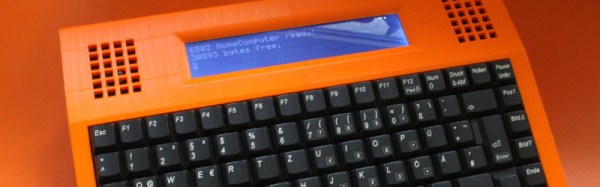
Constructing an 8-bit machine in 2017 is a much easier process, there are many more options at your disposal. There is no need to make a bare PCB when you have a 3D printer, and this is demonstrated perfectly by [Dirk Grappendorf]’s 6502 computer project. He’s built from scratch an entire 6502 system, with a text LCD display, and housed it in a case with a keyboard that would put to shame all but the most expensive commercial machines from back in the day.
But this is more than just a hobby project thrown together that just happens to have a nice case, he’s gone the extra mile to the extent that this is professional enough that it could have been a product. If you’d been offered [Dirk]’s machine in 1980 alongside the competitors from Apple and Commodore, you’d certainly have given it some consideration.
We’ve seen retrocomputers too numerous to mention on these pages over the years, so if they are your thing perhaps it’s time to draw your attention to our VCF West reports, and to our reviews of computer museums in Germany, and Cambridge or Bletchley, UK.
[Seb Holzapfel, VK2SEB] has a rather nice spectrum analyser, a Hewlett Packard 141T. It’s an entirely analogue instrument though, so it lacks some of the sophisticated features you might expect to see on its modern counterparts.
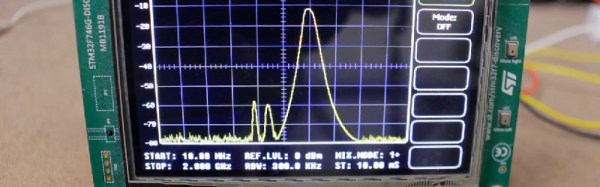
One feature the HP does have is a vertical deflection output that in effect allows the trace to be reproduced on an oscilloscope. [Seb] has taken that and applied it to an STM32F746 Discovery board with its associated LCD touchscreen to produce an interface for the HP that includes modern features such as trace normalisation and a waterfall view. Along the way he’s had to make a voltage level converter to render the HP’s scan output into a range acceptable for the ST board.
He goes into detail on his software for the project, which he is at pains to remind us is still very much a work in progress. He notes that the HP has a range of other outputs (on those “D” sockets that include co-axial connectors) that provide information about its band and scan settings, so there is ample possibility for further customisation.
If you are interested in this project then the code is all available via GitHub, otherwise you can watch his video below the break. He’s labelled it as “Part 1”, so we look forward to more on this project.
What do you do when your keenly anticipated hacker camp releases details of its upcoming badge and you really want to have a go at coding for it, but there are no badges for you to try yet? If you are [Artdanion], this is not a problem, you simply build your own.
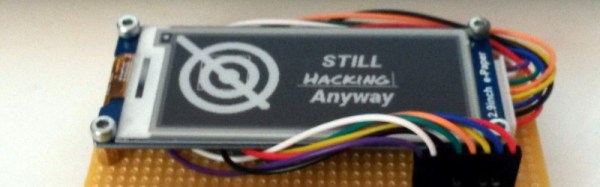
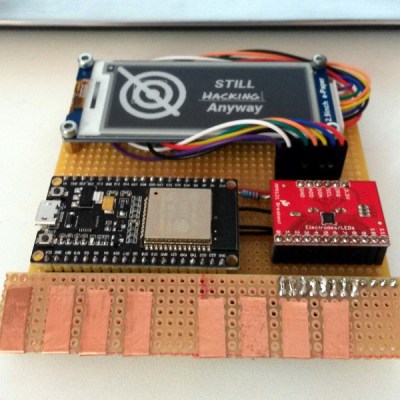
He found his requirement to interface with genuine hardware exceeded the abilities of the emulator that the SHACamp 2017 badge team had thoughtfully provided, so he reached for breakout boards for the ESP32, the MPR121 touch sensor, and the e-ink display, and assembled his own clone on a piece of stripboard. Not only did it provide him with enough to develop his own apps, he found when he brought it to the event that the public release of the official firmware ran on it with only a few configuration tweaks. He had an official event badge, that wasn’t the event badge. Is this the first time this has been done? We think it might be.
The home-made badge is an impressive piece of work, but it ties into an observation we made at the end of our review of the official version of the SHA2017 badge. The use of an ESP32 with well-designed peripherals and a solid firmware means that this is a design that is likely to form the bedrock upon which some future badges are built. [Artdanion] has proved how straightforward it is to clone, we’d like to be so bold as to make the prediction that we’ll see more developments of this platform at future events. Meanwhile this home-made badge is a neat achievement, and we can only imagine the surprise of the SHA2017 badge team on being presented with a clone of their work for reflashing.
If you sign up for a European hacker camp such as CCC Camp in Germany or SHA Camp in the Netherlands, you’ll see among the items recommended to take with you, a DECT handset. DECT, or Digital Enhanced Cordless Telecommunications, refers to the set of standards that lie behind the digital cordless telephones that are ubiquitous across Europe and some countries elsewhere in the world. These standards cover more than just the simple two-way telephone calls through a base station that most Europeans use them for though, they define a fully functional multi-cell 3G phone and data networking system. This means that an event like SHA Camp can run its own digital phone network without having to implement cell towers.
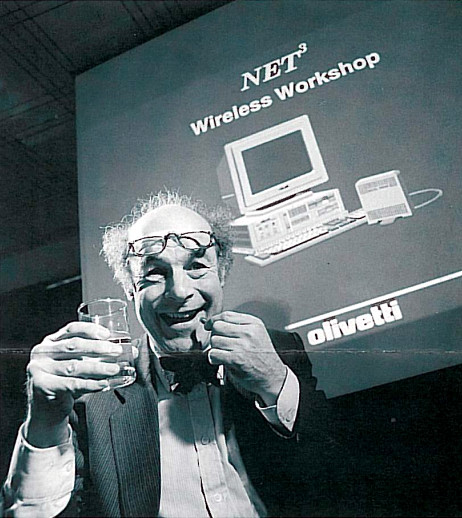
Olivetti promotional Net3 image
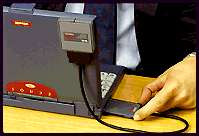
Reading the history of DECT, there is the interesting snippet that the first DECT product on the market in 1993 was not a telephone but a networking device, and incidentally the first wireless LAN product on the European market. Olivetti’s Net3 provided 512kB/s wireless networking to a base station with Ethernet or Token Ring interfaces for connection to a LAN. In its original form it was an internal card for a desktop PC coupled to a bulky external box containing radio circuitry and antenna, but its later incarnations included a PCMCIA card with a much smaller antenna box. The half-megabit speed seems tiny by today’s standards, but in the pre-multimedia world of 1993 would have been perfectly adequate for a Novell Netware fileserver and an HP Laserjet 4.
[Heinz Wolff] swallows a condom in another Olivetti promotional image.
Mystery Technology
So DECT is an interesting technology that can do more than just a simple cordless phone, and its first product was unexpectedly somewhat groundbreaking. It then becomes even more interesting to find that Net3 has left very little evidence of itself to find that can be found on the Web, and learning more about it requires a little detective work.
The Wikipedia entry has the bare bones, but it speaks volumes about the obscure nature of the product that the encyclopedia’s only picture of it is a tiny thumbnail-sized promotional image of the PCMCIA variant in a chunky mid-1990s laptop. A further search reveals a 1993 British Olivetti staff newsletter (PDF) carrying another promotional image of the desktop Net3 device featuring the then-well-known TV personality and academic [Heinz Wolff] demonstrating the technology bizarrely by swallowing a DECT medical instrumentation transponder wrapped in a condom. Some press releases remain in the fossilized remnants of the 1990s internet, and a Net3 design team member’s LinkedIn page led us to the patent covering the system, but that’s pretty much it. We can’t even find a high enough resolution image of a Net3 card for our featured image slot.
Wireless Things Before Their Time
It’s obvious that Net3 and DECT networking as a high-end wireless LAN before a need for wireless LANs existed never made it, but what is perhaps more interesting is that it seems to have left no legacy for other more mundane applications. We are in the midst of an explosion of hype around the Internet of Things and it seems new short-range wireless networking technologies appear almost daily, yet the world seems to have overlooked this robust, low power, and mature wireless network with its own dedicated frequency allocation that many of us already have in our homes. It seems particularly surprising that among the many DECT base stations on sale at your local consumer electronics store there are none with an Internet connection, and there is no market for IoT devices that use DECT as their backhaul.
In the open-source community there has been some work on DECT. The OsmocomDECT project for example provides a DECT software stack, and deDECTed.org states an aim to “better understand DECT and its security and to create an Open Source implementation of the DECT standard”. But there seems to have been very little hardware work in our community on the standard, for example there are no DECT-specific projects on Hackaday.io.
Net3 then was a product before its time, a herald of what was to come, from that twilight period when the Web was definitely a thing but had yet to become the world’s universal information repository. Public wireless networking was still several years in the future, so there was no imperative for road warriors to equip themselves with a Net3 card or for computer manufacturers — not even Olivetti themselves! — to incorporate the technology. It thus didn’t take the world by storm, and unusually for such a ground-breaking computer product there remains little legacy for it beyond a rarely-used feature of the protocol Europeans use for their cordless phones.
Did you have a Net3 card? Do you still have one? Let us know in the comments.
If you are an American, you’ll probably now find yourself in one of three camps. People who are going to see the upcoming solar eclipse that will traverse your continent, people who aren’t going to see the eclipse, and people who wish everyone would just stop going on incessantly about the damn eclipse.
Whichever of those groups you are in though, there is an interesting project that you can be a part of, an effort from the University of Massachusetts Boston to crowdsource scientific observation of the effect a solar eclipse will have on the upper atmosphere, and in particular upon the propagation of low-frequency radio waves. To do this they have been encouraging participants to build their own simple receiver and antenna, and make a series of recordings of the WWVB time signal station before, during, and after the eclipse traverse.
This is an interesting and unusual take upon participation in the eclipse, and has the potential to advance the understanding of atmospheric science. It would be fascinating to also look at the effect of the eclipse on WSPR contacts, though obviously those occur in amateur bands at higher frequencies.
If you are an EclipseMob participant, we’d love to hear from you in the comments. Does your receiver perform well?
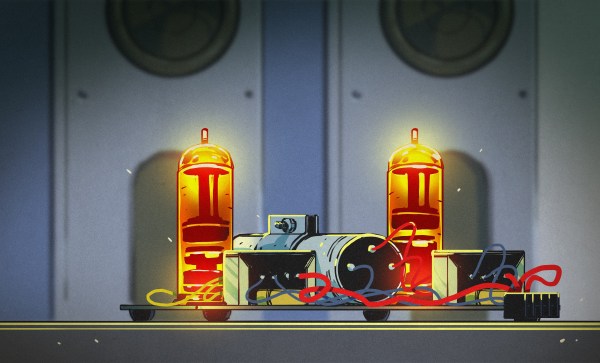
There are few greater follies in the world of electronics than that of an electronic engineering student who has just discovered the world of hi-fi audio. I was once that electronic engineering student and here follows a tale of one of my follies. One that incidentally taught me a lot about my craft, and I am thankful to say at least did not cost me much money.
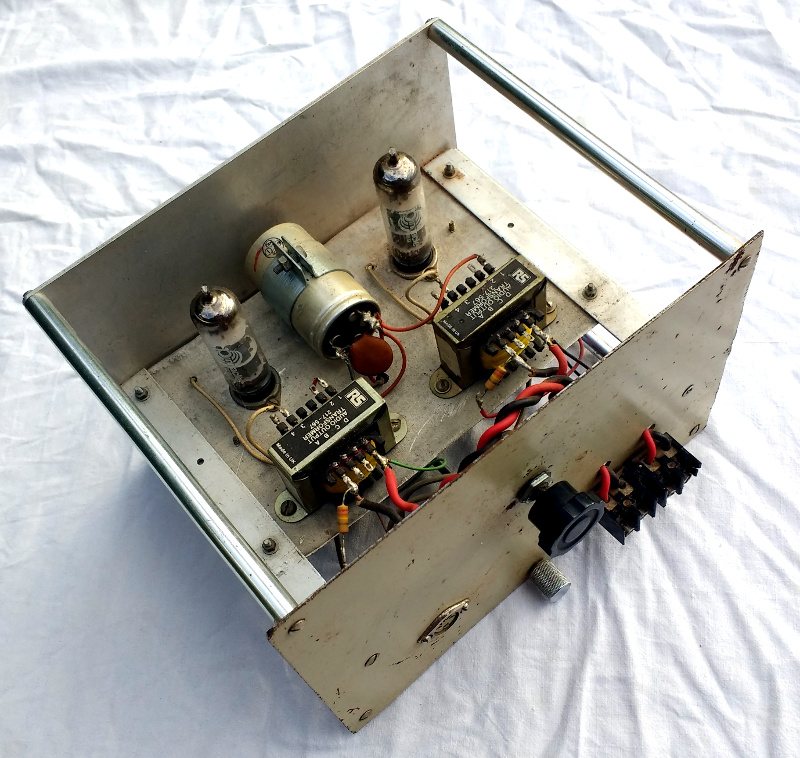
Construction more suited to 1962 than 1992.
It must have been some time in the winter of 1991/92, and being immersed in student radio and sound-and-light I was party to an intense hi-fi arms race among the similarly afflicted. Some of my friends had rich parents or jobs on the side and could thus afford shiny amplifiers and the like, but I had neither of those and an elderly Mini to support. My only option therefore was to get creative and build my own. And since the ultimate object of audio desire a quarter century ago was a valve (tube) amp, that was what I decided to tackle.
Nowadays, building a valve amp is a surprisingly straightforward process, as there are many online suppliers who will sell you a kit of parts from the other side of the world. Transformer manufacturers produce readily available products for your HT supply and your audio output matching, so to a certain extent your choice of amp is simply a case of picking your preferred circuit and assembling it. Back then however the world of electronics had extricated itself from the world of valves a couple of decades earlier, so getting your hands on the components was something of a challenge. I cut out the power supply by using a scrap Dymar Electronics instrument enclosure which had built-in HT and heater rails ready to go, but the choice of transformers and high-voltage capacitors was something of a challenge.
Pulling the amplifier out of storage in 2017, I’m going in blind. I remember roughly what I did, but the details have been obscured by decades of other concerns. So in an odd meeting with my barely-adult self, it’s time to take a look at what I made. Where did I get it right, and just how badly did I get it wrong?
If you’re a fan of outdoor hacker camps, or if you’re a SHACamp attendee who’s still coming down from the event high, you may already know about the upcoming BornHack 2017 hacker camp on the Danish island of Bornholm, from the 22nd to the 29th of this month. It’s a smaller camp than many of the others on the calendar, but it makes up for that with a quite reasonable ticket price, a much longer duration, and a location that is a destination in itself.
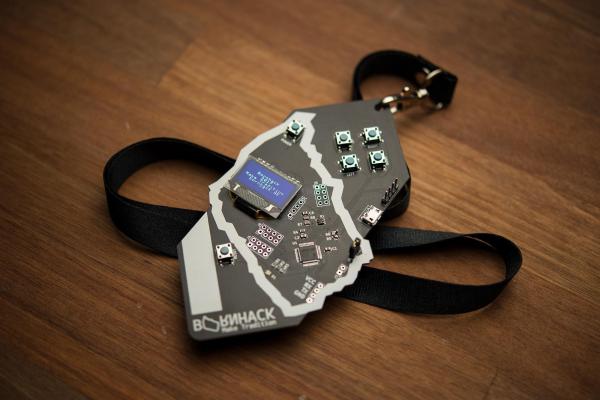
Today we have news of the BornHack badge announcement, and though the details are a little sketchy it’s safe to say that there should be plenty there to keep attendees occupied. The irregularly-shaped PCB contains a Silicon Labs “Happy Gecko” EFM32 ARM Cortex M0 microcontroller, a 128×64 pixel OLED display, and the usual array of I/O lines. There is no information about its connectivity as it seems the BornHack folks prefer to run a teaser campaign, but we’d be surprised if there wasn’t some kind of wireless module on the reverse.
Barring a transportation miracle it’s unlikely that any of the Hackaday team will be making it to BornHack, but that’s our loss. It may not be one of the larger camps, but it looks to offer no less of the atmosphere you’d expect from a European hacker camp. At the time of writing there are still BornHack tickets to be had, so head on over to their website if you fancy a week at a hacker camp on a Danish island.

 The home-made badge is an impressive piece of work, but it ties into an observation we made at the end of