The Trouble With Cordless Power Tools

If you grow up around a small engineering business you are likely to gain something of an appreciation for power tools. You’ll see them of all ages, sizes, manufacturers, and technologies. When thinking of the power tools constantly on hand in the workshop of a blacksmith like my dad for instance, I’m instantly seeing a drill and an angle grinder. The drill that most comes to mind is a Makita mains powered hand drill, and given that I remember the day he bought it to replace his clapped-out Wolf in 1976, it has given phenomenal service over four decades and continues to do so.

41 years of hard use, and still going strong.
41 years of hard use, and still going strong…

Of course, the Makita isn’t the only drill in his possession. A variety of others of different sizes and speeds have come and gone over the years, and there is always one at hand for any given task. The other one I’d like to single out is I think the most recent acquisition, a Bosch cordless model he bought several years ago. It’s similar in size and capabilities to the Makita save for its bulky battery pack, and it is a comparably decent quality tool.

So, we have two drills, both of similar size, and both of decent quality. One is from the mid 1970s, the other from the end of the last decade. One is a very useful tool able to drill holes all day, the other is little more than a paperweight. The vintage model from the days of flared trousers is a paperweight, you ask? No, the not-very-old Bosch, because its battery pack has lost its capacity. The inevitable degradation due to aged cell chemistry has left it unable to hold enough charge for more than maybe a minute’s use, and what was once a tool you’d be glad to own is now an ornament.

Continue reading “The Trouble With Cordless Power Tools”

One Person’s Experience Of Having PCB Assembly Done In China

Those of us who have our PCBs manufactured by Chinese PCB fab houses will be used to seeing tempting offers to also assemble our completed boards. Send the Gerbers as normal, but also send a BoM, and for an extra slice of cash you can receive fully assembled PCBs instead of just bare boards. It sounds alluring, but leaves a few questions for those without the experience. How much will it cost, what will the quality be like, and will my boards work? [Alexander Lang] had a limited run of ten small pressure sensor boards to make, and since his board house had started an assembly service,  decided to take the plunge and opt for full assembly.

His first step was to assemble his BoM and send it with the Gerbers. He is at pains to stress that the BoM is key to the whole project, and getting it right with the correct packages and more than one source for each component is critical. The board house first charged him £32.05 ($41.76) to make his PCBs and stencil, and assess his BoM for a build quote. A few days passed, and then he had a quote for assembly, £61.41 ($80). He placed the order, the board house processed it and made the boards, and in due course his working PCB modules arrived.

This might sound at this point like an unexciting saga, but its very smoothness is the key to what makes it interesting. Those of us who have wondered about the risks involved in taking up such a service need to hear stories like this one as surely as we do stories of failure, because without them we’re flying blind. Whether £93.46 ($121.76) for ten small boards represents good enough value is another matter, but if surface-mount soldering is not your thing you might be interested to follow [Alexander]’s example. After all, it wasn’t so long ago that getting a cheap PCB made in China was a similar leap of faith.

A New Battery For A Potted Clock Module

If you did much dismantling of PCs back in the 1980s and 1990s, you might be familiar with the Dallas Semiconductor range of potted real-time clock modules. These were chunky dual-in-line devices containing clock and non-volatile RAM chips, a crystal, and a lithium battery. The battery was good for about a decade, which was fine for most PCs of the day because the majority of desktop computers are replaced long before that deadline.

[Glitch], however has an industrial single-board computer with a 486 processor that has had a life much more prolonged than its desktop siblings due to its application. The battery in the onboard Dallas DS1387 has long ago expired, and since these devices are so long out of production to be unavailable, he’s had to improvise.

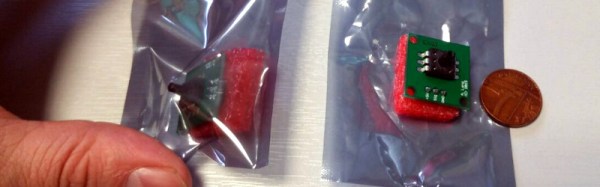
Improving on some previous documented projects he found through an internet search, he carefully ground away the potting compound to reveal a couple of the battery conductors, cut them with a PCB drill, and mounted a lithium cell holder on the top of the device with some tidily soldered Kynar wires to bring in the power. A CR1225 cell was used rather than the ubiquitous CR2032, as space was at a premium in the width of the ISA card form factor.

The potted RTC module is something of a rare device these days, but if you have a retro computer containing one this seems to be a very useful piece of work to bring it back to life. We’ve covered another similar one with a slightly larger battery in the past.

Hackaday Prize Entry: A Six Axis Robotic Arm With Fingertip Control

If you were a child of the 1980s whose fascination extended to the contents of your local Radio Shack store, you may remember the Armatron robot arm as a particular object of desire. It was a table top robot arm operated not by motors or a microcontroller, but by a clever set of gears directed manually from a pair of joysticks. If you took a look at it with an eye to control from your 8-bit home computer you were likely to be disappointed, but nevertheless it was an excellent toy.

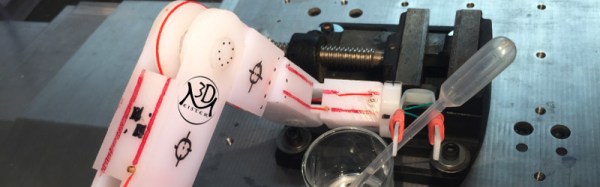
The Armatron may be long gone, but if you hanker for a similar device you should take a look at [3D Meister]’s finger controlled six axis arm. This is an arm similar to the Armatron in size, but with far more capabilities. Control is via cable loops to sliders at the arm’s base, and in addition to the usual arm movements there is an extra loop which can be used to operate any of a selection of tools including a gripper, a magnet, and a clipper. The video below the break shows the arm in action, and for the faint-hearted it should be noted that it contains the gratuitous death of some innocent plants.

Continue reading “Hackaday Prize Entry: A Six Axis Robotic Arm With Fingertip Control”

The Amazon Echo As A Listening Device

It is an inevitability that following swiftly on the heels of the release of a new device there will be an announcement of its rooting, reverse engineering, or other revealing of its hackability. Now the device in question is the Amazon Echo, as MWR Labs announce their work in persuading an Echo to yield the live audio from the microphone and turn the voice assistant device into a covert listening device.

The work hinges on a previous discovery and reverse engineering (PDF) of Amazon’s debug connector on the base of the Echo, which exposes both an SD card interface and a serial terminal. Following that work, they were able to gain root access to the device, analyze the structure of the audio buffers and how the different Echo processes use them, and run Amazon’s own “shmbuf_tool” application to pipe raw audio data to a network stream. Astoundingly this could be done without compromising the normal operation of the device.

It should be stressed, that this is an exploit that requires physical access to the device and a bit of knowledge to perform. But it’s not inconceivable that it could be made into a near-automated process requiring only a device with a set of pogo pins to be mated with an Echo that has had its cover quickly removed.

That said, inevitably there will be enough unused Echos floating around before too long that their rootability will make them useful to people in our community. We look forward to what interesting projects people come up with using rooted Echos.

This isn’t the first time we’ve covered the use of an Echo as a listening device.

Via Hacker News.

Amazon Echo image: FASTILY [CC BY-SA 4.0].

Avoiding The Engineer-Saviour Trap

The random seaside holidays of Hackaday staffers rarely sow the seeds of our articles, but my most recent trip had something slightly unusual about it. I was spending a couple of days in a resort town on the Isle of Wight, just off the coast of Southern England, and my hotel was the local outpost of a huge chain that provides anonymous rooms for travelling salesmen and the like. I could probably find an identical place to lay my head anywhere in the world from Anchorage to Hobart and everywhere in between.

My room though was slightly different to the norm. By chance rather than necessity I’d been assigned one of the hotel’s accessible rooms, designed with people with disabilities in mind. And once I’d reached the limit of the free amusement that the digital TV channels of Southern England could provide, my attention turned to the room itself, eyeing up its slightly unfamiliar design features as an engineer.

Continue reading “Avoiding The Engineer-Saviour Trap”

Getting Data Out Of Air-Gapped Networks Through The Power Cable

If you are an organisation that is custodian of sensitive information or infrastructure, it would be foolhardy of you to place it directly on the public Internet. No matter how good your security might be, there is always the risk that a miscreant could circumvent it, and perform all sorts of mischief. The solution employed therefore is to physically isolate such sensitive equipment from the rest of the world, creating an air gap. Nothing can come in and nothing can go out, or so goes the theory.

Well, that’s the theory, anyway. [Davidl] sends us some work that punches a hole in some air-gapped networks, allowing low-speed data to escape the air gap even if it doesn’t allow the reverse.

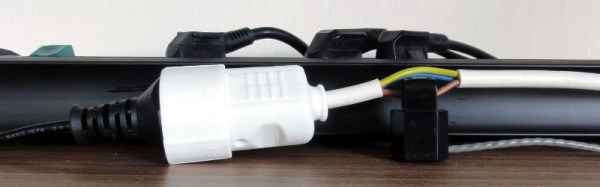
So how is this seemingly impossible task performed? The answer comes through the mains electrical infrastructure, if the air gap is bridged by a mains cable then the load on that mains cable can be modulated by altering the work undertaken by a computer connected to it. This modulation can then be detected with a current transformer, or even by compromising a UPS or electricity meter outside the air gap.

Of course, the Hackaday readership are all upstanding and law-abiding citizens of good standing, to whom such matters are of purely academic interest. Notwithstanding that, the article goes into the subject in great detail, and makes for a fascinating read.

We’ve touched on this subject before with such various techniques as broadcast radio interference and the noise from a fan,  as well as with an in-depth feature.