Estimate Your English Vocabulary Using Python

We take our mother tongue for granted, a language we learn as young children without realizing the effort involved. It is only when as adults we try to pick up another language that we fully understand how much hard work surrounds each acquired word.

Depending on who you listen to, estimates vary as to the size of a typical native English speaker’s vocabulary. The ballpark figures seem to put most adults under 20 thousand words, while graduates achieve somewhere around 23 thousand words. It’s a subject [Alex Eames] became interested in after reading a BBC article on it, and he decided to write his own software to produce a personal estimate.

His Python script takes the Scrabble word list, and presents the user with a list of words, for each one of which they have to indicate their comprehension. After a hundred words have been presented it calculates an estimate of the size of the user’s vocabulary. [Alex] wrote it on and for the Raspberry Pi, but it should work quite happily on any platform with Python 3. It certainly had no problem with our Ubuntu-based PC.

There is plenty of opportunity for bragging over the size of one’s vocabulary with a script like this one, but it’s something of a statistical leveler in that if you are truthful in your responses it will almost certainly put you exactly where you might expect for your age or level of education. If you want to know the result this script returned for a Hackaday scribe, for example, the answer is 23554.

This subject is a slight departure into software from our usual hardware subject matter, but it’s one of those tests that becomes rather a consuming interest when performed competitively among a group of friends. How well will you fare?

Via [Recantha]
Finding A Use For Surplus Filament Spools

If you’re a heavy user of a 3D printer, or a welder, you’ll know the problem of empty spools. You’ve used up all the filament or the welding wire, and you’re left with a substantial plastic spool. It’s got to be useful for something, you think, and thus it’s Too Good To Throw Away. Before you know it you have a huge pile of the things all looking for a use that you know one day you’ll find.

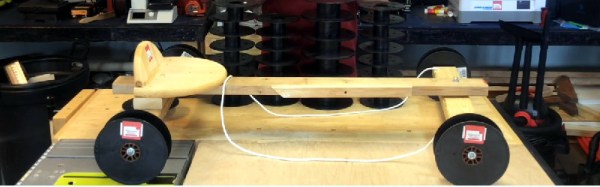
If you follow the example of [Chuck Hellebuyck], you could use them as wheels for a small go-kart (YouTube link). He 3D-printed some hub adapters for the spools to use skate bearings, mounted them of threaded axles to a classic wooden go-kart frame, and set off downhill wearing his stock-car racing helmet.

Of course, [Chuck]’s go-kart is a bit of fun, but it’s probably fair to say that 3D printer spools are not the ideal wheel. Those rims aren’t particularly durable, and with no tires he’s in for a bumpy ride. Perhaps a tire could be found to fit and a tube placed within it, but that would start to sound expensive against those cheap off-the-shelf wheelbarrow items.

But the project does raise the interesting question: what exactly do you do with your empty spools? There have to be some awesome uses for them, so please share yours in the comments. Meanwhile follow Chuck’s go-kart adventures in the video below the break.

Continue reading “Finding A Use For Surplus Filament Spools”

A Lot Of WiFi Power, A Yagi, And A Sniper’s ‘Scope

Do you remember the early days of consumer wireless networking, a time of open access points with default SSIDs, manufacturer default passwords, Pringle can antennas, and wardriving? Fortunately out-of-the-box device security has moved on in the last couple of decades, but there was a time when most WiFi networks were an open book to any passer-by with a WiFi-equipped laptop or PDA.

The more sophisticated wardrivers used directional antennas, the simplest of which was the abovementioned Pringle can, in which the snack container was repurposed as a resonant horn antenna with a single radiator mounted on an N socket poking through its side. If you were more sophisticated you might have used a Yagi array (a higher-frequency version of the antenna you would use to receive TV signals). But these were high-precision items that were expensive, or rather tricky to build if you made one yourself.

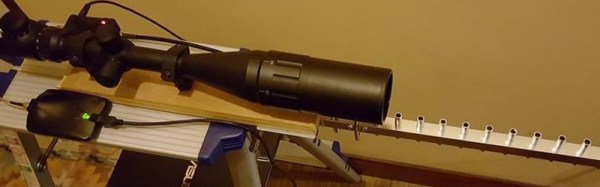
In recent years the price of commercial WiFi Yagi arrays has dropped, and they have become a common sight used for stretching WiFi range. [TacticalNinja] has other ideas, and has used a particularly long one paired with a high-power WiFi card and amplifier as a wardriver’s kit par excellence, complete with a sniper’s ‘scope for aiming.

The antenna was a cheap Chinese item, which arrived with very poor performance indeed. It turned out that its driven element was misaligned and shorted by a too-long screw, and its cable was rather long with a suspect balun. Modifying it for element alignment and a balun-less short feeder improved its performance no end. He quotes the figures for his set-up as 4000mW of RF output power into a 25dBi Yagi, or 61dBm effective radiated power. This equates to the definitely-illegal equivalent of an over 1250W point source, which sounds very impressive but somehow we doubt that the quoted figures will be achieved in reality. Claimed manufacturer antenna gain figures are rarely trustworthy.

This is something of an exercise in how much you can push into a WiFi antenna, and his comparison with a rifle is very apt. Imagine it as the equivalent of an AR-15 modified with every bell and whistle the gun store can sell its owner, it may look impressively tricked-out but does it shoot any better than the stock rifle in the hands of an expert? As any radio amateur will tell you: a contact can only be made if communication can be heard in both directions, and we’re left wondering whether some of that extra power is wasted as even with the Yagi the WiFi receiver will be unlikely to hear the reply from a network responding at great distance using the stock legal antenna and power. Still, it does have an air of wardriver chic about it, and we’re certain it has the potential for a lot of long-distance WiFi fun within its receiving range.

This isn’t the first wardriving rifle we’ve featured, but unlike this one you could probably carry it past a policeman without attracting attention.

From CRT TV To All-In-One Console

When the Raspberry Pi first appeared there was some excitement among Raspberry Jam attendees at the prospect of a computer with a video output on a board small enough to be concealed inside a TV. But while the idea is a good one the prospect of poking around among the high voltages of an older CRT model has meant that surprisingly few such ideas turned into reality.

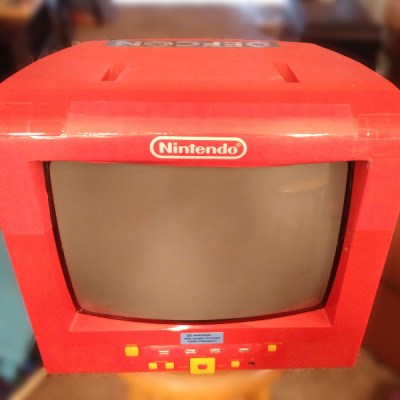
One person who made the idea into a reality was [Jon], who took a [Dora] The Explorer branded CRT/DVD combo in a fetching shade of red and turned it into an all-in-one retro console gaming system with an embedded Raspberry Pi.

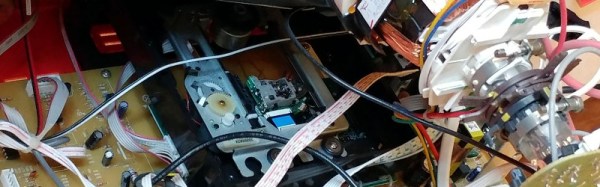
nintendo-crt-tv-thumbnailThis is however not merely a Pi stuffed inside the rear casing with a few holes for cables, instead he took away the substantial part of the DVD mechanism and mounted his Pi safely in a plastic box. Some USB extension cables bring all four USB sockets to the front panel through the DVD slot with a bit of Sugru to hold them in place. An HDMI panel-mount extension goes to the TV’s rear connector panel, as does a power switch for the Pi which is wired to a USB charger mounted on a trailing mains socket inside the case. The composite video from the Pi is wired to the TV’s AV in video socket.

We don’t blame [Jon] for not looking at the TV’s power rails to find power for his Pi, though a TV of this recent age would have safely mains-isolated rails that’s still a task fraught with hazards. The resulting unit is a high quality retro console, and as a final touch he’s given it a Nintendo logo and some storage for his gamepads on the rear.

We’ve had a few CRTs with integrated computers before here at Hackaday, but not all have been as they seemed. This Pi for instance sat in a vintage Singer TV, but the CRT was replaced with a modern LCD. Our favourite though it this Chromecast driving a 1978 GE model.

Too Good To Throw Away: Dealing With An Out-Of-Control Junk Hoard

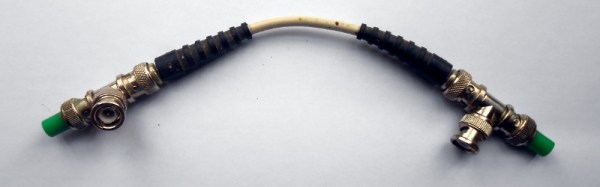
There it was, after twenty minutes of turning the place over, looking through assorted storage boxes. A Thinwire Ethernet network. About the smallest possible Thinwire Ethernet network as it happens, a crimped BNC lead about 100mm long and capped at each end by a T-piece and a 50 ohm terminator. I’d been looking for a BNC T-piece on which to hook up another terminator to a piece of test equipment, and I’d found two of them.

As I hooked up the test I wanted to run I found myself considering the absurdity of the situation. I last worked somewhere with a Thinwire network in the mid 1990s, and fortunately I am likely to never see another one in my life. If you’ve never encountered Thinwire, be thankful. A single piece of co-ax connecting all computers on the network, on which the tiniest fault causes all to fail.

So why had I held on to all the parts to make one, albeit the smallest possible variant? Some kind of memento, to remind me of the Good Old Days of running round an office with a cable tester perhaps? Or was I just returning to my past as a hoarder, like a Tolkienic dragon perched atop a mountain of electronic junk, and not the good kind of junk?

Continue reading “Too Good To Throw Away: Dealing With An Out-Of-Control Junk Hoard”

Bike Saddle As Workshop Stool

It is not uncommon for parts from a particular hobby or pursuit to be repurposed by enthusiasts as furniture. Car nuts will make sofas from the rear bodywork of a saloon car, for example, or coffee tables from engine blocks as you might have seen in the Top Gear studio.

A cycling enthusiast asked [Quinn Dunki] to produce a workshop stool using a bicycle seat, and the resulting piece of furniture is both elegant and functional, if probably comfortable only to those used to a racing saddle.

The stool itself rests on a vertical tube with a tripod at the bottom, each leg of which is fitted with a caster. We are taken through the steps to make the metalwork, in particular the rather tricky 45 degree tubular joint required for each leg. We see the unexpectedly high forces above the casters cracking the initial tack welds, and the resulting more substantial joint. And finally we’re treated to the stool being elegantly modelled by Sprocket the cat, as you can see below the break.

Continue reading “Bike Saddle As Workshop Stool”

An Easy Home Made Electroadhesive

There was a time when if you wanted to scale a wall you had to turn a camera on its side and call [Adam West] or [Lionel Ritchie]. Unless you were a gecko, that is. Their host of tiny bristles and intramolecular forces allow them to run up walls and across the ceiling with ease.

You may have seen synthetic gecko-like adhesive surfaces using the same effect. Some impressive wall-climbing robots have used these materials, though they’ve all shared the same problem. Gecko adhesion can’t be turned off. Happily, for the robot wall climber unwilling to expend the extra force to detach a foot there is an alternative approach. Electroadhesives use electrostatic force to attach a plate held at a high potential to a surface, and today’s featured video is [Carter Hurd]’s home-made electroadhesive panel (YouTube).

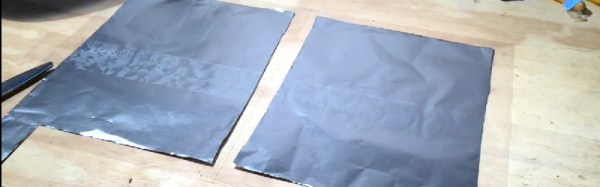
He cites this paper and this description of the technology as the influences on his design, two aluminium foil electrodes sandwiched between plastic sheet and sticky tape. He applies 6kV from an Emco DC to DC converter to his plates, and as if by magic it sticks to his drywall. Of course, it’s not quite as simple as that, he tried several surfaces before finding the one it stuck to. Adhesion is fully under control, and such a simple device performs surprisingly well. The Emco converters are sadly not cheap, but they are an extremely efficient product for which he only needs a few AA cells on the low voltage side.

His full description is in the video below the break.

Continue reading “An Easy Home Made Electroadhesive”