Daisy Kite Wind Turbine: Now You Can Buy One

The Isle of Lewis is the largest of the Scottish Outer Hebrides, sitting in the North Atlantic off the west coast of the Scottish mainland. It is the first landfall after thousands of miles of ocean for a continuous stream of Atlantic weather systems, so as you might imagine it is a place in which there is no shortage of wind.

It is thus the perfect situation for a wind power startup, and in the aptly-named Windswept and Interesting Ltd it has one that is pushing the boundaries. Their speciality is the generation of power from spinning kites, arrays of kites that transmit power to a ground-based generator through the rotation of their lines, and because they release their designs as open source they are of extra interest to us.

Of course, if you are a seasoned reader you’ll now be complaining that we’ve covered this story before when they had an entry in the 2014 Hackaday Prize, so what’s new? The answer is that the 2014 story was a much earlier iteration than their current multi-level kite array, and that they have now reached the point of bringing their products to market. You can buy one of their prototypes right now, and there is a soon-to-be-launched crowdfunding campaign for their latest model. It’s not exactly cheap, but this first product is the result of 5 years of product development, and it is pretty obvious that more is on the way. For any open hardware startup to stay afloat that long is an impressive achievement, to do so in a field in which you are not surrounded by a huge supporting industry in the way for example electronics startups are is nothing short of amazing.

If you would like to have a go at building one of their spinning kites, you can do so with full instructions released under a Creative Commons licence, but for non kite builders their website is a fascinating read in its own right. Their YouTube channel  in particular has a wealth of videos of previous tests as well as design iterations, and is one on which many readers will linger for a while. Below the break we’ve put one of their most recent, a montage showing the kite evolution over the years.

Continue reading “Daisy Kite Wind Turbine: Now You Can Buy One” →

Retrotechtacular: Max Headroom Takes Chicago In Audacious TV Hack

Those of you with long memories and a compulsive TV viewing habit might remember [Max Headroom], a quirky piece of TV ephemera from the late 1980s and early 1990s. [Max] was a supposedly computer generated TV show host and VJ with a pseudomechanical stutter, a slightly blocky rendered head, and a moving background of rendered lines. He looks a little quaint for viewers with a few decades viewing experience of CGI, but in his day he was cutting-edge cypberpunk TV.

He also made unscheduled showings on two Chicago TV stations in an audacious hack that has never been explained and whose culprit has never been found.

The real [Max Headroom] (Fair use) Via Wikimedia commons.
The real [Max Headroom] (Fair use) Via Wikimedia Commons.
If you were a bored British teenager and future Hackaday writer vegging out in front of your parents’ TV on an April night in 1985, you’d have caught [Max]’s genesis. He strung upon us by rising out of a title screen full of static in the Channel 4 TV movie [Max Headroom]: 20 Minutes into the Future.

The plot is a trip in itself. An investigative journalist seeking to uncover the sinister owners of his network (they run speeded-up adverts with the unfortunate side-effect of causing overweight viewers to explode) is pursued, causing a road accident in which he is injured by a collision with a safety barrier. Hence the name: [Max Headroom]. The network try to cover it up by producing a computerized facsimilie of the reporter which turns out to be an embarassing failure. They scrap the computer and it falls into the hands of a pirate TV station operating from a decrepit campervan, the Alphabetti-eating proprietor of which turns the character it contains into a TV sensation. Meanwhile the reporter escapes, recovers, and prevails over the villains.

The [Max] character proved to be something of a hit, with a TV spin-off series, VJing, adverts, and more. But that wasn’t the whole story of his appearances, back to that unexplained hack of Chicagoland TV.

The Chicago fake [Max Headroom].
On the night of the 22nd of November 1987, viewers of WGN were watching a sports program when the screen went blank and they were treated to a few seconds of a slightly home-made [Max Headroom] dancing in front of  those trademark moving lines. A couple of hours later on WTTW a rerun of a [Doctor Who] episode was again interrupted with the same fake [Max], this time speaking for a while before, if his performance wasn’t already bizarre enough, being spanked by a woman whose face is off camera.

As a piece of television history it’s an intriguing mystery, though since so little is known about the mechanism through which it was achieved it hasn’t achieved the notoriety in the technical world that you might expect. The stations involved conducted full investigations at the time and failed to locate a culprit, perhaps they should have been looking for that old campervan with the antennae on its roof.

It is very unlikely that a similar stunt could be performed today, with entirely digital TV studios and easy access to encryption technologies for external links to transmitter sites. But in the 1980s a studio would still have been an analogue affair so there would have been more opportunities to insert an unauthorized feed. Next year sees the 30th anniversary of the event, it would be fascinating if the perpetrator would mark it by anonymously revealing how it was achieved. Of course, we’d love to hear how you would have done it in the comments below. Surely we have readers who are intimately familiar with the television broadcasting equipment of the time.

Below the break we’re showing you both fake [Max] intrusions into the Chicago airwaves. First is the short outing on EGN, below that the longer one on WTTV.

Continue reading “Retrotechtacular: Max Headroom Takes Chicago In Audacious TV Hack” →

“Alexa, Make My ESP8266 Do Something”

The Amazon Echo and its diminutive Dot cousin have the handy feature of being able to control some home automation devices. If you own the right manufacturer’s hardware you can bend your home to your will using the power of your voice alone.

The trouble is, if your hardware isn’t on the list of supported devices or if you make your own, you’re out of luck.

[Xose Pérez] had been sidestepping this problem by using a server running a set of scripts emulating a Belkin WeMo device, which Echo supports. The server could issue commands to his microcontrollers, but he wanted more. Why not cut out the middle man to incorporate the WeMo emulation directly on the ESP8266 that did the work?

He took the Fauxmo Python WeMo emulator he had been using, and ported it to an ESP8266 library that can be incorporated in existing code to make it appear to the world as a WeMo device. With the code itself he has provided full instructions on its BitBucket page as well as on the page linked above.

He admits that he is not the first person to have achieved this aim, and points to this earlier project. However his requirement for a library to be incorporated in another piece of software were not satisfied by it, hence his work.

We like this project, but it’s probably worth reminding readers that Alexa does have an SDK in the form of the Alexa Skills Kit. You can use it to do all sorts of clever things with your Echo or Dot… or you can make it the brains of a Big Mouth Billy Bass novelty ornament.

Fail Of The Week: Talking Chinese Calculator Synth Orchestra

There are times when you set out to do one thing, and though you do not achieve your aim you succeed in making something else that’s just a bit special. [TheKhakinator] sent us something he described as a fail, but even though we’re posting it as one of our Fail Of The Week series we think the result still has something of the win about it. It may not be the amazing hack he hoped it would become, but that really does not matter in this case.

On his travels in China his attention was caught by an everyday electronic gadget, an electronic calculator  that speaks the numbers and operations in Chinese as you use it. He bought a few of them, hoping that when he got them back to his bench he’d find an EEPROM containing the samples, which he could replace with his own for a cheap but low bitrate sampler.

Sadly this neat hack was not to be, for when he tore the surprisingly well-built calculators down he found only an epoxy blob concealing a single chip. All was not lost though, for while investigating the device’s features he discovered that as well as speaking Chinese numbers and operands it also had a selection of alarm tunes built-in, plus a mode in which it operated as a rudimentary electronic organ. He leaves us with a couple of videos we’ve posted below the break, first his teardown, and then a virtual orchestra of calculators playing dance music as he forgets the fail and concentrates on the win.

Continue reading “Fail Of The Week: Talking Chinese Calculator Synth Orchestra” →

The Raspberry Pi 2 Gets A Processor Upgrade

A rumor that has been swirling around the Raspberry Pi hardware community for a significant time has proven to have a basis in fact. The Raspberry Pi 2 has lost its BCM2836 32-bit processor, and gained the 64-bit BCM2837 processor from its newer sibling, the Raspberry Pi 3. It seems this switch was made weeks ago without any fanfare on the release of the Pi 2 V1.2 board revision, so we are among many news sources that were caught on the hop.

The new board is not quite a Pi 3 masquerading as a Pi 2 though. The more capable processor is clocked at a sedate 900MHz as opposed to the Pi 3’s 1.2GHz and there is no Bluetooth or WiFi on board, but the new revision will of course benefit from the extra onboard cache and the 64-bit cores.

This move almost certainly has its roots in saving the cost of BCM2836 production in the face of falling Pi 2 sales after the launch of the Pi 3. It makes sense for the Foundation to keep the Pi 2 in their range though as the board has found a home in many embedded products for which the Pi 3’s wireless capabilities and extra power consumption are not an asset.

Avid collectors of Pi boards will no doubt be running to add this one to their displays, but given that the Pi 2 sells for the same price as a Pi 3 we suspect that most Hackaday readers will go for the faster board. It is still a development worth knowing about though, should you require a faster Pi that is a little less power-hungry. The full specification for the revised board can be found on the Raspberry Pi web site.

The Pi has come a long way since the morning in 2012 when our community brought down the RS and Farnell websites trying to buy one of the first models. This BCM2837 board joins a BCM2837-powered Compute Module as well as the Pi 3. It’s worth reminding you though that there are other players to consider, earlier this year we brought you a look at the Odroid C2, and of course the infamous Apple Device.

Pi 2 header image: Multicherry [CC BY-SA 4.0], via Wikimedia Commons.

Editorial Note: We originally covered this in Sunday’s Links article but thought it warranted another, expanded mention.

Sinclair I/O Board Completed Over 30 Years Later

In the early 1980s when the 8-bit microcomputer boom was well under way, [Alan Faulds] was a student, and an owner of a Sinclair ZX81. He had ambitions to use it, in his words, “to control the world“, but since the Sinclair lacked an I/O port he was thwarted. He bought an expander board and a couple of I/O card PCBs from the British electronic supplier Maplin in the days when they were a mail order parts stockist rather than a chain of stores chasing Radio Shack’s vacated retail position.

Sadly for [Alan], he didn’t have the cash to buy all the parts to populate the boards, then the pressures of a final year at university intervened, and he never built those Maplin kits. They sat forgotten in their padded envelope for over three decades until a chance conversation with a friend reminded him of his unfinished student project. He sought it out, and set about recreating the board.

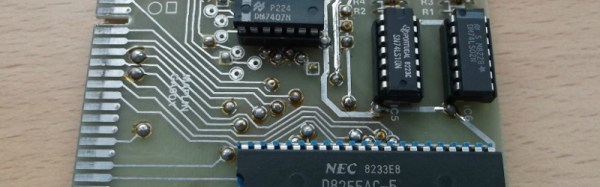
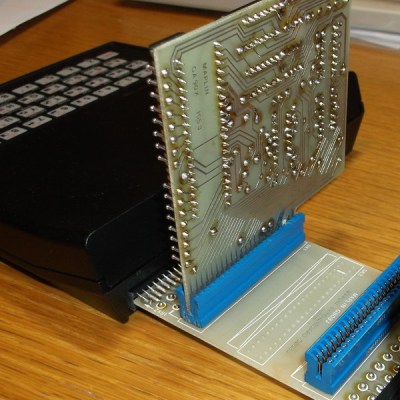
zx-io-thumbnailThe ZX81 had a single port: a PCB edge connector at its rear that exposed all the Z80 processor’s lines. It was notorious for unreliability, as the tiniest vibration when a peripheral was connected would crash the machine. Maplin’s expansion system featured a backplane with a series of edge connector sockets, and cards with bare PCB edge connectors. Back in the 1980s it was easy to find edge connectors of the right size with the appropriate key installed, but not these days. [Alan] had to make one himself for his build.



The I/O card with its 8255 and brace of 74 series chips was a double-sided affair with vias made through the use of little snap-off hand-soldered pins. [Alan] put his ICs in sockets, a sensible choice given that when he powered it up he found he’d put a couple of the 74 chips in the wrong positions. With that error rectified the board worked exactly as it should, giving the little ZX three I/O ports, albeit with one of them a buffered output.

We haven’t featured the little Sinclair micro as often as we should have here at Hackaday, it seems to have been overshadowed by its ZX Spectrum successor. We did show you a VGA ZX81 emulated on an mbed though, and a rather neat color video hack for its Brazilian cousin.

Ruggedizing A Cheap Camera For Spacecraft Testing

Name the countries that house a manned space program. In order of arrival in space, USSR/Russian Federation, United States of America, People’s Republic of China. And maybe one day, Denmark. OK, not the Danish government. But that doesn’t stop the country having a manned space program, in the form of Copenhagen Suborbitals. As the tagline on their website has it: “We’re 50 geeks building and flying our own rockets. One of us will fly into space“. If that doesn’t catch the attention of Hackaday readers, nothing will.

For their rocket testing they need a lot of video feeds, and for that they use cheap Chinese GoPro clones. The problem with these (and we suspect many other cameras) is that when subjected to the temperature and vibration of being strapped to a rocket, they cease to work. And since even nonprofit spaceflight engineers are experts at solving problems, they’ve ruggedized the cameras to protect them from vibration and provide adequate heatsinking.

The heat issue is addressed by removing the camera case and attaching its metal chassis directly to a heatsink that forms the end of an extruded aluminium case. Vibration was causing the camera SD cards to come loose, so these are soldered into their sockets. Power is provided by a pair of 18650 cells with a switching regulator to provide internal power, and another to allow the unit to be charged from a wide range of input voltages. A PCB houses both the regulators and sockets for cable distribution. There is even a socket on top of the case to allow a small monitor to be mounted as a viewfinder. Along the way they’ve created a ruggedized camera that we think could have many applications far beyond rocket testing. Maybe they should sell kits!

We’ve covered Copenhagen Suborbitals before quite a few times, from their earliest news back in 2010, through a look at their liquid-fueled engine, to a recent successful rocket launch. We want to eventually report on this project achieving its aim.

Thanks [Morten] for the tip.