Ask Hackaday: How Hard Is It To Make A Bad Solder Joint?

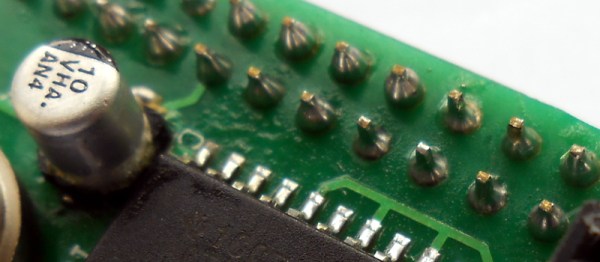
When you learn to solder, you are warned about the pitfalls of creating a solder joint. Too much solder, too little solder, cold joints, dry joints, failing to “wet” the joint properly, a plethora of terms are explained  if you read one of the many online guides to soldering.

Unsurprisingly it can all seem rather daunting to a novice, especially if they are not used to the dexterity required to manipulate a tool on a very small-scale at a distance. And since the soldering iron likely to be in the hands of a beginner will not be one of the more accomplished models with fine temperature control and a good tip, it’s likely that they will experience most of those pitfalls early on in their soldering career.

As your soldering skills increase, you get the knack of making a good joint. Applying just the right amount of heat and supplying just enough solder becomes second nature, and though you still mess up from time to time you learn to spot your errors and how to rework and fix them. Your progression through the art becomes a series of plateaux, as you achieve each new task whose tiny size or complexity you previously thought rendered it impossible. Did you too recoil in horror before your first 0.1″ DIP IC, only to find it had been surprisingly easy once you’d completed it?

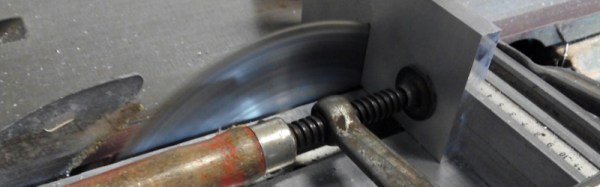
A few weeks ago we posted a Hackaday Fail of the Week, revolving around a soldering iron failure and confirmation bias leading to a lengthy reworking session when the real culprit was a missing set of jumpers. Mildly embarrassing and something over which a veil is best drawn, but its comments raised some interesting questions about bad solder joints. In the FoTW case I was worried I’d overheated the joints causing them to go bad, evaporating the flux and oxidising the solder. This was disputed by some commenters, but left me with some curiosity over bad solder joints. We all know roughly how solder joints go wrong, but how much of what we know is heresay? Perhaps it is time for a thorough investigation of what makes a good solder joint, and the best way to understand that would surely be to look at what makes a bad one.

Continue reading “Ask Hackaday: How Hard Is It To Make A Bad Solder Joint?”

The Champagne Of Light Bulbs

We’re all used to making our own lighting projects. Triac dimmers, LEDs, Neopixels, EL wire, there is a huge array of lighting components and technologies at our fingertips. But how many of us have made our own lighting rather than buying off-the-shelf? [Confined Maker] set out to do just that by creating an incandescent light bulb from scratch, and since he’s obviously a hacker with a bit of class he did it in an empty Dom Perignon champagne bottle.

It might seem a daunting project, but as he shows us in the video below the break, it turns out to be surprisingly straightforward with no exotic tooling required. He starts by winding a fine coil of thin tungsten wire round a dowel to act as his filament, before bringing a pair of enameled copper wires through holes drilled in the base of the bottle and out of the neck. The ends of these wires are then spliced to his filament and secured with conductive epoxy before the whole assembly is carefully slid back into the bottle. The holes are caulked with silicone, and the bottle is then carefully charged with argon. Argon is heavier-than-air, so he can do this on the bench with nothing more than a bicycle tube inflator and a drinking straw. The bottle is then sealed with a cork and more silicone, and his bulb is ready.

The first power-up with 120V mains power sees a puff of smoke inside the bottle as a coating on the tungsten is vapourised, but after that the bulb does its job well. He’s concerned about his epoxy melting, and the filament has moved to one side of the bottle so he’s not sure about the lifetime he can expect, but to make a working light bulb with such basic equipment is still an impressive accomplishment. His video below the break is eleven and a half minutes long, but well worth watching every minute.

Continue reading “The Champagne Of Light Bulbs”

Niklas Roy’s Music Construction Machine

If you think of a music box, the first image that might come to mind is that of a small tabletop device with a simple mechanism and a single instrument. Usually a row of chimes triggered by points etched on a roller. If you are a bit more ambitious maybe you thought of a player piano with a roll of perforated paper carrying a tune, but yet again with only the single voice of one instrument.

mcm_06[Niklas Roy] however has a different vision when it comes to mechanical music. He’s created an entire ensemble with real musical instruments, a drum kit, keyboard, and electric guitar. His Music Construction Machine is no simple music box with a single tune though, it generates a constantly changing melody through a mechanically implemented algorithm with a complex interaction of cyclic variables that periodically alternate between harmonic and discordant. Unfortunately we can’t find any audio examples of the installation at work.

There is a timeliness to this post, the machine is part of an art installation at the Goethe-Institut Pop Up Pavillion on the Nowy Targ square in Wrocław, Poland, and it will be exhibited until the 10th of July. We hope some of our Central European readers will be within range and can make the trip. If you do, we’d love to hear some sample audio from your visit.

We’ve featured [Niklas]’s work many times before here at Hackaday. Just a few highlights are a past musical project powered by water, God on the CB radio, and his all-terrain mobile beer crate.

UPDATE: [Niklas] has posted details of the exhibition in Wroclaw on his blog, including several videos like the on below the break that show the machine in its full glory.

Continue reading “Niklas Roy’s Music Construction Machine”

A 150MHz 6502 Co-Processor

If you are familiar with ARM processors, you may know of their early history at the 1980s British home computer manufacturer Acorn. The first physical ARM system was a plug-in co-processor development board for Acorn’s BBC Micro, the machine that could be found in nearly every UK school of the day.

For an 8-bit home computer the BBC Micro had an unusually high specification. It came with parallel, serial and analog ports, built-in networking using Acorn’s proprietary Econet system, and the co-processor interface used by that ARM board, the Tube. There were several commercial co-processors for the Tube, including ones with a 6502,  a Z80 allowing CP/M to be run, and an 80186.

As with most of the 8-bit generation of home computers the BBC Micro continues to maintain a strong enthusiast following who have not stopped extending its capabilities in all directions. The Tube has been interfaced to the Raspberry Pi, for instance, on which an emulation of original co-processor hardware can be run.

bbc-tube-screenshotAnd thus we come to the subject of this article, [Hoglet] and [BigEd]’s 150MHz 6502 coprocessor for the BBC Micro. Which of course isn’t a 6502 at all, but a 6502 emulated in assembler on an ARM which is in a way the very distant descendant of the machine it’s hosted upon. There is something gloriously circular about the whole project, particularly as the Pi, like Acorn, the BBC Micro, and modern-day ARM, has its roots in Cambridge. How useful it is depends on your need to run 8-bit 1980s software in a tearing hurry, but they do report it runs Elite, which if you were there at the time we’re sure you will agree is the most important application to get running on a BBC Micro.

We’ve featured the Tube interface before when we talked about an FPGA co-processor with a PDP/11 mode that was definitely never sold by Acorn. And we’ve also featured an effort to reverse engineer the primordial ARM from that first BBC Micro-based co-processor board.

BBC Micro image: Stuart Brady, Public Domain, via Wikimedia Commons.

The Sunday Morning Breakfast Machine

Breakfast is a meal taken very seriously indeed by Brits. So seriously that continual attempts have been made to perfect the experience mechanically. Who could not delight to be woken up by a Teasmade alarm clock delivering a fresh cup of hot beverage, and where else would the getting out of bed sequence in Wallace and Gromit be, not the comedic animated film, but a documentary?

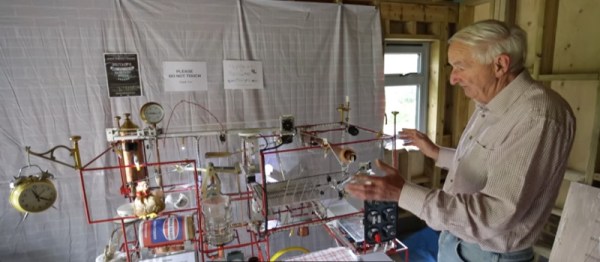
Latest in a long line of British builders of mechanical morning repast generators are [Peter Browne] and [Mervyn Huggett]. Working from a garden shed – where else! – in Sussex, they have spent three months and a thousand man hours creating their “Sunday Morning Breakfast Machine“, designed to cook and serve a slice of toast and a boiled egg alongside a cup of tea or coffee and the morning paper. Prototyping was done in Meccano , could there be any other medium for a machine like this one?

The machine itself is a mix of the practical and the whimsical. The giant-sized facsimile of a vintage Ever Ready battery and the toy rooster hide some pretty accomplished metalwork and control systems. They do admit that the primary purpose is to make people laugh, but it does the job, albeit with what looks like a leak from a cracked egg.

A full description from [Peter] is in the video below the break.

Continue reading “The Sunday Morning Breakfast Machine”

Retrotechtacular: How Solidarity Hacked Polish TV

In the 1980s, Poland was under the grip of martial law as the Communist government of General Wojciech Jaruzelski attempted to repress the independent Solidarity trade union. In Western Europe our TV screens featured as much coverage of the events as could be gleaned through the Iron Curtain, but Polish state TV remained oblivious and restricted itself to wholesome Communist fare.

In September 1985, TV viewers in the city of Toruń sat down to watch an action adventure film and were treated to an unexpected bonus: the screen had a brief overlay with the messages “Solidarity Toruń: Boycotting the election is our duty,” and “Solidarity Toruń: Enough price hikes, lies, repression”. Sadly for the perpetrators, they were caught by the authorities after their second transmission a few days later when they repeated the performance over the evening news bulletin, and they were jailed for four months.

The transmission had been made by a group of dissident radio astronomers and scientists who had successfully developed a video transmitter that could synchronise itself with the official broadcast to produce an overlay that would be visible on every set within its limited transmission radius. This was a significant achievement using 1980s technology in a state in which electronic components were hard to come by. Our description comes via [Maciej Cegłowski], who was able to track down one of the people involved in building the transmitter and received an in-depth description of it.

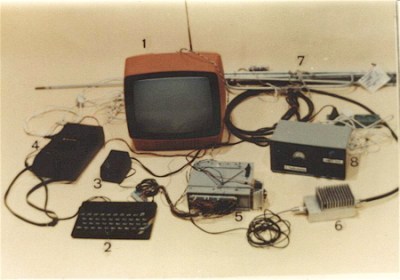
Transmission equipment seized by the Polish police.

The synchronisation came courtesy of the international effort at the time on Very Long Baseline Interferometry, in which multiple radio telescopes across the world are combined to achieve the effect of a single much larger instrument. Before GPS made available a constant timing signal the different groups participating in the experiment had used the sync pulses of TV transmitters to stay in time, establishing a network that spanned the political divide of the Iron Curtain. This expertise allowed them to create their transmitter capable of overlaying the official broadcasts. The police file on the event shows some of their equipment, including a Sinclair ZX Spectrum home computer from the West that was presumably used to generate the graphics.

There is no surviving recording of the overlay transmission, however a reconstruction has been put on YouTube that you can see below the break, complete with very period Communist TV footage.

Continue reading “Retrotechtacular: How Solidarity Hacked Polish TV”

A Very Tidy Circular Saw Bench

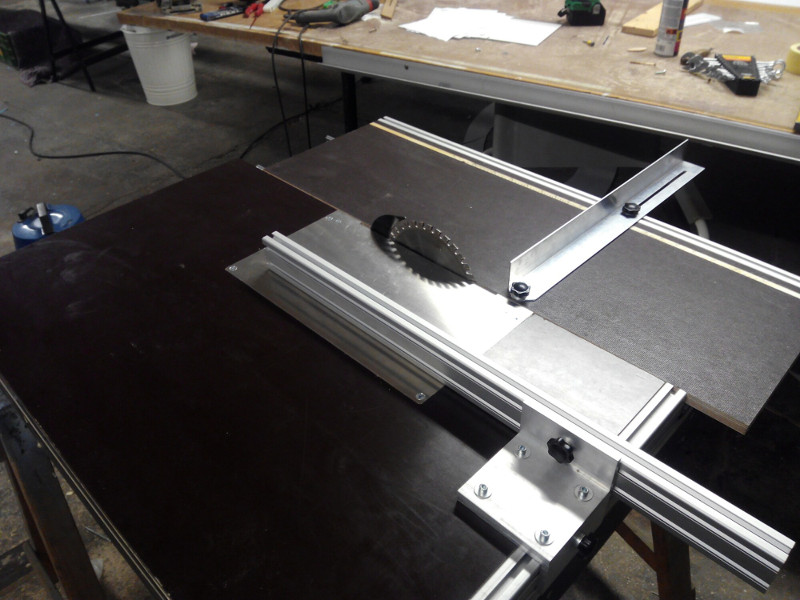
If your parents had a workshop as you grew up, the chances are it harbored some tools you came to know and love as you used them for your formative projects. Our reader [Joerg]’s father for instance has a circular saw bench that [Joerg] sorely misses, now living over 500km away. Our subject today is his response to this problem, now needing to cut aluminium he set about creating a  saw bench of his own, and the result is a rather nice build.

table-sawHe put together a variety of CAD models to formulate his ideas, and arrived at a structure in 18mm waterproof plywood with moving table linear bearings. The saw blade itself was mounted on a 5mm aluminum plate, though he doesn’t tell us what motor it uses. All the wooden parts came from a single sheet of plywood, and the result is a very tidy creation indeed.

Power saws are among the more hazardous tools in your workshop arsenal, whatever their type. If this was a commercial saw it would probably have a guard over the top of its blade, but even without that its sturdy construction and relatively low profile blade make this one stand above some of the more basic home-made saws we’ve seen. Building a power saw is something you have to take seriously.

We’ve featured quite a few home-made saws over the years. At least one other large table saw, a rather powerful but surprisingly tiny saw bench, this scroll saw using a sewing machine mechanism, or how about this simple jigsaw table?