The Impossible Repair: Ribbon Cables

It’s a problem that faces many a piece of older equipment that ribbon cables of the type used on membrane keyboards start to fail as they become older. These cables are extremely difficult to repair as they can’t be soldered to, and since they are usually custom to the device in question. All is not lost, though, as [Spare Time Repair] shows us with the cable on a Honeywell heating controller broken by a user attempting to remove the battery with a screwdriver.

The whole process can be seen in the video below the break, and it involves the use of a vinyl cutter to cut the pattern of tracks in aluminium tape stuck on a sheet of acetate. This makes a new piece of ribbon cable, however it’s still a step short of being part of the circuit. His challenge is to make a clip tight enough to attach it to the intact part of the broken cable and maintain contact, then to hope that the new piece of cable bent back on itself can make enough contact for the device to work.

At the end of it all, he has a working Honeywell controller, though as he points out, it’s a device he has little interest in. Instead, this opens a window on an extremely useful technique that should be of relevance far beyond the world of heating. There’s one machine close to home for us that could use this technique, for example.
Continue reading “The Impossible Repair: Ribbon Cables”

An Umbrella Can Teach A Thing Or Two About Product Longevity

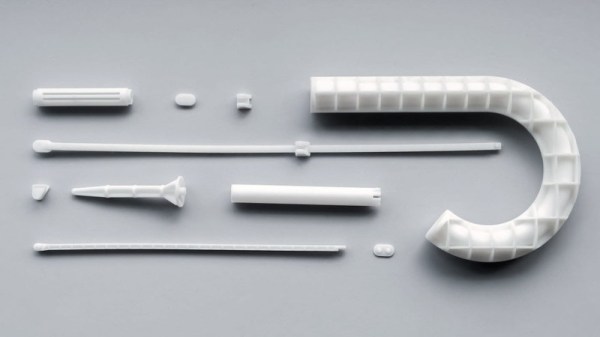
This time of year always brings a few gems from outside Hackaday’s usual circle, as students attending industrial design colleges release their final year projects, The worlds of art and engineering sit very close together at times, and theirs is a discipline which sits firmly astride that line. This is amply demonstrated by the work of [Charlie Humble-Thomas], who has taken an everyday object, the umbrella, and used it to pose the question: How long should objects last?

He explores the topic by making three different umbrellas, none of which we are guessing resemble those you could buy. The first is not particularly durable but is completely recyclable, the second is designed entirely with repairability in mind, while the third is hugely over-engineered and designed for durability. In each case the reader is intended to think about the impact of the umbrella before them.

What strikes us is how much better designed each one is than the typical cheap umbrella on sale today, with the polypropylene recyclable one being flimsy by design, but with a simplicity missing from its commercial counterpart. The durable one meanwhile is full of CNC parts, and carbon fiber.

If you’re hungry for more student work in this vein, we recently brought you this toasty typewriter.

The 3D Printed Computer Space Takes Shape

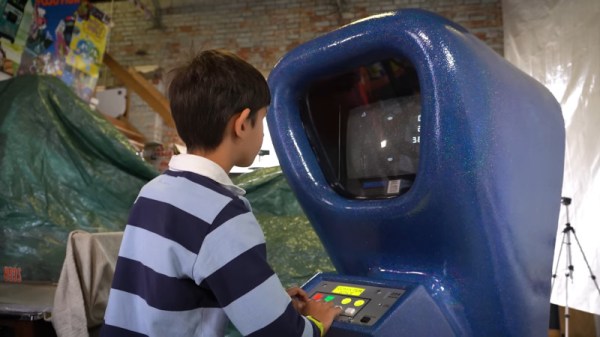
A few weeks ago we brought you news of a project to recreate the flowing lines of the first computerised arcade game, Computer Space, as a full-size 3D printed replica. We left the project with all the parts put together to make a complete but unfinished shell that was very recognizable as a Computer Space cabinet but had neither finishing nor internals. Now we’re very pleased to bring you the conclusion of the project, as it moves from unfinished 3D print to playable cabinet.

The video below the break is a journey of print finishing to a very high standard with that lustrous blue glitter resin, but oddly it’s most interesting to find out about the manufacturing quirks of the original. How the rear door was imprecisely cut from plywood and fixed on with gate hinges, how the ventilation holes differ from cabinet to cabinet, and how the collection vessel for those quarters was an old tin. The monitor is a newer broadcast CRT in this version and the electronics are naturally  modern, but if you didn’t know, you’d be hard pressed to spot that you weren’t playing the real thing.

Finally we see the gameplay which is admittedly frustrating, and a little bit of punditry as to why this wasn’t the commercial success of the following Pong. It’s a fascinating look at the early computer game industry.

Have a look at our coverage of the first episode of this project.

Continue reading “The 3D Printed Computer Space Takes Shape”

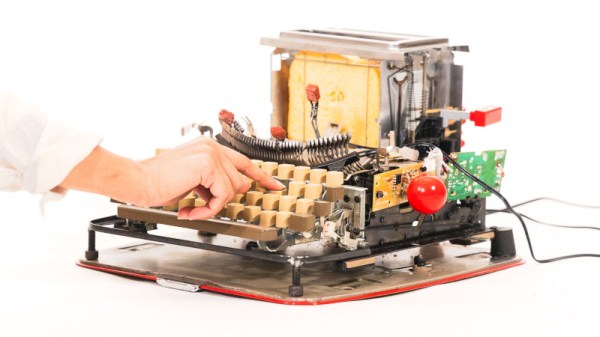
This Typewriter Types Toast

As a writer it’s a pleasure to see one’s work appear from time to time on a physical medium. While newspapers may be shuffling slowly off this mortal coil, there are still a few opportunities to write for printed media. It’s safe to say that no Hackaday scribe has ever managed to have their work published on the medium in this hack though, because it’s a typewriter designed to type on toast.

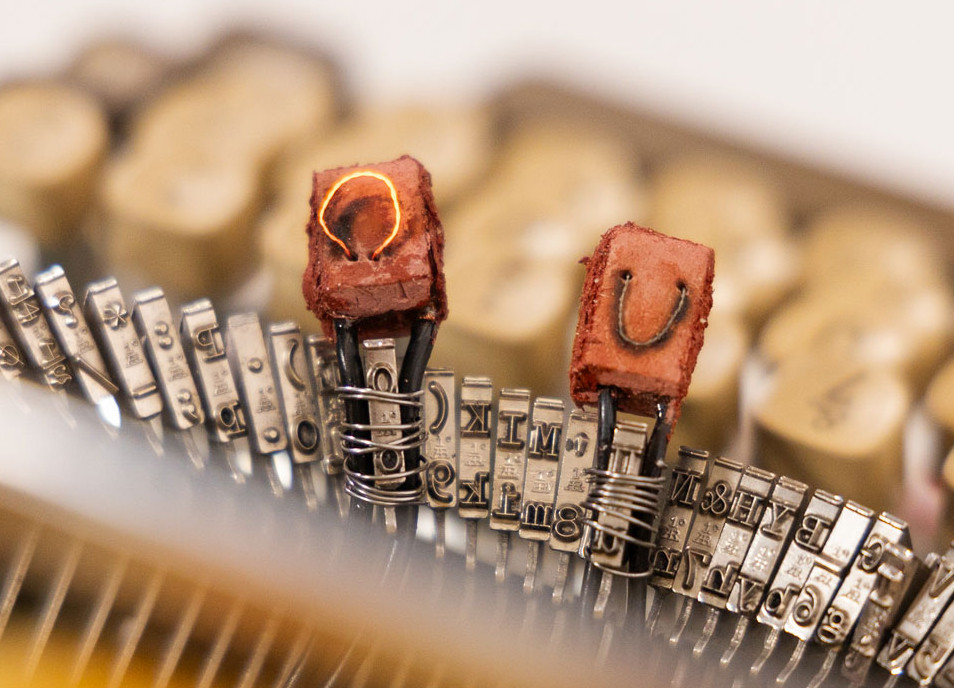
The toaster-typewriter is the work of [Ritika Kedia], and it forms part of her thesis in product design at the Parsons School of Design, New York. It’s written up very much from an artistic rather than a tech perspective, but it’s no less ingenious for that in the way it uses letters formed from hot wire on a clay substrate, mounted on the end of the typewriter arms in front of a toaster.

We’re slightly sad to see that it only has three operable letters at the moment as it’s an artwork rather than a document machine, but we love the idea and wish she had time to develop it further with a full alphabet. You can see a short demo in the video below the break.

Continue reading “This Typewriter Types Toast”

The ZX Spectrum Takes To The Airwaves Again

A perk of writing for Hackaday comes in the vast breadth of experience represented by our fellow writers. Through our colleague [Voja Antonić] for example we’ve gained an unparalleled insight into the cutting edge of 8-bit computing in 1980s Yugoslavia, of his Galaksija home computer, and of software being broadcast over [Zoran Modli]’s Ventilator 202 radio show.

We’re strongly reminded of this by hearing of the Slovenian Radio Študent broadcasting the classic Slovenian ZX Spectrum text adventure game Kontrabant 2, at the behest of the  Slovenian Computer History Museum. It’s been four decades and a lot of turbulent history, but once again 8-bit code will be heard on FM in Europe.

Some of our younger readers may never have experienced the joy of loading software from cassette, but in those days it represented a slow alternative to the eye-wateringly expensive floppy drives of the day. The software was represented as a serial bitstream translated into tones and recorded on a standard cassette recorder which was standard consumer electronics back then, and when played back through a speaker it was an ear-splitting sound with something in common with that of a modem handshake from a decade or more later. This could easily be transmitted over a radio station, and a few broadcasters tried experimental technology shows doing just that.

We haven’t heard from any listeners who managed to catch the game and run it on their Spectrum, but we hope that Slovenia’s retrocomputing community were out in force even if Audacity and a n emulator replaced the original hardware. Given that more than one hacker camp in our community has sported radio stations whether legal or not, it would be nice to hear the dulcet tones of 8-bit software on the airwaves again.

Meanwhile if cassettes are too cheap for you, feast your eyes on Sir Clive’s budget storage solution.

Thanks [Stephen Walters].

An Audio Delay, The Garden Hose Way

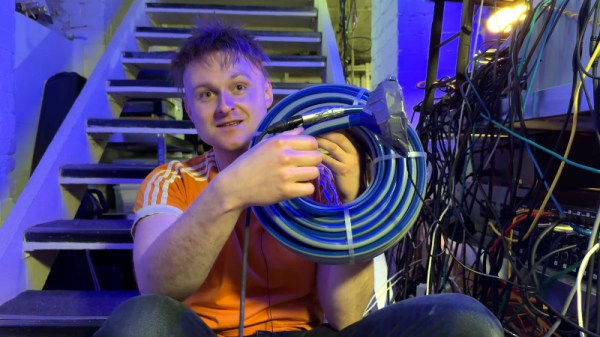
Creating music in 2024 is made easier by ready access to a host of effects in software that were once the preserve only of professional studios. One such is the delay; digital delays are now a staple of any production software where once they required infrastructure. [Look Mum No Computer] is no stranger to the world of Lo-Fi analogue music making, and along with his musical collaborator [Hainback], he’s created an analogue delay from an unexpected material: garden hose pipe.

The unit takes inspiration from some commercial 1970s effects, and lends a fixed short delay intended to give a double-tracking effect to vocals or similar. It involves putting a speaker at one end of a reel of hose and a microphone at the other, while the original unexpectedly used Shure SM57 capsules as both speaker and microphone they use a very small loudspeaker and a cheap microphone capsule.

The sound is not what you’d call high quality. Indeed, it’s about what one might expect when listening down a long pipe. But when mixed in behind the vocals, it gives a very pleasing effect. The duo use it on their new EP which, as you might expect, is released on vinyl.

If such effects interest you, also take a look at a 1950s reverb room at the famous Abbey Road Studios in London.

Continue reading “An Audio Delay, The Garden Hose Way”

Ask Hackaday: Do You Calibrate Your Instruments?

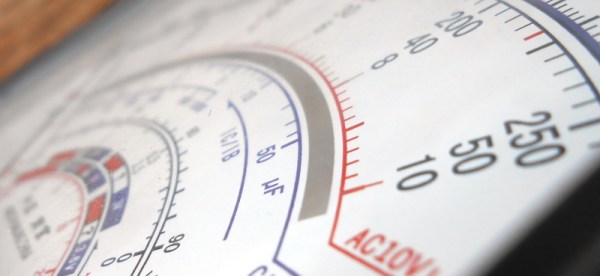
Like many of you, I have a bench full of electronic instruments. The newest is my Rigol oscilloscope, only a few years old, while the oldest is probably my RF signal generator that dates from some time in the early 1950s. Some of those instruments have been with me for decades, and have been crucial in the gestation of countless projects.

If I follow the manufacturer’s recommendations then just like that PAT tester I should have them calibrated frequently. This process involves sending them off to a specialised lab where their readings are compared to a standard and they are adjusted accordingly, and when they return I know I can trust their readings. It’s important if you work in an industry where everything must be verified, for example I’m certain the folks down the road at Airbus use meticulously calibrated instruments when making assemblies for their aircraft, because there is no room for error in a safety critical application at 20000 feet.

But on my bench? Not so much, nobody is likely to face danger if my frequency counter has drifted by a few Hz. Continue reading “Ask Hackaday: Do You Calibrate Your Instruments?”