Would Nuclear Winter Cancel Out Global Warming?

Nuclear war was very much a front-of-mind issue during the fraught political climate of the Cold War era. Since then, atomic sabre rattling has been less frequent, though has never quite disappeared entirely.

Outside of the direct annihilation caused by nuclear war, however, is the threat of nuclear winter. The basic concept is simple: in the aftermath of a major nuclear war, the resulting atmospheric effects could lead to a rapid cooling in global temperatures.

Some say it couldn’t ever happen, while others – including Futurama – suggest with varying degrees of humor that it could help cancel out the effects of global warming. But what is the truth?

Hard data is isn’t really available, as thus far there have been  no large-scale nuclear wars for scientists to measure. Several studies have explored the concept of nuclear winter, however, and explored its potential effects.

Continue reading “Would Nuclear Winter Cancel Out Global Warming?”

Floating Solar Farms Are Taking The World’s Reservoirs By Storm

Photovoltaic solar panels are wonderful things, capable of capturing mere light and turning it into useful electricity. They’re often installed on residential and commercial rooftops for offsetting energy use at the source.

However, for grid-scale generation, they’re usually deployed in huge farms on tracts of land in areas that receive plenty of direct sunlight. These requirements can often put solar farms in conflict with farm-farms — the sunlight that is good for solar panels is also good for growing plants, specifically those we grow for food.

One of the more interesting ideas, however, is to create solar arrays that float on water. Unlike some of the wackier ideas out there, this one comes with some genuinely interesting engineering benefits, too!

Continue reading “Floating Solar Farms Are Taking The World’s Reservoirs By Storm”

Display Your Speech In Realtime To Help Lipreaders In The Mask Era

Masks are all well and good when it comes to reducing the spread of deadly pathogens, but they can make it harder to understand people when they speak. They also make lipreading impossible. [Kevin Lewis] set about building something to help.

The system consists of a small screen that can be worn on the chest or other part of the body, and a lapel microphone to record the wearer’s speech. Using the Deepgram AI speech recognition API running on a Raspberry Pi Zero W, the system decodes the speech and displays it on the Hyperpixel screen.

The API is quite capable, and can be set to only respond to the wearer’s voice, or in a group mode, display speech from multiple people in the area, displaying other voices in another colour. There’s also a translation feature using the iTranslateApp API as well.

It’s a neat tool that could be of great use in conferences or in situations where a quick simple machine translation could majorly ease communication. Video after the break.
Continue reading “Display Your Speech In Realtime To Help Lipreaders In The Mask Era”

Running Methanol RC Engines On Gasoline

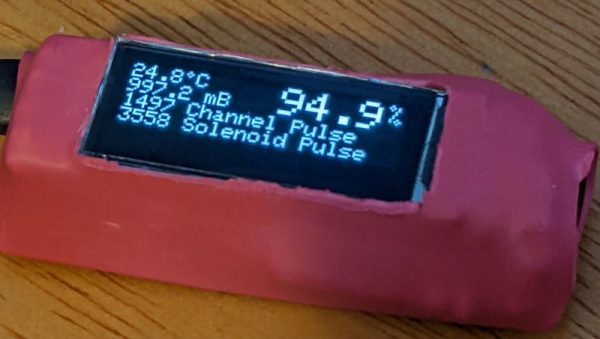
Methanol is a popular fuel for small engines used in radio-controlled models, but comes at a higher price than gasoline. It’s also harder to source and can be a mite corrosive, too. Gasoline comes with some benefits, but running it in a methanol engine usually requires some mods. [David] and [Bert] worked together to build a mixture controller for just this purpose.

The controller uses a solenoid to control the flow of gasoline to a conventional methanol-tuned carburetor for a small RC engine, allowing it to be accurately tuned to run gasoline well across the whole RPM range. Having gone through many revisions, all documented in a big forum thread, the latest version uses a Seeduino Xiao controller and a BMP280 pressure and temperature sensor for determining the right fuel/air mixture for the conditions. A small OLED screen can optionally be fitted to help with configuration of the mixture controller.

The system has worked well in testing, with [David] and [Bert] reporting that they have “converted engines as small as 0.3 CID up to large radials with this system.” It’s a promising tool that could be handy to have in the RC modeller’s arsenal.

These tiny engines have other applications too; they can make for one crazy power drill, that’s for sure!

Sending Pics To Grandma, No Smartphone Needed

When it comes to keeping in touch with the grandparents, a lack of familiarity with modern technology can get in the way. [palmerabollo] wanted to share photos with his grandmother, but found that it was difficult as she didn’t have a smartphone or an Internet connection to receive photos. Thus, a custom build for grandma was in order! (translated)

To minimise maintenance requirements, the build relies on a thermal receipt printer. Each roll of thermal paper is good for printing off about 150 images before needing a change, so it’s a low-cost, fuss-free solution with no need for ink changeovers.

A Raspberry Pi Zero 2W runs the show, paired with a HAT that provides cellular internet connectivity. Photos are sent over Telegram with some custom Python code that [palmerabollo] put together. The system uses the Python “thermalprinter” library, with the Floyd-Steinberg dithering algorithm baked in allowing nice quality even on the simple thermal printer.

It’s a fun build, and lets [palmerabollo] send his grandmother fun photos and messages without requiring any effort on her part. It’s super cute to see the photos stuck up on the refrigerator, too.

There’s plenty of fun to be had with thermal printers, so don’t be afraid to get stuck in yourself! Video after the break. Continue reading “Sending Pics To Grandma, No Smartphone Needed”

Robot Nerf Alarm Blasts You Awake With Foam

The sentry gun targets [Vinnie] with blasts of foam as he runs through the bedroom to the sounds of Your New Morning Alarm by [Marc Rebillet].
Waking up is hard; sometimes you need more than a little chiming alarm to get you out of bed. When [Vinnie Satriale] started unconsciously switching his alarms off, he went all out, deciding to build a Nerf sentry blaster to wake him up instead. 

A Nerf Rival Nemesis MXVII-10K flywheel blaster is the core of the build, with a 100-round capacity of soft foam balls. Stepper motors are used to control a pan and tilt system to aim the blaster. It’s moved under instruction from a Raspberry Pi that uses machine vision algorithms running on a Coral USB accelerator to track targets in the bedroom. A relay board is then used to activate the blaster’s firing action, blasting any targets until they wake up.

[Vinnie] had plenty of fun during build, also showing the sentry gun off to his coworkers in the office. It’s a hard sentry to dodge, with the machine vision algorithm using a full-body tracking model, so merely covering one’s face won’t be enough to get away.

We’ve seen all kinds of sentry guns over the years, from those firing rubber bands to others spraying jets of water. Video after the break.

Continue reading “Robot Nerf Alarm Blasts You Awake With Foam”

Longer Range EVs Are On The Horizon

When electric cars first started hitting the mainstream just over a decade ago, most criticism focused on the limited range available and the long recharge times required. Since then, automakers have been chipping away, improving efficiency here and adding capacity there, slowly pushing the numbers up year after year.

Models are now on the market offering in excess of 400 miles between charges, but lurking on the horizon are cars with ever-greater range. The technology stands at a tipping point where a electric car will easily be able to go further on a charge than the average driver can reasonably drive in a day. Let’s explore what’s just around the corner.

Continue reading “Longer Range EVs Are On The Horizon”