A Mobius Strip Track For Superconductor Levitation

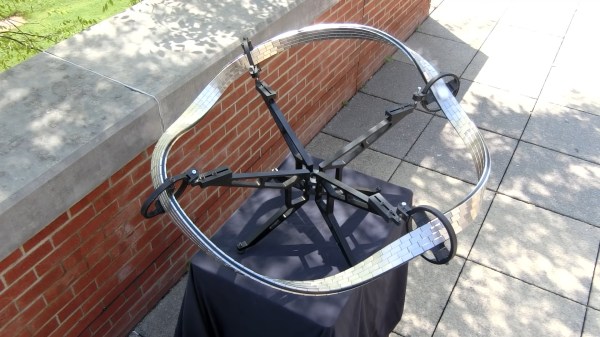
Superconductors are interesting things, though we don’t really rely on them for much in our day to day lives. They’d be supremely useful, if only they didn’t need to be so darned cold. While the boffins toil away in the lab on that problem however, there’s still some fun to be had, as demonstrated by the Möbius Strip levitation track at Ithaca College.  (Video, embedded below.)

The rig takes advantage of the fact that superconductors can levitate over magnets, and vice versa. Under certain conditions, the superconductor can even lock into position over a magnet, due to flux pinning, wherein flux “tubes” from the magnet’s field penetrate a superconductor and are pinned in place by currents in the superconductor. It’s an awe-inpsiring effect, with the superconducting material appearing to magically float at a locked height above the magnetic surface, quite distinct from traditional magnetic levitation.

Construction of the track wasn’t straightforward. Early attempts at producing a Möbius Strip twisted through 540 degrees were unsuccessful in steel. The team then switched tack, using a flexible plastic which was much more pliable. This was then covered in neodymium magnets to create the necessary field, and the resulting visual effect is one of a silver-bricked magnetic road.

It’s a great display, and one that quite intuitively demonstrates the concepts of both a Möbius Strip and superconducting levitation. If room-temperature semiconductors become a real thing, there’s every possibility this could become an always-on installation. It’s also the trick behind one of the coolest hoverboards we’ve ever seen. Video after the break.

Continue reading “A Mobius Strip Track For Superconductor Levitation”

How Laser Headlights Work

When we think about the onward march of automotive technology, headlights aren’t usually the first thing that come to mind. Engines, fuel efficiency, and the switch to electric power are all more front of mind. However, that doesn’t mean there aren’t thousands of engineers around the world working to improve the state of the art in automotive lighting day in, day out.

Sealed beam headlights gave way to more modern designs once regulations loosened up, while bulbs moved from simple halogens to xenon HIDs and, more recently, LEDs. Now, a new technology is on the scene, with lasers!

Continue reading “How Laser Headlights Work”

Robot Arm Achieves Amazing Accuracy With Just Servos

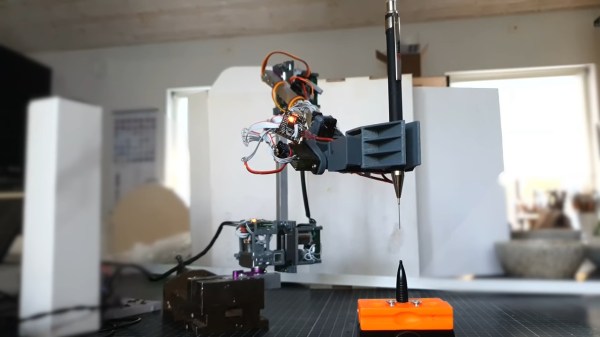
While few of us need robotic arms in our daily life, they’re a popular build with makers. Often, the most accessible builds throw together some RC servos and 3D printed parts, with limited accuracy a consequence of the components chosen. [Adam Bäckström] decided to take such a design and push it to its limits, however, with astounding results.

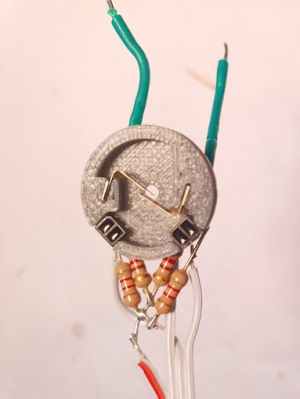
Part of the “special sauce” that makes this arm so capable is the custom optical encoders installed in the servo motors themselves.

[Adam]’s first robot arm build was a major disappointment, when the servos he had purchased for the build turned out to be terrible at holding an angle. With limited funds, he elected to improve on what he had, learning much about precision control techniques along the way. [Adam] taught himself how to implement industrial strength control loops using hobby hardware, by implementing additional encoders into servos and taking into account velocity and torque in addition to just position. With a magnetic encoder on the servo output shaft and a tiny optical encoder hand-built for inside the motor itself, much higher accuracy is achievable by allowing the control system to compensate for backlash.

The results are stunning, with [Adam]’s robot arm able to move incredibly smoothly throughout its range of motion. Perhaps the best demonstration of this is the pencil demo, where the robot arm delicately threads a pencil lead through the tip of a mechanical pencil without breaking. We’d love to see these techniques implemented more often; we imagine they’d be a great addition to a build like this one. Video after the break.

Continue reading “Robot Arm Achieves Amazing Accuracy With Just Servos”

Homebrew Grain Synth Has A Rad Step Sequencer

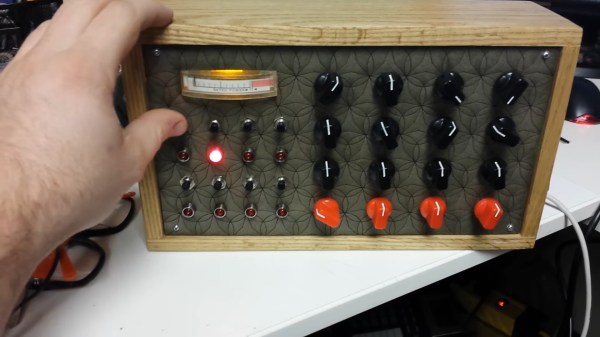
In the world of homebrew synthesizers, there are plenty of noiseboxes and grooveboxes that make all kinds of wacky and wild noises. However, common projects like the Auduino and Atari Punk Console are often limited in that they can’t readily be programmed to play multiple notes or any sort of discernable rhythm. [Nick Poole] changes this with his Auduino step sequencer build.

The build takes the Auduino grain synthesizer, and modifies it by adding a step sequencer. This is possible as the Auduino code, which runs on the old-school ATMEGA-based Arduinos, is incredibly fast, leaving plenty of processing time for extra features to be added. [Nick] adds eight LEDs and eight buttons to the build, allowing the user to select one of eight steps to modify. Then, the sound parameters for the step can be altered with the standard Auduino controls. This lets the user quickly and easily build up 8-step melodies, something that was previously impossible with the Auduino.

It’s a fun build, and one that makes a great intro into the world of DIY synth builds. The techniques learned here will serve any aspiring maker well if they dive further into the world of modular synthesis and associated arcana. Video after the break.

Continue reading “Homebrew Grain Synth Has A Rad Step Sequencer”

Interfacing The Dreamcast Controller With Just An Arduino

The Dreamcast is a somewhat forgotten console today, but for a shining minute in the late 1990s, it was possible to believe Sega were still in the fight. Regardless, their hardware lives on, lovingly preserved by collectors and enthusiasts. [Nicholas FitzRoy-Dale] is one such enthusiast, and set about interfacing the old console’s controllers to an Arduino.

Initial work involved getting the Arduino (presumably a basic 16 Mhz Uno) to read the controller’s buttons, and spitting the data out over serial. The Dreamcast’s Maple bus is fast, which presented some challenges, but it was simple enough. [Nicholas] then moved on to interfacing the VMU, the Dreamcast’s fancy controller-mounted memory card. After initial attempts were shaky and unstable, he redoubled his efforts. Research indicated that the VMU can vary the speed of the bus when it’s in control, so he updated his code to suit. It’s full of great hacks, like connecting the Dreamcast’s two data pins to four input pins on the Arduino, to save a handful of cycles by not having to shift incoming data.

The work is a great read for anyone into assembly-level optimisation of interfaces, as well as proper use of limited resources. Obviously, it’s easy to just throw a faster, more expensive microcontroller at the problem, but then nobody would have learned anything. We’ve featured a great many Dreamcast hacks over the years; [Nicholas]’s work here builds upon [Dmitry]’s work in 2017. We can’t wait to see what comes next out of the underground Sega hacking scene!

High Speed Flight In A Homebrew FPV Cockpit

First-person view, or FPV, has become hugely popular in RC flying circles. A pair of video goggles lets the pilot fly with vision from the plane itself. To make things even more realistic, the team at [FliteTest] built a replica cockpit with working controls and took it down to the field for testing. (Video, embedded below.)

Since the pilot is wearing video goggles, aesthetics aren’t the key here. A RC transmitter was gutted for its gimbal and potentiometers. The former fitted with a long stick for aileron and elevator control, and the latter hooked up to pedals for the rudder. There’s even a proper throttle handle. It’s a low-budget build, with PVC pipe and bungee straps doing much of the work, but that doesn’t detract from the fun factor one bit. The team later upped the stakes, flying a faster model with the rig at speeds up to 120 mph.

Interesting to note is the somewhat visceral reaction by the pilot when crashing, as the combination of first-person view video and realistic controls gives a powerful sense that one is actually in a real plane. FPV flying actually has a longer history than you might expect, with roots as far back as the 1980s. Continue reading “High Speed Flight In A Homebrew FPV Cockpit”

Wireless 360 Controllers Now On The Dreamcast

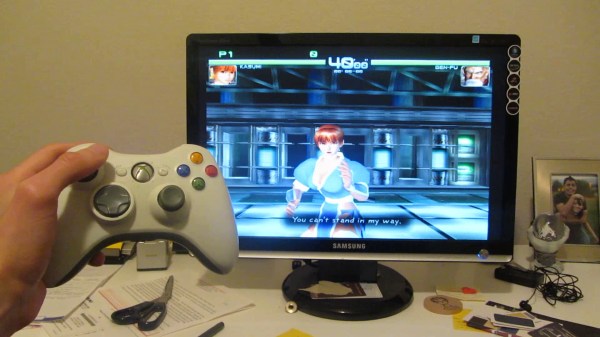
Perhaps the greatest convenience feature of modern consoles is the wireless controller. Eliminating the risk of tripping over cords and enabling play in all manner of poorly ergonomic positions, they added huge comfort to the console gaming experience. [ismell] was no fan of the Dreamcast’s original controller, and the cable was too short to boot. It was time to bring the 360 Wireless controller to Sega’s swansong.

Early attempts by [ismell] involved a Windows computer acting as a USB host for the 360 controller, which would then send out commands back to the Dreamcast via a Cypress EZ-USB FX2 microcontroller. If this sounds esoteric and messy, that’s because it is. It was also too slow to reliably work, as the Dreamcast’s Maple controller bus expects updates every millisecond, else it considers the controller disconnected.

Instead, a dedicated USB host was needed to speak to the 360 controller and also the Dreamcast. [ismell] landed on the MicroZed 7010, a System on Chip that also packs an FPGA on board. With Petalinux running on the board, it interfaces with the Xbox 360 USB wireless controller interface, and then sends the data out over a custom “network” driver that sends packets to the Dreamcast over the Maple bus.

It’s by no means a simple hack, and the MicroZed is far from cheap, but it works and works well as shown in the video below. We’ve seen other wireless controller adapters over the years, too – like the wild BlueRetro build. We always love to see a good retro console hack, so don’t be shy about sending in your own!

Continue reading “Wireless 360 Controllers Now On The Dreamcast”