Windows 3.1 Screensavers, Now On Twitter

Back in the early dawn of the GUI age, cathode ray tubes were the dominant display technology for the personal computer. In order to avoid burn-in of static display elements, screensavers were devised to help prevent this problem. Out of love for the software of yesteryear, [Greg Kennedy] has put together a bot that posts Windows 3.1 screensavers on Twitter.

A Perl script runs the show in this case. Screensavers are packed into “units”, which are loaded by the script. A basic Windows 3.1 environment is then configured, and loaded into a specially patched DOSBOX that allows automated demo recording in a headless environment. Once up and running, video is recorded of the desktop and subsequent triggering of the screensaver. After a couple of minutes, the recording is stopped, and FFMPEG is used to transcode the video into a Twitter-suitable format. It’s then a simple job of Tweeting the video using the standard API.

It’s a fun project that makes sharing old screensavers easy. Be sure to check out the Twitter feed @dot_scr. If you’re addicted to the vintage aesthetic, try this Apple ][ screensaver hack on your Linux boxen. Video after the break.


Continue reading “Windows 3.1 Screensavers, Now On Twitter”

Steam Bike Rocks It Old-School

Petrol engines dominate the world of the automobile, while electric propulsion races to take an ever larger market share. Despite this, some still hold a flame for steam power. Such aficionados would hold this build in high regard, from the recent past of 2014.

In steampunk, finish is everything.

The bike is of a recumbent design, featuring a relaxed riding position well suited to the sophisticated nature of a steam-powered vehicle. Sporting a wooden frame, the build carries a strong steampunk aesthetic. The flash boiler packs 100 feet of copper pipe, and there’s an electric pump and controller to handle water delivery from the stylish brass tank. The setup is capable of producing steam within 30 seconds of startup. Motive power is courtesy of a 1.5 inch bore single-cylinder steam engine, connected to the rear wheel via a belt drive.

There’s something intoxicating about the sounds and smells of a working steam engine, though the threat of catastrophic burns does temper the excitement just a touch. Steam power isn’t going away any time soon – and it’s not just limited to transport applications, either. Video after the break.

Continue reading “Steam Bike Rocks It Old-School”

Meccano Max Gets Hacked

There are plenty of “smart” toys out in the marketplace, some with more features than others. Nevertheless, most makers desire complete control over a platform, something that’s often lacking in any commercial offering. It was just this desire that motivated [MrDreamBot] to start hacking the Meccano Max.

Meccano Max is a small-statured companion robot, at about 30 centimeters high. Not content with the lack of an API, [MrDreamBot] decided to first experiment with creating an Arduino library to run Max’s hardware. With this completed, work then began on integrating a Hicat Livera devboard into the hardware. This is an embedded Linux system with Arduino compatibility, as well as the ability to stream video and connect over WiFi. Thus far, it’s possible to control Max through a browser, while viewing a live video feed from the ‘bot. It’s also possible to customize the expressions displayed on Max’s face.

Oftentimes, it pays to replace stock hardware rather than try and work with the limitations of the original setup, and this project is no exception. With that said, we’re still hoping someone out there will find a way to get Jibo back online. Look after your robot friends! Video after the break.

Continue reading “Meccano Max Gets Hacked”

Analog Gauges Keep An Eye On Computer Performance

Keeping an eye on your computer’s resource utilization can be useful, particularly if you’re regularly doing computationally intensive tasks. While it’s entirely possible to achieve this with software tools, creating a dedicated hardware monitor can be cool too. [Sasa Karanovic] did just that, with a set of old-school analog gauges.

The build uses an STM32 microcontroller to drive a series of four galvanometers through an MCP4728 digital-to-analog converter. Data on CPU, memory, network and GPU utilization is collected by a Python script, and sent over a USB serial connection. This data drives the four-channel DAC, which in turn creates the voltages which control the needle position on the gauges. Aesthetically, the build features a few nice touches, including custom gauge faces and a 3D printed enclosure with a tasteful matte finish. A custom PCB keeps the electronics and wiring neat and tidy.

[Sasa] does a great job of explaining the basic theory of the device, as well as practical considerations for working with galvanometer-based gauges. It would make a great weekend project for anyone seeking to add some vintage charm to their desktop rig. There’s also scope to monitor other variables, like hard drive usage or CPU temperature. There’s bonus points if you integrate this into a laptop; the tip line would love to know. We’ve seen LED-based monitoring systems before, too. Video after the break.

Continue reading “Analog Gauges Keep An Eye On Computer Performance”

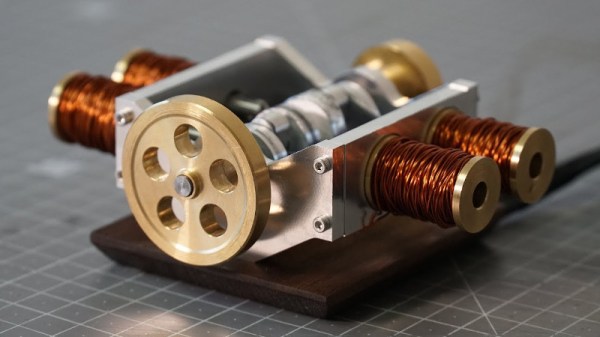
Stunning 4-Cylinder Solenoid Motor Should Be A Hit With Subaru Fans

As far as electric propulsion is concerned, the vast majority of applications make use of some kind of rotational motor. Be it induction, universal, brushed or brushless, these are the most efficient ways we have to do mechanical work with electricity. There are other, arcane methods, though – ones which [Maker B] explores with this 4-cylinder solenoid engine.

The principle of the solenoid engine is simple. Cylinders are wound with coils to act as solenoids, with the piston acting as the armature. When the solenoid is energised, it pulls the piston into the cylinder. The solenoid is then de-energised, and the piston can return to its initial position. The piston is coupled to a crankshaft via a connecting rod, and a flywheel is used to help the motor run continually. These are also known as reciprocating electric motors.

[Maker B]’s build is a 4-cylinder design in a boxer configuration. Produced with basic hand-operated machine tools, the build process is one to watch. Aluminium and brass are carefully crafted into the various components of the motor, and parts are delicately assembled with small fasteners and plenty of retaining compound. Solenoid timing is via a series of microswitches, installed neatly in the base of the motor and actuated by the crankshaft.

While solenoid motors are inefficient, they’re quite something to watch in action. This one is no exception, with the motor spinning up to 1100 rpm when running at 7.2 volts. We’d love to see some data on the power output and efficiency too. It’s possible to build solenoid motors in different configurations, too – this radial build is particularly fun. Video after the break.

Continue reading “Stunning 4-Cylinder Solenoid Motor Should Be A Hit With Subaru Fans”

Glitching LED Display Proves Crowd Favorite

There’s something enchanting about the soft glow of a properly diffused LED, and this is only improved by greater numbers of LEDs. [Manoj Nathwani] was well aware of this, setting out to build a large display using ping-pong balls for their desirable optical qualities.Unfortunately, not everything went to plan, but sometimes that’s not all bad.

The matrix, built back in 2016 for EMF Camp, was sized at 32×18 elements, for a total of 576 pixels. This was achieved with the use of 12 WS2811 LED strips, with the lights set out on a 50mm grid. Cheap knock-off pingpong balls were used for their low cost, and they proved to be excellent diffusers for the LEDs.

With everything wired up to a NodeMCU, basic testing showed the system to be functioning well. However, once the full matrix was assembled in the field, things started to fall over. Basic commands would work for the first 200 LEDs or so, and then the entire matrix would begin to glitch out and display random colors. Unable to fix the problem in the field, [Manoj] elected to simply run the display as-is. Despite the problems, passers-by found the random animations to be rather beautiful anyway, particularly at night.

After the event, [Manoj] determined the issue was due to the excessive length of the data line, which in the final build was 48 meters long. While the problem may be rectified when [Manoj] revisits the project, the audience seemed to appreciate the first revision anyway.

LED displays will be a hacker staple until the heat death of the universe. Ping pong balls will also likely retain their position as a favorite diffuser. If you’ve got a great LED build of your very own, be sure to hit up the tips line!

Arduino Bot Rocks A PS2 Controller

As far as controlling robots goes, makers today are spoilt for choice. WiFi and Bluetooth enabled microcontrollers are a dime a dozen, and integration with smartphone apps is a cinch. Despite this, the old methods still hold sway, as [Igor Fonseca] demonstrates with a simple Arduino bot.

It’s a classic build, using a tracked chassis with a pair of motors providing propulsion and skid steering. The motors are controlled by an L298N H-bridge board, with power courtesy of a trio of 18650 batteries. An Arduino Uno acts as the brains of the operation. Control is via a Playstation 2 controller, in this case a 2.4 GHz third party version. This allows the robot to be controlled wirelessly, with the decoding handled by [Bill Porter]’s useful Arduino library.

It’s a cheap approach to building a remote-controlled bot, and one that would be a great way to teach interested children about how to work with embedded systems. We’ve featured a similar build before, too. Video after the break.

Continue reading “Arduino Bot Rocks A PS2 Controller”