Conductive Cellulose-Based Fibers For Clothing: Coming Soon?

Summary of the process of producing side-by-side PANI and cotton cellulose fibers. (Credit: Wongcheng Liu et al., 2023)

With the rise of ‘smart’ devices, it seems like only a matter of time before smart fabrics become an every day thing. Yet a complication with these is that merely threading copper wires into clothing is neither practical nor very durable, which is why researchers have been trying to find a way to combine cellulose-based fibers like cotton with another, conductive material like carbon to create an affordable, resilient material which can provide the pathways for these smart fabrics. Recently a team at Washington State University created a version that integrates polyaniline (PANI, press release for paywalled paper), which is a well-known conductive polymer.

A recent review article by Duan-Chao Wang and colleagues in Polymers covers the research in conductive fibers, with conductive additives ranging from carbon nanotubes (CNT) and graphene to various metallic compounds and conductive polymers. As noted by Wang et al., a major aspect to successful commercialization is enabling scaling and cost-effectiveness of producing such fibers. This is the core of the achievement by the WSU team, who used a side-by-side structure of a cellulose substrate and the PANI conductive covering, which should be easier to produce and more durable than previous attempts to merge these two materials into conductive fibers suitable for fabrics.

Other research by Zhang-Chi Ling and colleagues, as reported earlier this year in NPG Asia Materials, details the creation of composite, conductive fibers made from bacterial cellulose with in-situ entanglement of CNTs. With even 100,000 bending cycles not showing much degradation, this could be another good candidate for conductive fabrics. Which of these approaches will first hit mass-production is still anyone’s guess, but we might see them sooner rather than later.
The Logg Dogg: How A Mysterious Logging Robot Leads Down Twisting Forestry Paths

There are many places where you’d want to use remotely controlled robots, but perhaps forestry isn’t the first application to come to mind. Yet there are arguments to be made for replacing something like a big logging machine with grapple for a much smaller robot. The reduced ground pressure can be beneficial in fragile ecosystems, and removing the operator is much safer if felling a tree goes wrong.

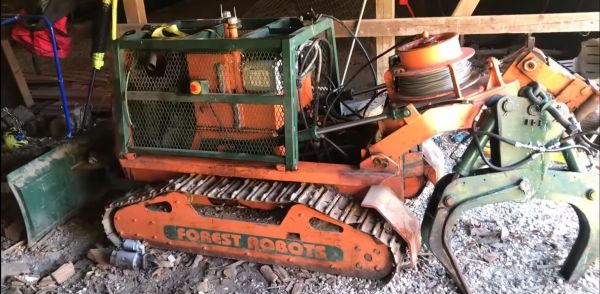
This is where a US company called Forest Robots tried to come in, with their Logg Dogg, of which [Wes] over at Watch Wes Work found a very unique prototype abandoned in a barn, courtesy of Zuckerberg’s marketplace of wonders.

One of the two receivers on the Forest Robots' Logg Dogg logging robot prototype. (Credit: Watch Wes Work)
One of the two receivers on the Forest Robots’ Logg Dogg logging robot prototype. (Credit: Watch Wes Work)

After lugging the poor abandoned robot back into a warm repair shop, he set to work on figuring out what it was that he had bought. At the time he knew only that it was some kind of logging robot, but with no model number or name on the robot, it was tough to find information. Eventually he got tipped off about it being the Logg Dogg, with even a video of the robot in action, helpfully uploaded to YouTube by [Hankey Mountain Garage] and embedded below for your viewing pleasure.

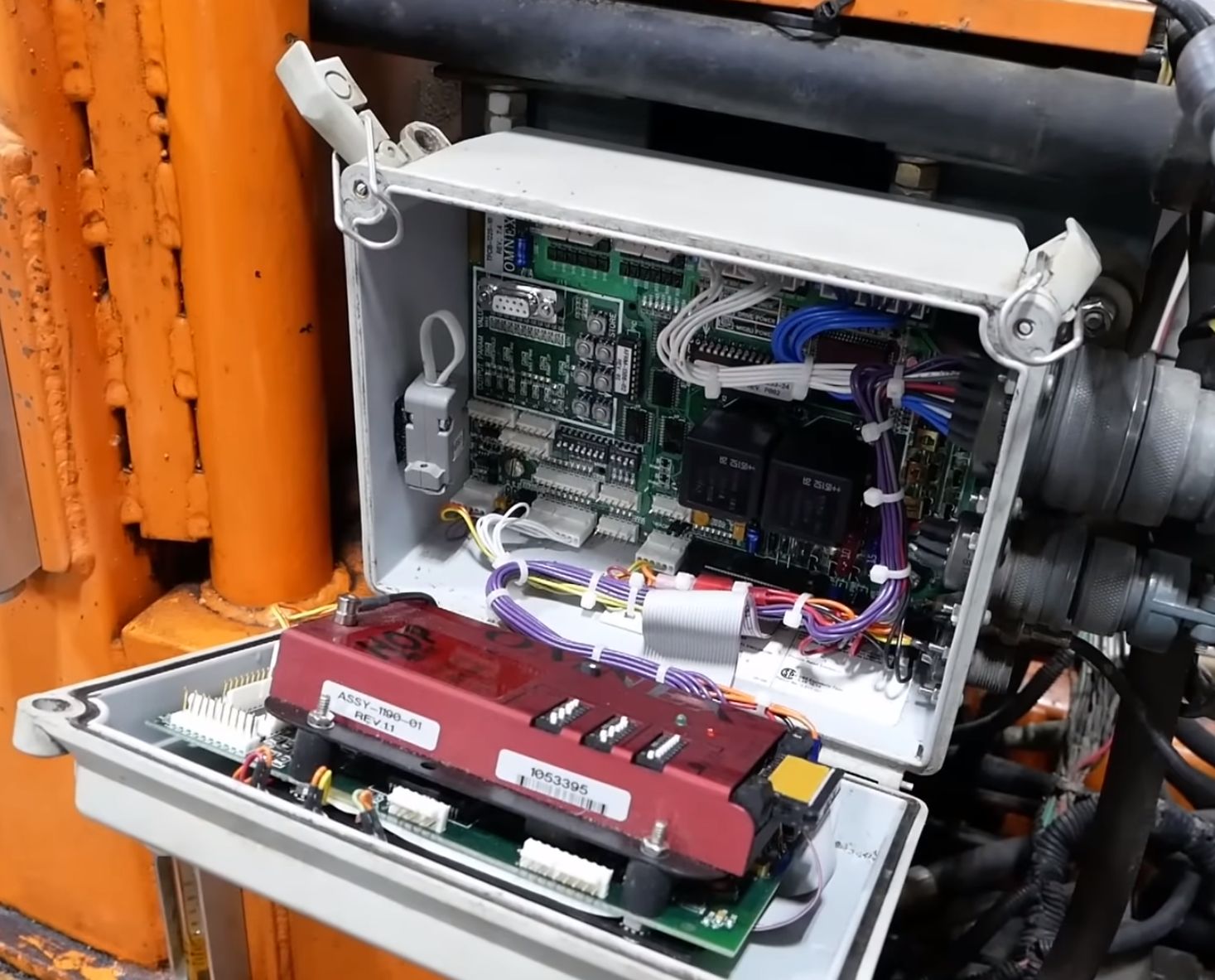
As [Wes] noticed during teardown and inspection was that it has that distinct mix-and-match feel to it of a prototype, ranging from metric and US customary bolts to both European and US/Canadian supplied components. Although it has two RF receivers on the device, no remote(s) came with the device, and the seller only knew that it was already in the barn when they purchased the place. After getting the engine working again on the robot, [Wes] contacted one of the people behind the robot: [Dean Edwards], a professor at the University of Idaho, hoping to learn more about this robot and how it ended up abandoned in a barn.

Hopefully we’ll find out in a Part 2 whether [Wes] got a response, and whether this robot will get a second chance at life. Meanwhile, in countries such as Portugal such robots are already finding significant use, including for fire protection in its forests, tackling difficult terrain more easily than humans. With forest fires an increasing risk, perhaps the Logg Dogg and kin could find a use there.

Continue reading “The Logg Dogg: How A Mysterious Logging Robot Leads Down Twisting Forestry Paths”

Building A Solar-Powered, Supercapacitor-Based Speaker

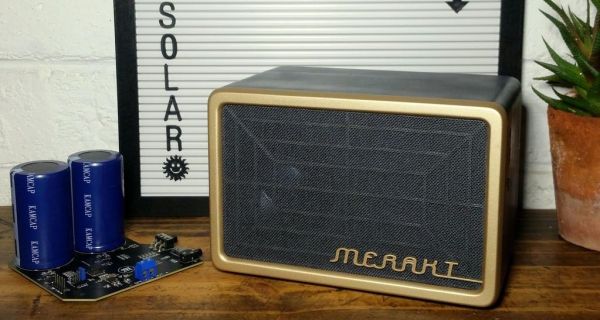
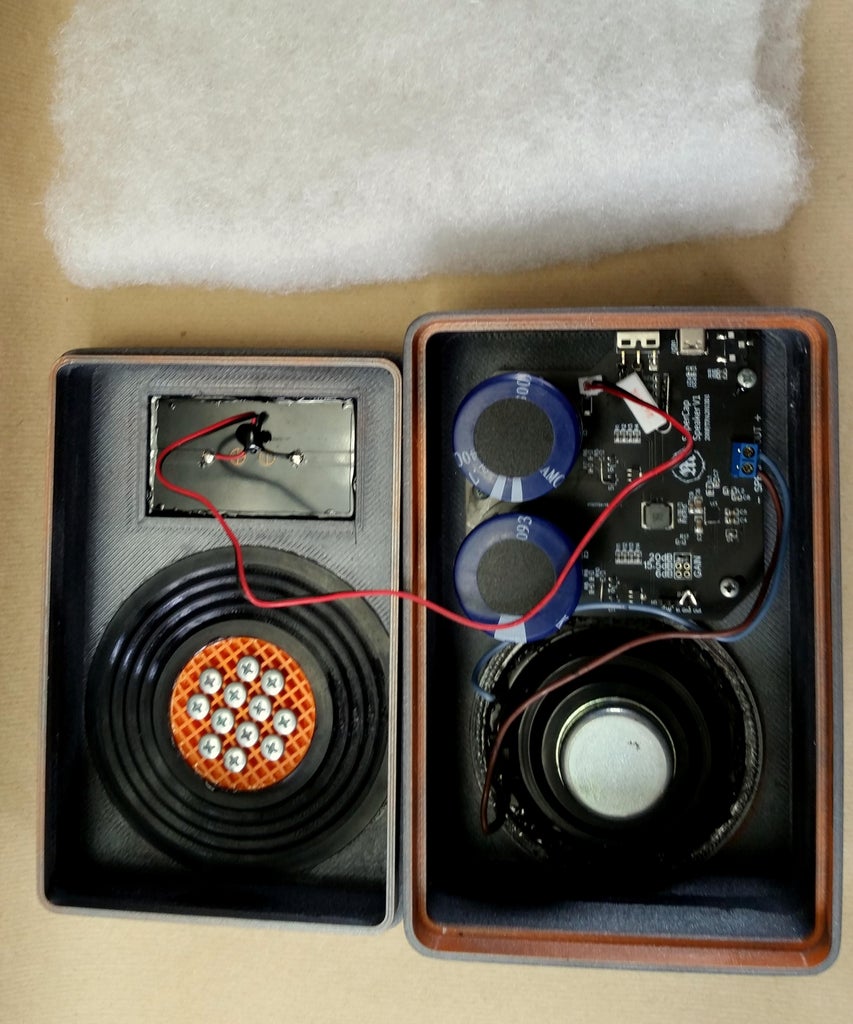
Inspired by many months of hours-long load shedding in South Africa, [JGJMatt] decided to make a portable speaker that can play tunes for hours on a single charge and even charge off the integrated solar panel to top the charge off. None of this should sound too surprising, but what differentiates this speaker is the use of two beefy 400 F, 2.7 V supercapacitors in series rather than a lithium-ion battery on the custom PCB with the Ti TPA2013D1 Class-D mono amplifier.

Insides of the speaker prior to stuffing and closing.

The reason for supercapacitors is two-fold. The first is that their lifespan is much longer than that of Li-ion batteries, the second that they can charge much faster. The disadvantages of supercapacitors come in the form of their lower energy density and linear discharge voltage. For the latter issue the TPA2301D1 amplifier has a built-in boost converter for an input range from 1.8 – 5.5 V, and despite the lower energy density a solid 6 hours of playback are claimed.

Beyond the exquisitely finished 3D printed PETG shell and TPU-based passive bass radiator, the functionality consists out of a single full-range speaker and an analog audio input (TRS jack and USB-C). To add Bluetooth support [JGJMatt] created a module consisting out of a Bluetooth module that connects to the USB-C port for both power and analog audio input.

Charging the speaker can be done via the USB-C port, as well as via the solar panel. This means that you can plug its USB-C port into e.g. a laptop’s USB-C port and (hopefully) charge it and play back music at the same time.

For those feeling like replicating this feat, the Gerbers, bill of materials, enclosure STLs, and everything else needed can be be found in the tutorial.

Continue reading “Building A Solar-Powered, Supercapacitor-Based Speaker”

How Germany’s Troubled Pebble Bed Reactor Came Of Age In China

Although the concept of nuclear fission is a simple and straightforward one, the many choices for fuel types, fuel design, reactor configurations, coolant types, neutron moderator or reflector types, etc. make that nuclear fission reactors have blossomed into a wide range of reactor designs, each with their own advantages and disadvantages. The story of the pebble bed reactor (PBR) is among the most interesting here, with its development winding its way from the US Manhattan Project over the Atlantic to Germany’s nuclear power industry during the 1960s, before finding a welcoming home in China’s rapidly growing nuclear power industry.

As a reactor design, PBRs do not use fuel rods like most other nuclear reactors, but rather spherical fuel elements (‘pebbles’) that are inserted at the top of the reactor vessel and extracted at the bottom, allowing for continuous refueling, while helium acts as coolant. With a strong negative temperature coefficient, the design should be extremely safe, while providing high-temperature steam that can be used for applications that otherwise require a coal boiler or gas turbine.

With China recently having put its twin-PBR HTR-PM plant into commercial operation, why is it that it was not the US, Germany or South Africa to first commercialize PBRs, but relative newcomer China?

Continue reading “How Germany’s Troubled Pebble Bed Reactor Came Of Age In China”

5Ghoul: The 14 Shambling 5G Flaws Used For Disruptive Attacks On Smartphones

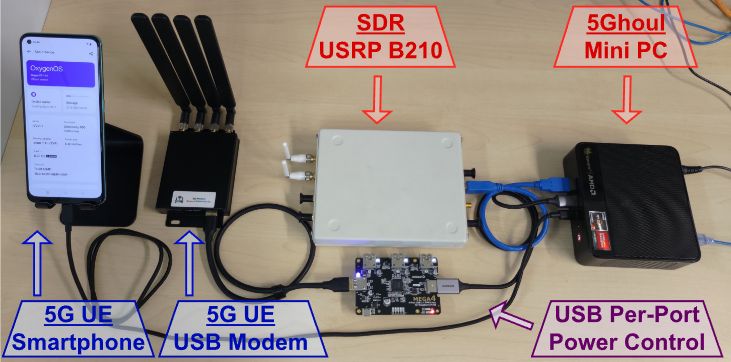
A team of researchers from the ASSET Research Group in Singapore have published the details of a collection of vulnerabilities in the fifth generation mobile communication system (5G) used with smartphones and many other devices. These fourteen vulnerabilities are detailed in this paper and a PoC detailing an attack using a software defined radio (SDR) is provided on GitHub. The core of the PoC attack involves creating a malicious 5G base station (gNB), which nearby 5G modems will seek to communicate with, only for these vulnerabilities to be exploited, to the point where a hard reset (e.g. removal of SIM card) of the affected device may be required.

Hardware Setup for 5Ghoul PoC testing and fuzzer evaluation. (Credit: Matheus E. Garbelini et al., 2023)

Another attack mode seeks to downgrade the target device’s wireless connection, effectively denying the connection to a 5G network and forcing them to connect to an alternative network (2G, 3G, 4G, etc.). Based on the affected 5G modems, the researchers estimate that about 714 smartphone models are at risk of these attacks. Naturally, not just smartphones use these 5G modem chipsets, but also various wireless routers, IoT devices, IP cameras and so on, all of which require the software these modems to be patched.

Most of the vulnerabilities concern the radio resource control (RCC) procedure, caused by flaws in the modem firmware. Android smartphones (where supported) should receive patches for 5Ghoul later this month, but when iPhone devices get patched is still unknown.

Voyager 1 In Trouble As Engineers Scramble To Debug Issue With Flight Data System

Recently the team at JPL responsible for communication with the Voyager 1 spacecraft noticed an issue with the data it was returning from the Flight Data System (FDS). Although normally the FDS is supposed to communicate with the other subsystems via the telecommunications unit (TMU), this process seems to have broken down, resulting in no payloads from the scientific instruments or engineering sensors being returned any more, just repeating binary patterns. So far the cause of this breakdown is unknown, and JPL engineers are working through potential causes and fixes.

This situation is not unlike a similar situation on Voyager 2 back in 2010 when the returned data showed a data pattern shift. Here resetting the memory of the FDS resolved the garbled data issue and the engineers could breathe a sigh of relief. This time the fix does not appear so straightforward, as a reset of the FDS on Voyager 1 did not resolve the issue with, forcing the team to consider other causes. What massively complicates the debugging is that each transmission to and from the spacecraft takes approximately 22.5 hours each way, making for an agonizing 45 hour wait to receive the outcome of a command.

We wish the JPL engineers involved all the luck in the world and keep our collective appendages crossed for Voyager 1.

Make Carbon Fiber Tubes With An Open Source Filament Winder

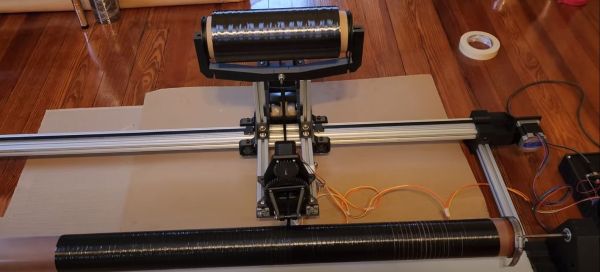
Result of winding a carbon fiber tube. (Credit: Andrew Reilley)

Carbon fiber (CF) is an amazing material that provides a lot of strength for very little weight, making it very useful for a lot of applications, ranging from rods in CoreXY 3D printers to model- and full-sized rockets. The model rocketry hobby is the reason why [Andrew Reilley] developed his own CF tube winding machine called Contraption. A tutorial video (also embedded below) shows how this machine is prepped for a winding run, followed by the winding progress and finalizing before admiring the result.

The entire machine’s design with 3D printed parts and off-the-shelf components is open source, as is the TypeScript and NodeJS-based Cyclone software that creates the toolpath specifying the parameters of the tube, including number of layers and the tow angle.

As a wet winding tow machine, the carbon fiber strands are led through the liquid resin before being wound onto the prepared mandrel. During winding some excess resin may have to be removed, and after the winding has been finished the tube is wound with shrink tape. This is followed by a heat gun session to shrink the tape and letting the resin cure. Following curing, the tape and mandrel are removed, resulting in a rather fancy looking CF tube that can find a loving home in a lot of applications, except perhaps ones that involving crushing outside pressures like those found deep below the ocean surface.

Continue reading “Make Carbon Fiber Tubes With An Open Source Filament Winder”