Would We Recognize Extraterrestrial Technology If We Saw It?

There’s a common critique in science fiction series like Star Trek about the extraterrestrial species not looking ‘alien’ enough, as well as about their technology being strangely similar to our own, not to mention compatible to the point where their widgets can be integrated into terrestrial systems by any plucky engineer. Is this critique justified, or perhaps more succinctly put: if we came across real extraterrestrial life with real extraterrestrial technology, would we even notice? Would an alien widget borrowed of an alien spacecraft even work with our own terrestrial spacecraft’s system?

Within the domain of exobiology there are still plenty of discussions on the possible formation and evolutionary paths conceivable within the Universe, but the overarching consensus seems to be that it’s hard to escape the herding effect of fundamental physics. For lifeforms, carbon-based chemistry is the only reasonable option, and when it comes to technology, it’s hard to not end up at technology using the same physical principles which we presume to exist across the Universe, which would practically guarantee some level of interoperability.

What’s notable here is that over the past years, a number of people have claimed to have observed potential alien technology in our Solar System, in particular the ʻOumuamua asteroid in 2017 and a more recent claim by astrophysicist Abraham Loeb regarding an interstellar meteor that impacted Earth in 2019, which he says could be proof of ‘alien technology’. This raises the question of whether we are literally being pummeled by extraterrestrial spacecraft these days.

Continue reading “Would We Recognize Extraterrestrial Technology If We Saw It?”

Exploring Tropical Rainforest Stratification Using Space-Based LiDAR

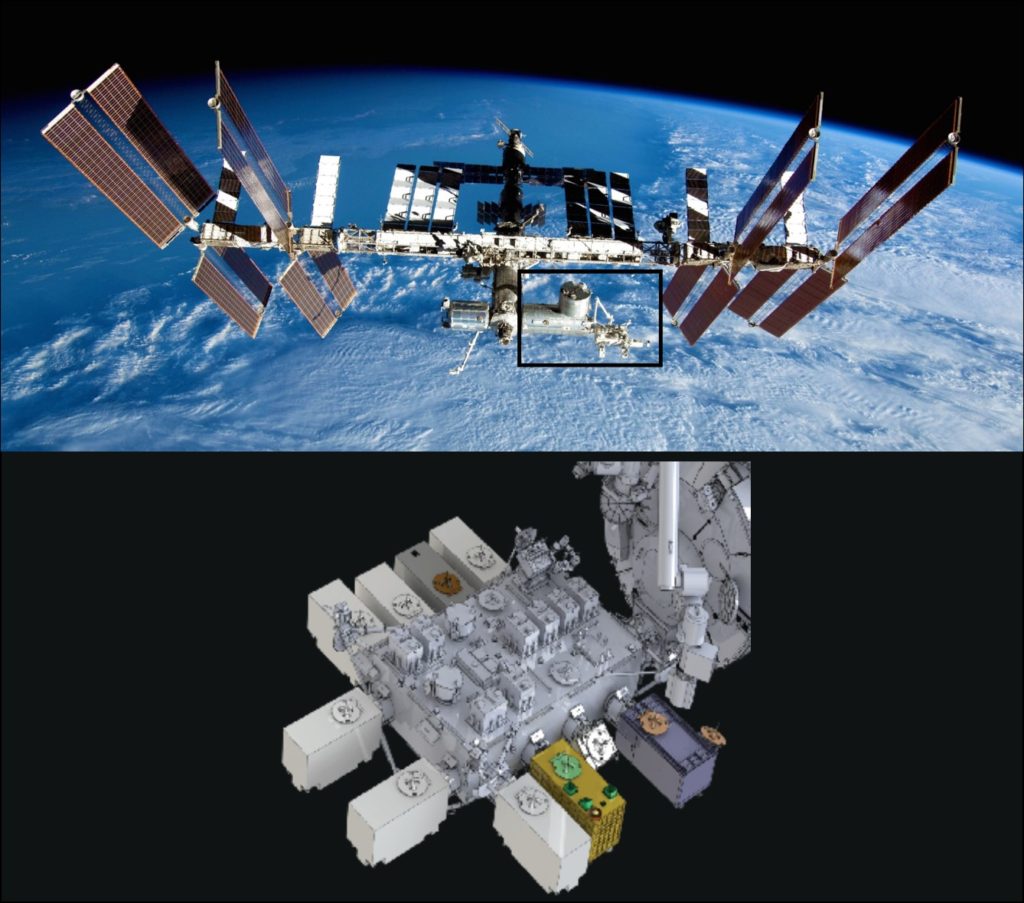
GEDI is deployed on the the Japanese Experiment Module – Exposed Facility (JEM-EF). The highlighted box shows the location of GEDI on the JEM-EF.

Even though it may seem like we have already explored every single square centimeter of the Earth, there are still many areas that are practically unmapped. These areas include the bottom of the Earth’s oceans, but also the canopy of the planet’s rainforests. Rather having herds of explorers clamber around in the upper reaches of these forests to take measurements, researchers decided to use LiDAR to create a 3D map of these forests (press release).

The resulting GEDI (Global Ecosystem Dynamics Investigation) NASA project includes a triple-laser-based LiDAR system that was launched to the International Space Station in late 2018 by CRS-16 where it has fulfilled its two-year mission which began in March of 2019. Included in the parameters recorded this way are surface topography, canopy height metrics, canopy cover metrics and vertical structure metrics.

Originally, the LiDAR scanner was supposed to be decommissioned by stuffing it into the trunk of a Dragon craft before its deorbit, but after NASA found a way to scoot the scanner over to make way for a DOD payload, the project looks to resume scanning the Earth’s forests next year, where it can safely remain until the ISS is deorbited in 2031. Courtesy of the ISS’s continuous orbiting of the Earth, it’ll enable daily monitoring of its rainforests in particular, which gives us invaluable information about the ecosystems they harbor, as well as whether they’re thriving or not.

Hopefully after its hibernation period the orbital LiDAR scanner will be back in action, as the instrument is subjected to quite severe temperature changes in its storage location. Regardless, putting LiDAR scanners in orbit has to be one of those amazing ideas to help us keep track of such simple things as measuring the height of trees and density of foliage.

Running A Modern Graphics Card In A 33 MHz PCI Slot

If you ever looked at a PCI to PCIe x16 adapter and wondered what’d happen if you were to stick a modern PCIe GPU in it, the answer apparently is ‘it works’ according to an attempt by [Circuit Rewind]. As long as you accept needing to supply external power with even a low-end GT 1030 card – as the PCI slot cannot provide enough power – and being limited to a single PCIe lane. This latter point isn’t so much of an issue as a single PCIe lane offers more bandwidth than the (shared) PCI bus anyway.

Despite the somewhat improvised setup, the GT 1030 card provided a decent 1080p experience in a range of games, after removing half of the 8 GB of system RAM before the configuration would work, probably due to VRAM mapping issues. Since the mainboard used also offered PCIe, the same card was run in a PCIe x4 slot, as well as in an x1 configuration, both with noticeably higher performance and putting the ‘why’ in ‘try’.

Perhaps unsurprisingly, a RTX 3080 also booted fine with external power and only 4 GB system RAM installed. Despite the PCIe x1 link, the system was able to finish a 3D benchmark and play Doom 2016, but with only 4 GB of system RAM and an old Athlon quad-core CPU, it was a terrible experience. Perhaps the most fascinating lesson to learn from this is that PCI and PCIe are amazingly compatible with only a simple translation bridge, even if high-performance graphics aren’t quite what PCI was meant for. After all, that’s why we got cursed with AGP for many years.

Continue reading “Running A Modern Graphics Card In A 33 MHz PCI Slot”

VanMoof E-Bike Bankruptcy: The Risks Of Cloud-Connected Transport

When the bankruptcy of VanMoof, the company behind a series of e-bikes, was announced recently, many probably shrugged at this news. After all, what is an e-bike but a regular bicycle that has some electronics and a battery strapped to it to assist with cycling? Unfortunately for owners of a VanMoof e-bike, their fancy wheels come with a Bluetooth-connected smartphone app that somehow involves storing a special encryption key on the VanMoof servers, as detailed by [Gergely Orosz] at the Pragmatic Engineer. Without this key that is connected to your VanMoof account, your VanMoof app cannot communicate with your VanMoof e-bike.

Although basic functionality of the e-bike will be retained, features such as setting the gear modes, changing assistance mode, locking the bicycle and other features not exposed on the bicycle itself will be lost. Essentially this is the equivalent of losing the remote control to a modern-day TV and getting locked out of 90% of the device’s features.

Fortunately, as [Gergely] and others are (urgently) pointing out to VanMoof e-bike owners, this special key can be downloaded with a Key Exporter project on GitHub, as well as obtained and used with an alternative app by Cowboy Bikes, which is a competitor of VanMoof. The unfortunate reality remains, however, that should you lose this special key, you are going to be in a world of pain as your expensive e-bike now is mostly an e-brick.

(Thanks to [Jan Praegert] for the tip)

Keeping Thermal Plants Cool Without Breaking The Cooling Water Budget

Steam generators in thermal (steam-cycle) power plants require a constant influx of cool water to maximize the transfer of thermal energy. How this water is cooled again in the condensor after much of the steam’s thermal energy has been spent in the steam turbines or heat exchangers is a very important consideration in the design and construction of these plants. The most obvious and straightforward system is direct “once-through” cooling, where the water is drawn straight from a nearby river or other body of water and released after passing through the condenser. This type of system is by far the cheapest, but is also impacted by both the seasons and environmental considerations.

Where cool surface water is less abundantly available, evaporative cooling in a recirculating system such as with spray ponds and cooling towers is a good alternative. Although slightly more costly, a big benefit of these is that they require far less water and have much more control over the intake water temperature, which can raise plant efficiency. Finally, dry cooling is essentially a closed-loop system, which is exceedingly useful in areas where water is scarce. This latter type of cooling is what allows thermal plants to operate even in desert regions.

As the global climate changes – with more extreme weather events – picking the right cooling solution is more important than ever, and has us looking at retrofitting existing thermal plants with more efficient solutions. If you were ever curious how power plants keep the cool side cool, read on!

Continue reading “Keeping Thermal Plants Cool Without Breaking The Cooling Water Budget”

MicroLisp: Lisp For Microcontrollers Now Has Lisp-Based ARM Assembler

In a way it feels somewhat silly to market a version of Lisp as targeting resource-constrained platforms, considering the systems it ran on back in the 1960s, but as time goes on, what would have given 1970s Big Iron a run for its money is now a sub-$5 microcontroller that you can run uLisp (MicroLisp) on. This particular project now even has an ARM assembler that is written in Lisp whose source code (GitHub) fits on a mere two A4-sized pages.

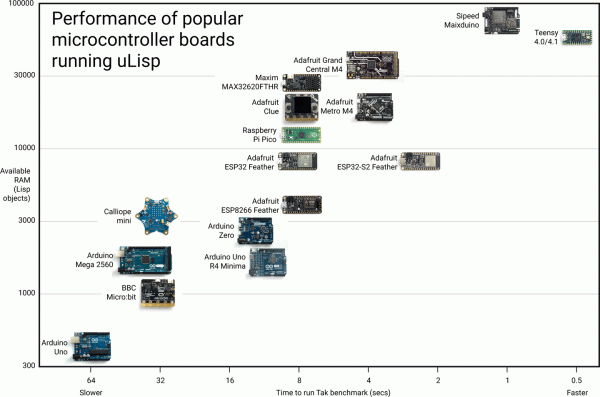
ULisp currently supports five platforms, being AVR-nano (ATmega328 and similar low-cost AVRs), AVR, ARM, ESP (8266 and 32), as well as RISC-V. The purpose of this assembler is to execute native ARM instructions when running on an ARM board, since uLisp itself runs a Lisp interpreter on the platform. When executed natively like this, a considerable speed-up of the task can be expected, as illustrated by a number of ARM assembler examples in the documentation.

Running a Fibonacci sequence that takes 24.6 seconds with the Lisp version on an Adafruit Metro M4 is reduced to a mere 61 ms when ARM assembly is used instead. This shouldn’t be too shocking, since this assembler essentially bypasses the Lisp runtime, coming closer to what would be the performance of firmware written in e.g. C. However, it also demonstrates that with this ARM assembler it is possible to have your Lisp and still get native performance when you want it, all using Lisp code.

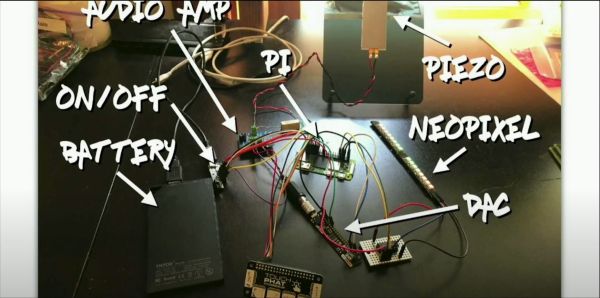
Testing the World's Thinnest Boombox with a modular setup containing the basic components.

Supercon 2022: Joe Grand And The Thinnest Boombox

Boomboxes are one of those status symbols that define the 1980s and part of the 1990s, being both a miracle of integration and the best way to share your love of music with as many people as possible. Naturally, this led Joe Grand to figure that it would make it a perfect subject for a modern take on such an iconic device. The primary inspiration for this came from a piezo speaker developed by TDK called the ‘PiezoListen’. These are piezo devices that can be less than a millimeter thick, while still claiming to reproduce a broad range of audio frequencies.

Just having these speakers is only part of the solution, of course, which led Joe down the rabbithole of not only figuring out the components that should go into the system, but also how to get it all on a single PCB and see how far one can push different solder mask colors with an appropriately boombox-like design. At its core is a Raspberry Pi Zero 2 W that runs Mopidy, to provide music server functionality. Also added are some RGB lighting and touch controls.

Continue reading “Supercon 2022: Joe Grand And The Thinnest Boombox”