RFID RGB Lamp Goes The Distance

rfid-RGB-lamp

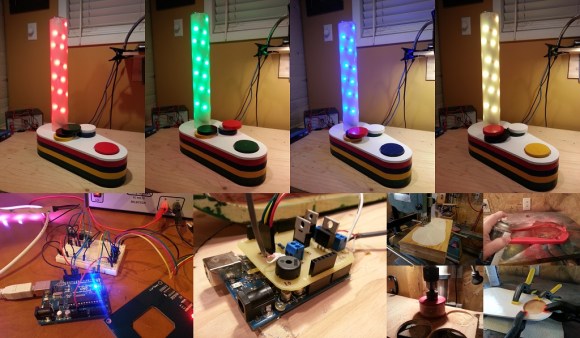
[Philippe Chrétien’s] project makes it to our front page just based on its completeness. When you hear about a multicolored lamp which changes based on an RFID tag you might not get too excited. When you look at the refined electronics and the quality of the wooden enclosure it’s another story entirely.

As we’ve said many times before, coming up with the idea for a project is the hardest part… especially when you just want to start hacking. With his kids in mind [Philippe] figured this would be something fun for them to play around with, opening the door to discussing the electronics concepts behind it.

He prototyped on a breadboard using three N-type MOSFETs to drive the colors of an RGB LED strip. The proven circuit was laid out and etched at home to arrive at the clean-looking Arduino shield shown off above. The entire thing gets a custom enclosure cut using layered plywood, a paper template, and a bandsaw.

Need a use for this once the novelty has worn off? Why not mod it to use as a motion activated night light? Alas the actual project link for that one is dead, but you get the idea.
8-Bit Video Game Is Best Of Retro Gaming On A Shoestring Budget

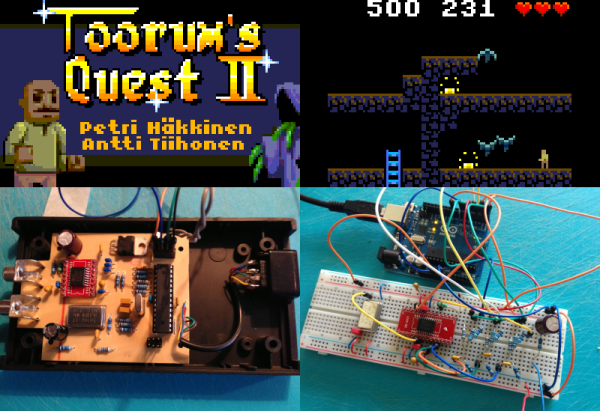
[Petri] wrote in to show off the 8-bit gaming system and original platformer which he and [Antti] developed. Don’t get us wrong now, it’s impressive that the duo were able to put together what looks like a very interesting game. But we’ve seen many industry-leading video games developed with just one or two people (we’re thinking all the way back to the days of Atari). Nope, what’s most interesting to us is that the console is also their creation. We should note that the title screen was the work of their friend [Juho].

Take this with a grain of salt, as the bottom right image in the vignette obviously includes an Arduino. But isn’t it a testament to the state of open hardware and the sharing of knowledge through the Internet that this is even possible on the hobby level? And just because we call it “hobby” doesn’t mean you have to lower your expectations. This thing is full featured. Watch the clip after the break to see the ATmega328 driving a 104×80 resolution screen with a 256 color palette, while using four audio channels for the chiptunes. The thing even utilizes an original NES controller port for user input.

And for those of you who are thinking we’ve seen the same thing before, we never get tired of seeing projects where a lot of hard work has obviously paid off!

Continue reading “8-Bit Video Game Is Best Of Retro Gaming On A Shoestring Budget”

Breadboard Friendly ARM Board Based On STM32F4

breadboard-friendly-stm32-dev-board

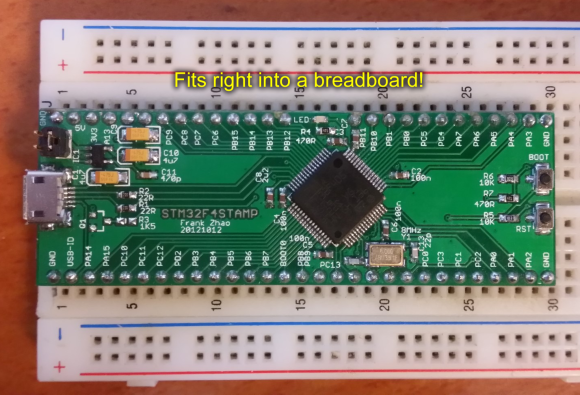
Umm yeah… this is more like it. The STM32F4Stamp is a project which [Frank Zhao] put together to make his ARM prototyping process more like is was back when everything came in a DIP format. As you can see, it’s just narrow enough to leave one row open on the breadboard for jumper wires.

Don’t get us wrong, we do really like STM’s own Discovery Boards for the hardware they deliver at a very low price. But the dual-row pin headers on the larger versions (all except the F0 variant) make it tricky to connect your peripherals. This is pushed to the point that a large percentage of hacks we’ve seen with the Discovery boards are actually just to make connecting external hardware easier.

You may be thinking that there’s a lot missing from this board, but we disagree. Obviously there’s still a USB port which can be used to power the board via a 3.3V regulator. But since the STM32 chips have a built-in bootloader the USB connection can also be used to flash firmware to the processor. Nice! It’s open hardware if you want roll your own. For your convenience we’ve embedded the schematic after the break, along with [Frank’s] demo video.

Continue reading “Breadboard Friendly ARM Board Based On STM32F4”

Robot Painter Works Like A Photobooth

robot-painter-photo-booth

[Ben], [David], [Drew], [Kayla], and [Peter] built a robotic artist as their senior design project. This mashes up a bunch of different project ideas, but the thing we like the most about it is that it works much like a photo booth that produces a painting. A Raspberry Pi uses a webcam to snap the picture, converts the image to three colors (plus the white background of the canvas) and sets the robot in motion. The team laments that initial testing of the completed project (seen in the clip below) worked out quite well but took hours to produce the painting. What do they expect? It’s art!

This is quite a bit different from the WaterColorBot (whose manufacturing process we just looked in on yesterday). WaterColorBot uses a flat canvas and a gantry system. This offering, which is called PICASSAU, uses an upright canvas with the paintbrush mounted in much the same way as a plotter robot. The biggest difference is that there is the ability to pivot the paint brush in order to pick up more paint, and for cleaning in between color changes.

Continue reading “Robot Painter Works Like A Photobooth”

How Hacker News Page Rankings Really Work

Page rankings are the secret sauce of websites that automatically aggregate user submissions. The basic formula used by Hacker News was published a few years back. But there are several pieces of the puzzle that are missing from that specification. [Ken Shirriff] recently published an analysis that digs deeper to expose the article penalization system used by Hacker News’ ranking engine.

One might assume that the user up and down votes are what determine a page’s lifespan on the front page. But it turns out that a complex penalization system makes a huge difference. It takes into account keywords, and domain names but also weighs controversy. It’s a bit amusing to note that this article on the topic was itself penalized, knocking it off of the front page.

You can get the full details of the system from his post, but we found his investigation methods to be equally interesting. He scraped two pages of the news feed every minute using Python and the Beautiful Soup package (a pretty common scraping practice). This data set allowed him to compare the known algorithm with actual results. What was left were a set of anomalies that contained enough sense for him to reverse engineer the unpublished formulas being used.

Hackaday Links: November 24, 2013

hackaday-links-chain

We love home theater hacks and this one especially since it is also part of a larger home automation project. [Falldeaf] use Z-Wave wireless home automation and includes mains switching for his television. The only problem being that when power is switch back on the TV remains in the standby state. His solution was to use an ATtiny85 to detect power, then push the IR code to turn the TV on after a short delay.

[Pjkim] wanted to prototype using the Tiva Launchpad on his Mac. He managed to get a toolchain up and running that includes the TivaWare libraries. He put together a guide that shows how to set up Eclipse and Energia for the Tiva family. If you haven’t heard of Energia check out the Github Readme.

Most folks have a smartphone and you can bet that the handsets are Bluetooth enabled. But we think there is still a low percentage who are connecting their smartphone audio to wireless speakers. [Anton Veretenenko] shows how you can use some cheap KRC-86B modules from Ali Express to make your own wireless speakers. He’s even powering his hack with a single 18650 Li-Ion cell.

Taking a turn away from electronics we got a chuckle out of [CADFood’s] plan to make pearls with his bicycle. He used DesignSpark Mechanical to model what amounts to a bicycle powered ball mill. It attaches to his spokes and after taking a hammer to some oyster shells he loads them up and goes for a ride. Well actually he needs to go for a bunch of rides. The idea is that about six months of bicycling will yield a cache of pearls. [Thanks Holger]

We enjoyed this article on how designing powered scooters is changing engineering education. We’re happy to see that hacking is starting to be widely accepted as a functional and effective way to gain and pass on knowledge.

If you have access to a 3D printer you can own some of the relics from the Smithsonian. They’ve been 3D scanning some pieces in their collection and you can download the models.

And finally, [GravityRoad] is working on building a delta-bot arm to use as part of a performance art project. Check out one of the most recent development videos and if that gets you interested there’s much more on the website. [Thanks Charles]


Pimp My Keyboard: Automatic Lift Kit And More

Cherry-keyboard-with-lifts

Wondering what the heck a lift kit is? You know those low-riding cars that bounce? That’s the idea with this hack. [Justblair] added automatic height adjustment to his Cherry G80, and hid a few other extras while he was at it. Since there’s a fair amount of room inside the case of this model he was able to hide everything and keep just a single cord to run it all.

Certainly what catches your eye is the keyboard’s ability to rise to a typing height automatically. This is accomplished with a few servo motors and some 3D printed replacement feet. There were some hiccups along the way with under-powered servos, but bulking up to some HXT 900 9G models provide more power than is currently necessary. The automatic feature is thanks to a capacitive sensor built with a wire that loops the perimeter of the keyboard.

Of course to monitor the sensor and drive the servos you need some kind of brain. For that [Justblair] went with an ATmega32U4 breakout board. Since he had to patch into USB for power anyway he added a USB hub and routed one of the ports out the left side of the keyboard as a convenient way to connect other peripherals. There was even room to include an RFID reader which he uses to unlock his sessions (similar to the desk install from earlier this year). There’s still a lot of potential left in that hardware. To make future improvements easier the hack includes an IDC socket as an auxiliary port.

[Justblair] did a great job of sharing his work. His post links to a Github repo for the code and a Thingiverse project for the 3D printed legs. And it wouldn’t be complete without the demo video which is found below.

Continue reading “Pimp My Keyboard: Automatic Lift Kit And More”