CNC Ping Pong Printer Uses Simple Construction

spherebot

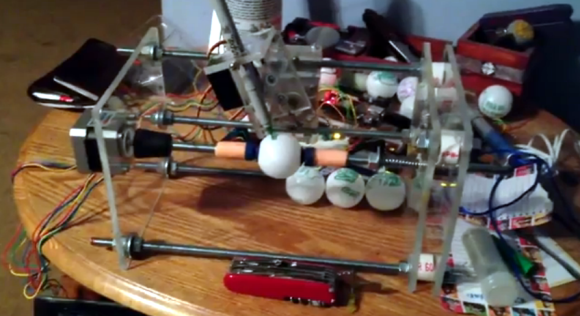
This is one of the simplest CNC builds we’ve seen but it still functions quite well. It’s a clone of the EggBot, but is aimed at printing on spherical Ping Pong balls rather than oblong eggs. [Chad] calls it the Spherebot, but you should be careful not to confuse it with the morphing sphere robot which can walk around like a hexapod.

The project is both mechanically and electronically simple. The body of the printer is made up of three acrylic plates, which we’re sure were clamped together when drilling holes to guarantee proper alignment. Threaded rod and nuts are used to mount the plates to one another, as well as to hold the sphere in place while printing. One stepper motor turns the ball while the other pivots the pen mount. A servo motor is responsible for lifting the pen. The entire thing is driven by an Arduino along with two stepper motor driver boards. Don’t miss [Chad’s] presentation embedded after the break.

Continue reading “CNC Ping Pong Printer Uses Simple Construction”
ATtiny2313 Frequency Meter Measures 1Hz-10MHz

attiny2313_frequency_meter

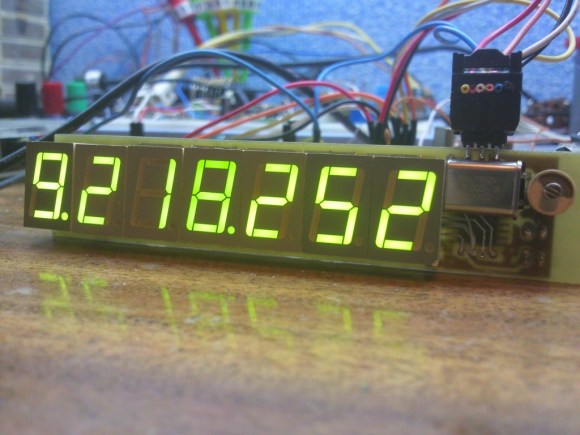
This frequency meter project squeezes a lot of performance out of the ATtiny2313 microcontroller. That chip does all of the work, measuring the frequency on the input pin as well as multiplexing the set of 7 seven-segment displays which read out the measurement.

The system is only as accurate as the clock crystal used by the AVR chip, so [Manekinen] recommends using one with the best tolerances available. It is also necessary to choose a value which is divisible by 1024 to get the best combination of accuracy and resolution. In this case he’s using a 22.1184 MHz crystal oscillator which is a slight overclocking of the chip which is spec’d to run at 20 MHz max.

We didn’t totally follow his explanation of how the two timers are used for counting. But if we really wanted to drill down for a full understanding his code (written in BASCOM-AVR) is available. If you’re just interested in the hardware we embedded a screenshot of the schematic after the break.

Continue reading “ATtiny2313 Frequency Meter Measures 1Hz-10MHz”

LiFePO4 Batteries Work Much Better In A Camera Than NiMH

SAMSUNG

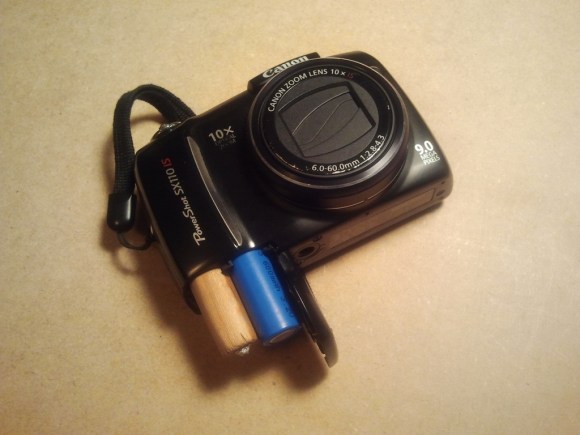
We agree with [Zapmaker] that Canon cameras chew through nickel metal hydride batteries. But we’re not going to use Alkaline because we think it’s wasteful. His solution is to use a battery that has a higher voltage rating. What you see here is a single lithium iron phosphate cell paired with a dummy cell to increase life between charges.

The reason that NiMH batteries don’t last very long is that they’re only rated at 2.4V. It won’t take long for that voltage to drop below the camera’s cutoff threshold since they didn’t start very high to begin with. But a single LiFePO4 cell has the same form-factor but produces 3.2V and maintains voltage well through it’s discharge cycle.

The size is right, but using one cell won’t work by itself. He built a filler for the other slot which is just a wood dowel with a screw all the way through it. The point was ground down and a bit of foil added to ensure a proper connection. We’d be interested to hear back about how this performs over the long term.

Shocking Operation Makes Sure You Have Skin In The Game

operation-shocks-you

Odds are you played the game of Operation when you were a kid. The classic electronic toy challenges you to use a tethered tweezers to extract plastic pieces without touching the sides of the holes they’re hiding in. This upgrade makes the challenge more interesting for a grown-up audience. If you touch the sides you won’t hear a jarring sound, you’ll get a painful shock!

The modification starts by clipping off the melted plastic portions that hold the paperboard face plate on the game. From there the original electronics are completely removed. We think this a bit of a mistake as we’d still like spectators to hear the sound as the player gets a shock. But we digress. The circuit board from a disposable camera is patched into the game. A wrist band forms an electrical connection with your body, providing a path for the camera’s flash capacitor to discharge if you happen to touch the sides with the tweezers.

This write-up is missing one important thing: video of someone getting shocked. [Psycosisnine] promises to add some soon, but for now you’ll just have to fall back on our absolute favorite Mindflex shock project.

HTML Link Tag Hack Sends You To The Wrong Place

hacking-html-a-tag

We consider ourselves fairly cautions Internet warriors. We know when to watch out for malicious links and tread lightly during those times. But this hack will still bite even the most cautions of link followers. It’s a hack that changes where a link is sending you after you click on it.

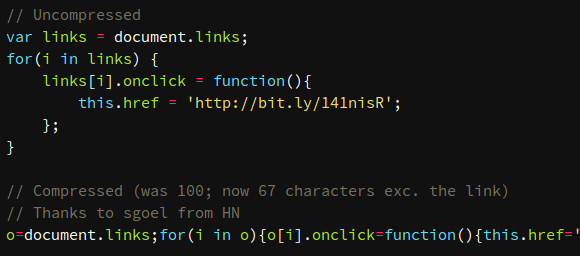
The concept is driven home right away by a link in the post which lists PayPal as the target when you hover over it with your mouse. Clicking on it will give you a warning that it could have been a malicious page you were redirected to. Of course the address line of the page shows that you were sent somewhere else, but it’s still an interesting issue. The hack is accomplished with just a few lines of JavaScript. In fact, the original example was 100 characters but a revision boils that down to just 67.

So who’s vulnerable to this kind of thing? It sounds like everyone that’s not using the Opera browser, which has been patched against the exploit. There are also some updates at the bottom of the post which mention that Firefox has been notified about it and Chrome is working on a patch.

[via Reddit]

Hacking The Right Side Of A Keyboard Completely Off

hacking-the-right-side-of-your-keyboard

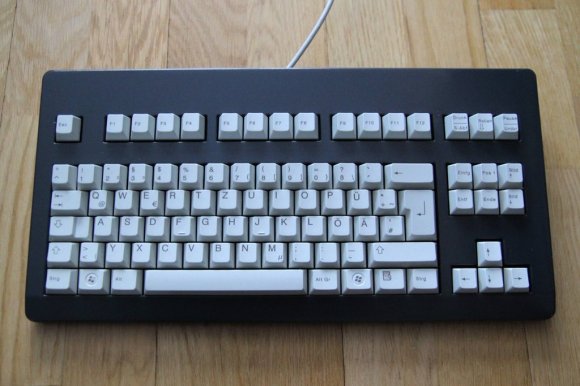
The form factor of this keyboard just doesn’t look right. What’s missing? Oh, the numpad has been completely removed! We use our numpad almost exclusively (especially when coding) so it’s a little hard to figure out why [Ludw] did this. His only mention of motive is that he wanted the mouse closer to the main part of the keyboard and that he didn’t use the numpad. No matter what the reason, we still think he did an amazing job of giving new life to the older keyboard.

It started out as a plain old beige Cherry G80-3000 keyboard. After cracking open the case [Ludw] carefully traced out the connections between the key matrix and the PCB which provides the USB connection. This is because the controller is mounted over on the part of the PCB he his about to remove. Before making the cuts he desoldered all seventeen switches (these can be reused to fabricate a new keyboard, or add switches to various projects). He then lopped off the depopulated substrate and used point-to-point soldering to reconnect the controller. A bit of case alteration removed the extra space while also reusing the nicely molded edges. A clean and tidy paint job finishes the hack.

[via Reddit]

Comparing USB To Ethernet Converters: Apple Vs. Knock-off

usb-ethernet-comparison

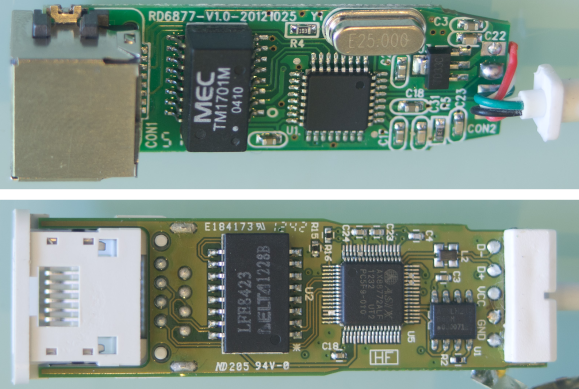
[Angus Gratton] recently cracked open a pair of USB to Ethernet converters to see what’s inside. One was an Apple branded device, the other a no-name from eBay. The former rings in at $30, with the latter just $4. This type of comparison is one of our favorites. It’s especially interesting with Apple products as they are known for solid hardware choices and the knock-offs are equally infamous for shoddy imitations.

From the outside both devices look about the same. The internal differences start right away with a whole-board metal shield on the Apple dongle and none on the off-brand. But the hardware inside is actually quite similar. There’s an RJ-45 jack on the left, followed by the Ethernet isolation chip next to it. From there we start to see differences. The off-brand had a blank chip where Apple’s ASIX AX88772ALF USB to Ethernet bridge controller is located. There is also a difference with the clock; Apple is using two crystals with the other using just one.

[via Reddit]