Microswitch Keyboard Gives Those Lazy Thumbs A Workout

Upon first sight there will be no doubt in anyone’s mind that this is a hacker’s keyboard. [Tim Tyler] built the odd-looking conglomeration of keys a few years ago with the goal of improving the man-machine interface. Why waste all that thumb space with just one long keyboard when you can have at least nine keys per thumb?

After some additional consideration this isn’t all that unorthodox. We’ve seen keyboards that split the hands; in fact you can buy them. This just adds the thumb matrices and that rack of programmable keys above the alpha-numeric portion. It’s rather organ-like with its multiple ranks, don’t you think? Check out the demonstration video after the break. It certainly has a keystroke sound that is all its own. The sound is different from the clackity “M” keyboard and its modern relatives thanks to the microswitches that make up each key.

Continue reading “Microswitch Keyboard Gives Those Lazy Thumbs A Workout”
Arduino Saves You A Bundle When It Comes To Guitar Pedal Effects

[Deadbird] wanted to recreate some guitar pedal effects that he heard on a music video. The thing is, you can end up spending a bundle on hardware unless you’re crafty like he was. He grabbed a Whammy 4 pedal, but decided to forego using a $125 MIDI controller and sourced an Arduino to perform MIDI-based alterations instead.

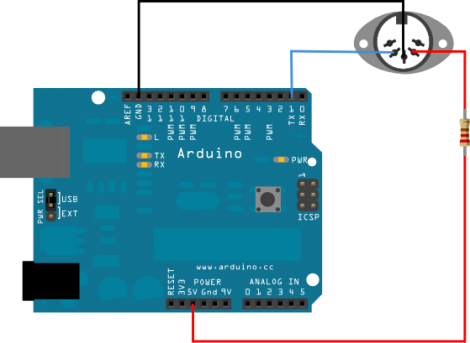
The Whammy 4 was chosen for its ability to perform the sound processing he desired, but also because it can be MIDI controller. By hooking up the Arduino to that port (as seen in the diagram above) he’s able to program changes that would be difficult or impossible with just the pedal. For instance, [Deadbird] illustrates a command which jumps from the lowest to highest setting of an effect without hitting any of the values in the middle. With that under his belt he goes about programming loops of changes with delays in between them. The best part is, you’re only limited by your ability to craft the MIDI commands as Arduino code.

Tablet Cover From Old Hardcover Books

Here’s a way to look hip and destroy books at the same time. This table cover is made from an old hardcover book. It’s not difficult to do, an afternoon is all it takes, and if you follow all of the instructions we’d bet this will hold up for a long time.

It’s basically another version of the Moleskine cover for the Kindle Fire. You find a donor book (second-hand shops are packed with ’em) with a hardcover which you really enjoy. Kids books would be the most fun because of the artwork – if you can find one thick enough. With book in hand remove all of the pages. This will leave the binding a little flimsy, and since this is a project by the company which make Sugru, you can see why they used the moldable adhesive for that purpose. But check out the brackets in the picture above. They covered the Kindle in cling wrap, then molded Sugru around the corners. Once set, it can be peeled away from the plastic wrap, but will retain its shape. Nice.

A Lot Of Love Went Into This Glowing Valentine

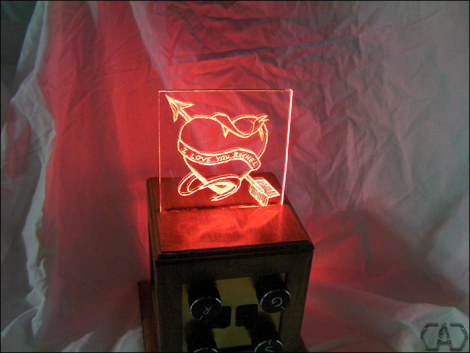
[Will] didn’t pick up a card, rose, and bottle of wine for Valentine’s Day like most guys. Nope, he planned way ahead and built this color-selectable glowing Valentine. When we first saw it, we figured he threw some LEDs together with a microcontroller and edge-lit a piece of acrylic. While that is technically what happened, there was a lot more design and craftsmanship at play here than you might think.

First off, the controller board is a beautifully designed two-sided PCB which he etched rather than throwing a mess of wires and hot glue into an enclosure. Speaking of enclosures, he grabbed a wooden picture box from the big box store and used a piece of brass plate stock to serve as the control panel. The enclosure was finished with tinted polyurethane after having a slit added to the top for the acrylic. The message itself was milled using an engraving bit and a Dremel tool. This was done by hand and we think achieves a finished look that is comparable to the CNC milled ornaments we’ve seen in the past.

Get a good look at the device and a demonstration of its features in the clip after the jump.

Continue reading “A Lot Of Love Went Into This Glowing Valentine”

Space; It’s A Junkyard Until The Swiss Get Their Way

The Swiss plan to clean up the near-space environment. They just announced a debris removal device which they plan to launch in three to five years. The first goal of the program is to scoop up two satellites. Both of them are Swiss owned, but there’s something very James Bond like that pops into our heads when we hear that.

We’re sure you already know there’s a space junk issue in orbit. But did you know that NASA tracks a half-million pieces of orbital debris? Cleaning that up does sound like a good thing. The plan is to detect the offending item, match its trajectory, grab it somehow (which includes halting any spinning that it’s doing), then encapsulating everything for an eventual re-entry. Looks like they plan on the whole robot burning up along with the junk during that final stage.

We keep hearing about ways robots will clean up the messes we make. Hopefully we’ll see these in action at some point.

[via Reddit]

Hexbug Code Rewrite Makes It A Walking Line-follower

You know you’ve got a good hardware platform if you can easily repurpose it with a code rewrite. And that’s what [Eric] continues to do with these little Hexbugs. This time around he’s bent the IR emitter and receiver downward to use as a reflectance sensor. This gives it the ability to follow a dark line on a light surface.

He originally patched an MSP430 into the $25 RC toy. The IR pair was intended for obstacle avoidance, which we saw in a recent links post. This hack does a great job of repurposing the avoidance system. Since the add-on hardware is mounted on a motorized turret, the single sensor pair can sweep back and forth to find the line it will follow. In one way this is better than most line followers which use multiple sensors mounted to the body. But the drawback is that this results in slower travel and won’t be winning any contests. Don’t miss the demo clip after the break.

Continue reading “Hexbug Code Rewrite Makes It A Walking Line-follower”

Intro To Phase-Locked Loops

[Kenneth Finnegan] put up a lengthy primer on PLLs (Phase-Locked Loops). We really enjoyed his presentation (even the part where he panders to Rigol for a free scope… sign us up for one of those too). The concepts behind a PLL are not hard to understand, and [Kenneth] managed to come up with a handful of different demonstrations that really help to drive each point home.

A PLL is made up of three parts: a phase detector, a low pass filter, and a voltage controlled oscillator. It can do really neat things, like multiply clock speed (you see them in beefier chips like the ARM architecture all the time). The experiments seen in the video use a CD4046 chip which has two different types of phase detectors. The two signals displayed on the oscilloscope above compare the incoming clock signal with the output from the VCO. Depending on the type of phase detector used, and the quality of the low-pass filter, these might be tightly synchronized or wildly unstable. Find out why by watching the video embedded after the break.

Continue reading “Intro To Phase-Locked Loops”