
Mini Racing Cabinet

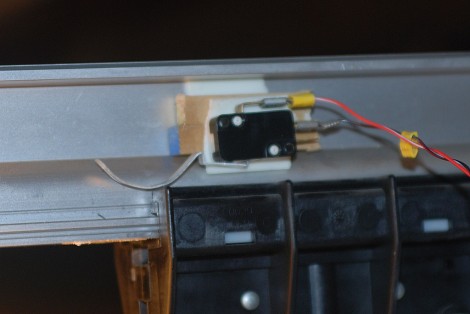
Here’s another small arcade cabinet. This time around it’s the racing simulator Daytona USA. [Pocket_lucho’s] cabinet work has been featured before and he did some fine work with the control interface on this build. The wheel is from the controller of an RC car and the gear lever from a heavily used toy. He fashioned two pedals using gate hinges and a couple of leaf switches. The guts pack quite a punch with a mini ITX motherboard running the show. This will look great next to Ms. Pac-Man. Check out the video after the break.

Continue reading “Mini Racing Cabinet”

Bassoforte And Other New Instruments

[youtube=http://www.youtube.com/watch?v=lhp6P9Ygsoc]

[Diego Stocco] makes music with instruments he assembled. For instance, his Bassoforte uses piano keys, the neck and strings from an electric bass, and what look like some cymbals. Throw in a hammer from that piano and a double bass bow (plus heavy use of audio software) and he’s in business. Big business actually, his work has been in video games such as The Conduit and in feature films like Sherlock Holmes where he worked with Hans Zimmer. Bassoforte isn’t his only invention, he’s got several more including the Experibass string family on one instrument, the Light Controlled Oscillator, and sand music using the fine aggregate along with some piezoelectric film transducers.

[Thanks LuciusMare]

Power Laces Take Us 5 Years Into The Future

[youtube=http://www.youtube.com/watch?v=ROEZs0HpFQc]

Back to the Future Part 2 provided a glimpse of a future that included hover boards and holographic advertisements. But you don’t have to wait until 2015 to get your hands on at least some of the technology. [Blake Bevin] has produced a pair of shoes with power laces as seen in the film. Of course present day technology doesn’t allow him to make the mechanical parts disappear so you’ll have to deal with two servo motors and an Arduino hanging off of your heels.  But hey, at least you won’t have to tie your own shoes like some 20th century peasant. No word on using these for a little theme music as you walk around but maybe that’s something from the more distant future.

Wireless Garage Door Indicator

[Sixerdoodle’s] garage door indicator tells him if the door is open or closed. He was inspired by the hack from last September but wanted to make it wireless. The setup uses an RF transmitter/receiver pair from Sparkfun, each controlled by an ATtiny13 microcontroller. We found his battle with RF interference from other devices to be interesting. Working out those bugs made for a great learning experience.

OLED Hack Saves Juice On Nexus One

Want to really stretch the battery life on your phone? If you have an OLED display [Jeff Sharkey] may have the answer. He did some testing with his Nexus One to see if color alterations can save on current. Darker colors draw less amperage and he found that the red pixels are the most efficient. He did a little work with SurfaceFlinger, which handles the display on Android devices to make this easy, but what will you get by going red? He measured that using only the red pixels dropped the current use down to 35% of what the full color display was pulling. This reminds us of those efforts to save energy by running a black background with Google. Whether you use it or not his post is an interesting read.

Tomato Irrigation

No hack will be more readily accepted by the significant other more than an automated vegetable watering system. [Jouni’s] homemade rig keeps those tomatoes happy with just the right amount of moisture. A bucket serves as the reservoir, a submersible pump gets the water to the soil through a bit of plastic hose. An Arduino monitors the soil sensor, watering and tweeting about it when things dry out too much. Don’t miss the soil moisture sensor post if you need some tips on how to get that end of things working. The rest is pretty straightforward.

Coded Safety For Diy Laser

[youtube=http://www.youtube.com/watch?v=2yVtJia5UWY]

Finally we see a hack that is focuses on safety when it comes to high-power laser hacks. A safety switch has been added to the butt of the flashlight body which houses the laser diode. When the safety is flipped on an LED blinks to prompt the user for a security code. If you enter the correct code on a momentary push switch, electrical access to the laser is enabled. There are also a couple of nice features such as continuous on and auto shutoff.

This would be hard to implement if you’re working on a watertight package but we like the fact that an unsuspecting house guest won’t go blind if searching for a flashlight during a storm. One last thing, the code entry system is PIC based which reminds us of [Alan Parekh’s] one-button system.