Baking Pan Tube Amp Sounds Better Than You’d Expect

baking_pan_tube_amp

A few years back, [Gio] decided to try his hand at building a couple of tube amplifiers.

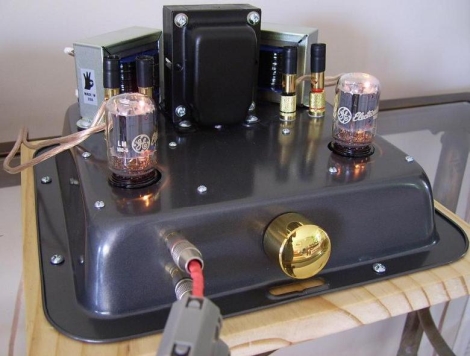
The first amp was more of an experiment to see how well a DIY single-ended tube amp would sound. The amp is based off the 6T9 design created by Spare Time Gizmos, and incorporates a pair of 6T9 vacuum tubes, hence the name.  He wired things up in an afternoon, then got busy drilling holes in a baking pan, where he mounted the amp. Bear with us for a second, it’s not as bad as it sounds. The amp actually looks pretty good mounted in the dark black steel, and this sort of enclosure is far cheaper than most DIY amp enclosures. He says that he was sure to be extra careful in isolating all of the electronic components from the metal chassis.

The second amp was built to test the performance differences between Pentode-mode and Ultra-Linear mode configurations. While both amps share a substantial amount of the same components, his UL amp benefits from slightly better capacitors and an uprated power supply, not to mention a more conventional case.

Both amps sound great, according to [Gio], but should be paired with efficient speakers for the best experience. He does note that the ultra-linear amp is the better choice, mounting options aside.

[Thanks, Philippe]

[via RetroThing]
Bluetooth Headset Battery Swap Keeps Going And Going…

bluetooth_headset_battery

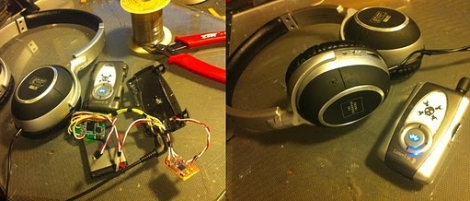
[Reginaldo] purchased a cheap Bluetooth headset adapter, and while it worked well with all of his devices, he was disappointed to find that the battery life didn’t quite live up to the manufacturer’s claims. Advertised as capable of operating for 10 hours, he discovered that the device would typically die after only 7. He wanted more from the headset, so he took things into his own hands and replaced it with a much larger battery (Google Translation).

His goal was to keep the modifications as cheap as possible, so he repurposed a lot of items he had sitting around the house. He used a battery out of an old cell phone, with a capacity over six times greater than that of his original headset battery. He built a charging circuit using a MCP73863 microchip, specifically designed for managing Li-Ion/Li-Poly batteries. The Bluetooth headset was dismantled and repackaged in the shell of a cheap “audio amplifier” that he had on hand, along with the new battery and charging circuit. A nifty Hackaday logo was included on the outside of the new battery case, and the project was deemed complete.

[Reginaldo] reports that he is quite happy with his battery retrofit. The new power brick only takes about half an hour longer to charge, but can now be used for approximately 44 hours before requiring a recharge – not too shabby!

Reverse Engineering LED Vodka Bottle Displays

wireless_led_marquee

When [Tyler] heard about the LED matrix display that Medea Vodka was building into their bottles, he immediately wanted to get his hands on one. Who could blame him? Someone had finally combined two things we love dearly: booze and LEDs.

He struggled to find a bottle at any of his local stores for the longest time, but was absolutely stoked when he finally came across one of their reps promoting the brand while he was out shopping.

Once he got home, he pulled the display off the bottle and began poking around to see what made it tick. The display is made from a flexible PCB, and attached to the bottle with some clear elastic film. It is powered by two CR2032 batteries and controlled by a PIC16F chip, which pulls stored messages from a small Atmel EEPROM.

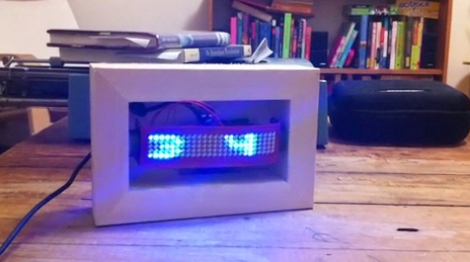
Once he figured out how to control the LED matrix, he uploaded his own fonts and added a LINX wireless module to remotely send messages to the board. He mounted it in a wooden frame and now uses it as a simple marquee display.

If you have one of these displays hanging around your house, be sure to swing by his site for schematics of his wireless interface board as well as the code he uses to drive the marquee. You can check out a video of the display in action there as well.

Xbox 360 Briefcase Is Ready To Go Wherever You Do

portable_xbox

Hackaday forum member [azazelcrey] recently wrote in to share his portable Xbox 360 build. This is not his first attempt at constructing one of these, as he completed his first portable console a few years back. This time, he has taken what he learned from the first go round, making his newest creation a bit cleaner and more compact.

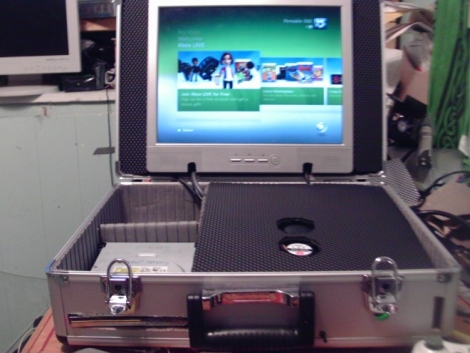
He sourced an LCD monitor with built-in speakers to use as the display, mounting it into a $20 metal-sided suitcase from Home Depot. He disassembled his Xbox and added it to the case, installing a couple extra fans to keep things cool. Some standard Xbox functions were externalized, allowing him to power on the console, load games, and synchronize controllers, all while keeping the briefcase shut.

This obviously isn’t something that you would carry on a train or bus for on-the-go gaming, but it’s a great way to travel with your Xbox as well as a handful of gear.  We imagine this rugged, fully-contained gaming center is quite useful for one-off Xbox LAN parties, and it seems like it would be a good way to get your game on if stuck overnight in a hotel.

Check out his web site if you are interested in seeing his first build or more pictures of this one.

Hacking Automated Hand Sanitizers With Ben Heck

benheck_sanitizer

If you have visited a hospital any time recently, you probably noticed quite a few automated hand sanitizer dispensers scattered throughout the hallways and in each patient’s room. Since hospital-acquired infections are a growing problem, there has been a push for all personnel to use these hand sanitizers regularly to lessen the likelihood of spreading disease.

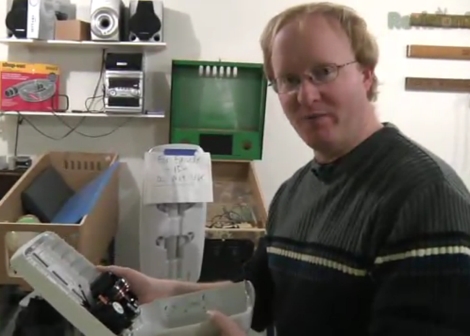
In the most recent episode of his web show, [Ben Heck] took on the challenge of hacking one of these dispensers to use motion sensors in order to sense when hospital personnel are near, as well as to remind them that they should sanitize their hands on the way out.

He disassembled the dispenser to see how it operated, then worked on replacing the IR sensor pair with a set of motion detectors. He hooked the motion sensors to a Propeller board, which uses a separate add-on board for keeping time. Once the motion sensors are triggered, the passer-by is given a window of time before the machine notifies them to kindly sanitize their hands. All movements and sanitizer dispensing events are logged to an SD card connected to the controller, which can be reviewed to ensure policy compliance.

If you have about 20 minutes to spare it’s worth checking out, and if you are interested in more hand washing tech, check out this DIY hand dryer we featured a while back.

Retrofitting LCD Projectors With High-powered LEDs

highpower_led

[Devon] recently repaired a handful of Phillips LCD projectors which he was quite excited to use. The only problem is that he didn’t want to mess with replacing the bulbs after every 2000 hours of use at $100 apiece. He was pretty confident that he could find a better way to drive the projectors, so he disassembled them once more and started looking around for bulb replacements.

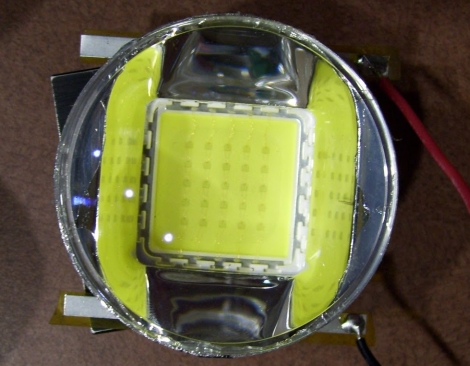
He figured that a high-powered LED would do the trick, so he ordered a handful of parts and went about his first retrofit. Using his oscilloscope, he found that the control board pulses the high voltage board when the projector is powered on, and continues to pulse a signal until the machine is turned off. At this point, the HV board powers down the bulb.

He created a small circuit using a PIC that is used to interpret the initial pulse from the control board as well as watch for the steady “heartbeat” pulses that occur while the projector is powered on. This board is used to control the driver board for the high-powered LED he purchased.

His bulb replacement works well as far as color fidelity is concerned, but is not nearly as bright as he hoped for. He has plans to source some far brighter LEDs or automobile HID lighting in the very near future, and we look forward to seeing if he can match the brightness of the original bulbs.

Class Up Your Next Party With The Drink Making Unit 2.0

drink_making_unit_20

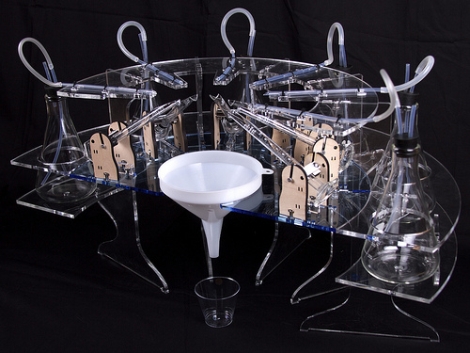
The crew over at [Evil Mad Scientist Laboratories] has been hard at work preparing for the Barbot 2011 cocktail robotic exhibition. This year, they are packing some serious drinking fun with the Drink Making Unit 2.0. The predictably named follow-up to last year’s wildly popular Drink Making Unit doubles the mixing capability with six, rather than three fluids, and provides a visually stimulating drink mixing experience.

While they are similarly named, the new unit has been completely redesigned since last year. No longer are they relying on breast pumps to move the alcohol along. Instead, they are using compressed air to dispense fluids from wash bottles which were constructed from laboratory beakers. The fluids are measured in specially altered graduated cylinders that are designed to tip over and release their contents when the appropriate amount of alcohol has been poured. These cylinders are designed to mimic the movement of Japanese garden fixtures called “deer chasers”, tipping back and forth solely powered by the ingress and egress of liquid.

The dispenser’s control panel houses an ATmega164, which orchestrates the entire operation. It interfaces with the LED driver boards that make up the display via SPI. The micro controller is also tasked with monitoring when the graduated cylinders tip their libations into the dispensing funnel, which is done using IR LEDs and photogates.

It’s a great looking machine, and while there isn’t any drink mixing video as of yet, we can’t wait to see it in action.