Simple Fixes Breathe New Life Into Aging Game Consoles

dreamcast_repair

While the Sega Dreamcast has long been out of production, there is an avid fanbase that loves the console dearly. As with many CD/DVD-based consoles, the Dreamcast can sometimes run into issues reading discs, at which point all games are unplayable.

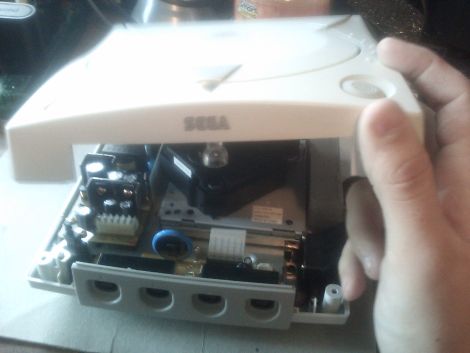
Instructables user [Andrew] got his hands on a pair of the consoles and found that one could not read CDs, while the other suffered from a fried controller interface board, the result of a controller wiring mix-up on his part. Determined to get the consoles up and running again, he disassembled them and got to work, sharing his fixes with us.

The CD drive fix is a pretty standard one. He first needed to locate the potentiometer that regulates the laser. Once he did, a slight counter-clockwise turn is all it required in order to increase the laser’s voltage. Once he did this, he popped in a game to see if it worked. No longer greeted with a disc read error when he powered on his Dreamcast, he reassembled the console and began work on the other one.

To fix his controller issues, [Andrew] had to remove the entire controller board from the console. He eventually located a resistor that had been damaged by his wiring mishap, and replaced it. The console was tested and seeing that the controllers worked again, he put everything back together.

While this pair of fixes is not incredibly complex, it’s nice to see people sharing their tips for bringing these consoles back to life.

These Apple-inspired Speakers Would Make Steve Jobs Envious

isound_speakers

Reader [Brett] sent in the build log of his beautiful set of Apple-inspired computer speakers for us to look over. Having seen our recent post on DIY speakers, he thought he would throw his hat into the ring as well, and we’re glad he did.

He wanted a nice set of speakers to complement his iMac, but couldn’t find anything he liked that would provide the sound quality he was looking for while closely matching the design of the computer. The speakers are constructed out of MDF with CNC milled acrylic front and back panels. Hand-built crossovers reside inside the speaker boxes, which provides for a clean, polished look. He originally planned on building a pair of subwoofers into his desk, but ultimately settled on building a single subwoofer to sit on the floor.

The finished product is simply stunning, and we would have a hard time believing they were a DIY project if we didn’t see them come together piece by piece. Do you think you can match [Brett’s] handiwork?  If so, feel free to share your speaker builds in the comments.

Chilling Drinks With Your Friends’ Faces

facecube

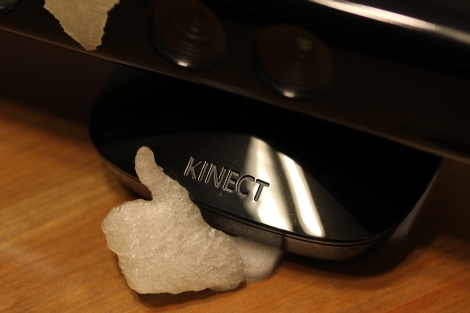
3D printing of Kinect-mapped models seems to be all the rage lately. [Nirav] caught the bug and has developed software which allows him to join in the fun. Frustrated by the lack of documentation and source code for the Fabricate Yourself project, he set out to create his own open-source process for scanning people and objects to share with the hacking community.

His software allows you to aim the Kinect and capture a 3D scan of any object, after which you need to use MeshLab or similar software to turn the scan into a STL file for printing. He says that the process is a bit tedious at the moment, but he is working hard to condense it down into a single step.

While he can scan and print pretty much anything he wants, his ultimate goal is to create ice cube trays for his friends featuring molds of their faces. The project has a lot of promise, though we’re not sure about our friends crunching on our faces after finishing their drink.

limpy_the_robot

Remote-controlled Robot Toy From Air Freshener Parts

[jcopro] is pretty fond of Glade automatic air fresheners. Using a pair of them, he built a simple remote-controlled toy which he shared with us over the weekend. You may remember that he built a remote shutter release system for his camera using these air fresheners, which we featured a few weeks ago.

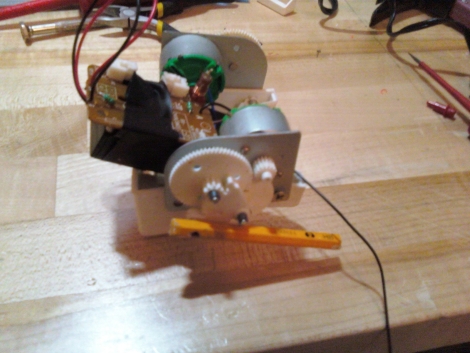
Instead of throwing away the shell of the air fresheners after gutting them for motors and gears, he decided to use the excess plastic as a robot chassis. Using a pair of pencils for legs, he constructed his robot, “Limpy.” He removed a pair of motors and control board from an old toy, mounting it to his creation with a few strips of electrical tape.

He admits that he’s reluctant to even call the toy a robot, but he had fun building it, and suggests that it would make a great beginner project. We agree – it would make a great project for kids, especially if you are looking to reuse an old remote-controlled toy they no longer play with.

Continue reading “Remote-controlled Robot Toy From Air Freshener Parts”

Quick Hack Brings Wi-Fi To An Aging Laptop

usb_wifi_adapter

[Jarrod] has an older Compaq laptop he is still pretty keen on, but he has one niggling problem – the laptop doesn’t have a built-in wireless card. He recently changed security protocols on his home wireless network to WPA and realized that his old Linksys PC card only supports WEP. He decided it was time to find another way to connect wirelessly, so he started searching around for options.

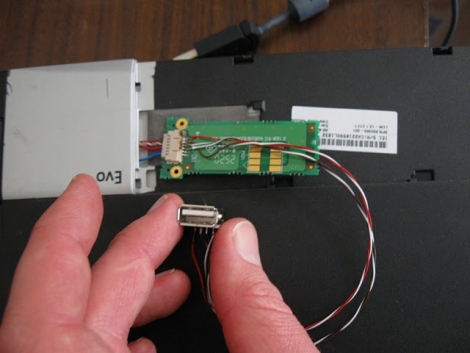
It turns out that his laptop does have the ability to accept a LCD-mounted add-on wireless card, but it costs about $100 and doesn’t support WPA. He figured that the card slipped into some sort of glorified USB port, and after disassembling the laptop, he found that he was right.

He quickly soldered a few wires and a USB adapter to the Bluetooth board that already occupied the card slot, then plugged in a wireless mouse to see what would happen. The mouse’s radio powered on without issue, and much to [Jarrod’s] delight, the port was USB 2.0 compatible.

Now that he knows the port is live, he plans on finding a small USB 802.11 G or N adapter to cram into the slot – with the deluge of miniature USB Wi-Fi adapters on the market, that shouldn’t be too hard.

8th ACM Conference On Creativity & Cognition Call For Papers

acm_cnc2011

[Jim Davies] from the Association for Computing Machinery wrote us to let us know about a conference being hosted this fall, the 8th ACM conference on Creativity and Cognition. C&C 2011 has a lot to offer, providing an opportunity for artists, scientists, designers and educators to gather together and share their expertise via a series of group meetings, tutorials, and workshops.

We wanted to bring C&C 2001 to the attention of our readers as it is likely many of you had some level of interaction with your college or university’s local ACM chapter in the past. [Jim] wanted to point out that though the conference is slated for the first week of November, there is a deadline of April 25th for all papers and proposals. If you are interested in submitting something to the conference, it would be wise to get started soon.

The overall theme of this year’s conference is Creativity and Technology, which fits the hacking community quite well. Good luck to any of you who decide to give it a shot!

Follow-up: Radio-controlled LED Light Show

travelling_light_circus

[Alan] shared an update with us regarding a project he has been working on for some time, radio-controlled LED light strips destined for use by the Travelling Light Circus. If you are not familiar with the project or need a quick refresher, you can read our post about it here.

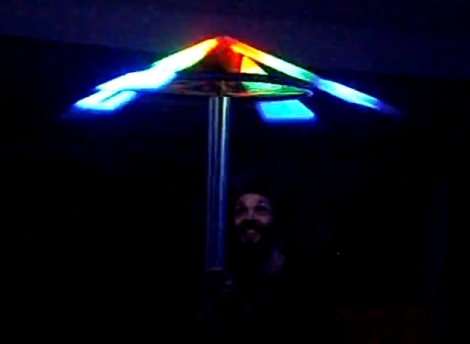
He recently met up with the guys from TLC to finish things up and was happily surprised that they did not want to mount his lights on the performers, as was originally planned. He would have had to make a few modifications if that was the case, but instead, they planned on attaching them to bicycle wheels. The light strips were mounted inside translucent plastic tubes that fan out from the center of the wheels, where the battery and radio equipment is located. The wheels were mounted on aluminum poles, allowing the performers to create a visually stunning show, just by spinning the pole.

Check out the pair of videos we have embedded below, the project came together quite nicely.

Continue reading “Follow-up: Radio-controlled LED Light Show”