Micro Audio Player Can Hide Behind A Postage Stamp

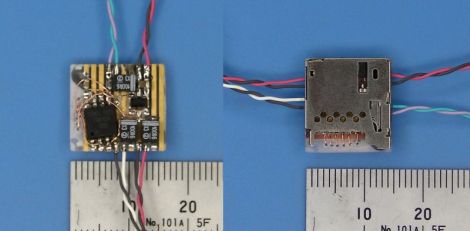
The original iPod shuffle was a pretty small device, there’s no doubt about that. However, in the world of miniature audio players, [Chan] is no slouch either.

A few years ago, he set out to construct a micro audio player that used little more than a small microcontroller and a microSD memory card. He chose an ATinyX5 series microcontroller to run the show, utilizing its pair of PWM output pins to directly drive the speakers. Since there is no built-in amplifier, the audio volume is not loud, but it does sound reasonable if you use a set of high efficiency desktop speakers. He does mention that the sound can easily be amplified after passing the signal through a filter, so there is hope for those of you who like your music turned up to 11.

The only downside we can see is that the audio player can only process Wave files, but it’s hard to expect more from a DIY audio player smaller than a postage stamp. It would be great to see what sort of micro-handiwork [Chan] could perform if he were to update his design and build a full-functioning MP3 player based upon this project.
Audio Two-fer – Sneaker Speakers And DIY Mid-Fi Woofers

speakers

Nike Air Force 1 shoes are probably some of the most well-recognized sneakers around the world, aside from the always timeless Chuck Taylor All Stars. So when [Alex Nash] was asked to create some art using something ordinary with a goal of turning it into something special,  he immediately grabbed a pair and got to work.

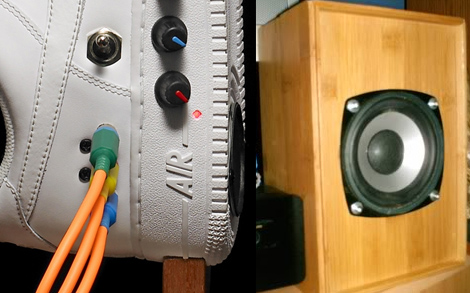
His vision was to build a set of PC speakers by embedding a small amplifier and speakers into a pair of Air Force 1s. As you can see from the pictures on his site, they look awesome. He doesn’t say how good they sound, but we’re betting they perform better than that old pair that came with your last computer.

When [Stacy] was in college, she didn’t have a ton of room or money for a nice audio setup, so she decided to build a pair of speakers rather than buying them. She admits that these “Mid-Fi” woofers won’t be the centerpiece of your Hi-Fi setup, but they still sound pretty darn good for $50 DIY speakers. She compares them to units you would find in the store for $300+, and they sound so good she continues to use them as a compliment to the rest of her Hi-Fi setup now that she has a place of her own.

LED Backlight Conversion Using Recycled CCFL Inverter Parts

inverter_repair

[Ammon] repairs busted LCD monitors as a side hobby, so replacing burned out CCFLs and inverter circuits is something he can do in his sleep. One Dell monitor he received had him so perplexed, that he simply gave up on trying to repair the inverter circuit. He still wanted to get it working, so he had some narrow PCBs made and started working on his LED replacement backlight.

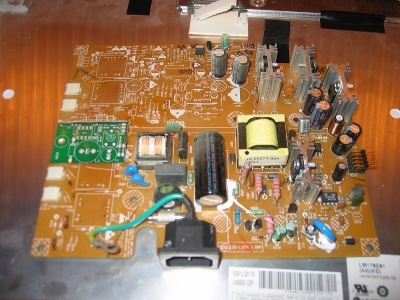
He built a driver board for the LEDs, populated with left over components that he stripped from the LCD panel’s inverter circuit. He needed space to insert his driver board, so he simply cut out a chunk of the inverter board and slipped his replacement driver board in its place. As you can see in the picture above, his board (in green) takes up far less space than the original inverter circuit it replaces.

He provides a schematic for his circuit as well as a PCB layout file, so it should be fairly easy to replicate his work. He has not posted schematics or layout information for his LED strips, but we’re betting he will if someone asks nicely.

Check out this pair of posts if you are interested in reading more about replacing your burned out CCFL with LEDs.

Real-time Arduino Interpreter Ditches The PC

computerless_arduino

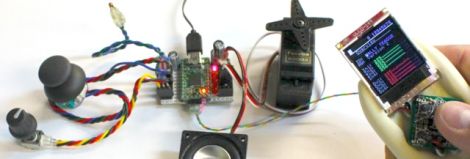
When prototyping a project using an Arduino, there are a few things that are pretty much required equipment. A computer for generating sketches is typically one of those things, but [Adam] over at Teague Labs is looking to change all that with his current project, the Computerless Arduino.

Instead of using a computer to alter the code running on the Arduino, they have implemented a real-time code interpreter using a Teensy 2.0. The microcontroller is connected to a 5-button LCD display where the user can view the status of any port, view the current running code, as well as alter that code on the fly.

The real-time instruction set is somewhat limited, making it a breeze for newcomers to begin using the Arduino. While that may turn some people off, it still has enough functionality baked in to handle moderately sized projects as well.

Be sure to check out the video we have posted below to see the interpreter in action.

Continue reading “Real-time Arduino Interpreter Ditches The PC”

Analog Robot Navigates Around The Workshop With Ease

556_wall_following_robot

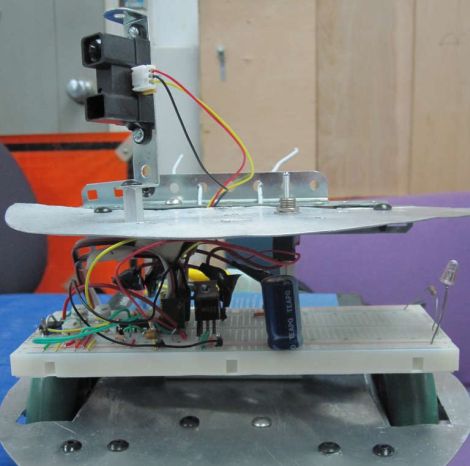
Many of the robots we feature here are driven by some sort of microcontroller, whether it be an Arduino, Launchpad, Picaxe, etc. Rarely do we see a robot however, using analog circuits to perform higher-level functions typically relegated to those more complex controllers. Instructables user [hasn0life] built such a robot recently, which he entered into a contest at his college. After hearing about the 555 design contest from a friend, he tweaked his project and created a wall-following robot using a 556 timer.

The robot is fairly simple when you take a close look, though that does not take away from the elegance of his design. A single IR sensor is used to detect objects in the robot’s periphery, guiding the robot along. When the robot gets too close to a wall, one wheel reverses, pulling the robot away. Once the robot has moved a sufficient distance, the other wheel is reversed in order to straighten out the robot. Then, both wheels work in concert to get the robot moving forward.

Take a look at the video below to watch the robot navigate its way around his workshop, and if you are interested in learning more about analog robotics, check out this post from a few days back.

Continue reading “Analog Robot Navigates Around The Workshop With Ease”

Hacking Strippers To Do Your Bidding

wire_strippers

[Alex] knows his strippers.

By his estimation, he has stripped millions of wires over the years, and he has seen his fair share of wire strippers come and go. That cheap set of wire strippers you have with the graduated holes, or that adjustable stripper you squeeze as you pull the wire through? They just stress the insulation as well as the wires you are trying to strip – he says you might as well just use them in your tackle box.

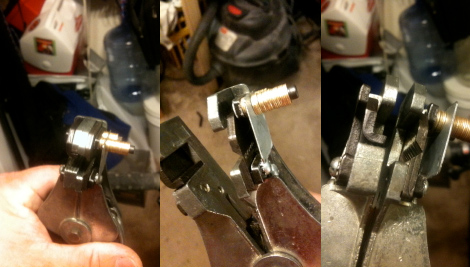
His favorite style of wire stripper is the automatic kind that grip the wire, then cut and remove the insulation just by squeezing the handles. His issue with this particular tool is that it’s difficult to get a uniform length of stripped wire when working in volume.

Since [Alex] needs uniformity in his line of work, he modified a set of automatic wire strippers to include an adjustable wire stop. He determines the length of wire he needs, adds or removes some washers from his wire stop, and off he goes. It’s a very simple yet very useful hack, depending on your application. We bet it is probably one of the most accurate ways to get uniform length, this side of a fully automatic wire stripper.

Simple PCB Etchant Made From Chemicals You Can Put In Your Mouth

etching_test

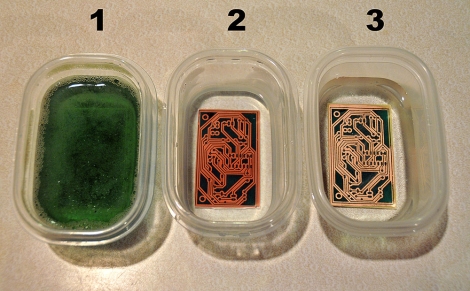
[Stephen] often finds the need to make his own PCBs at home, and when he got the urge to do some etching recently, he realized that he was fresh out of “Ferret Chloride and Bureaucratic Acid*.” Undeterred by his empty chemical cabinet, he poked around in his kitchen mixing together anything and everything that might have the ability to strip copper from a PCB.

Now, we don’t necessarily recommend this course of action, but it seems that he finally hit upon a winner. He discovered a formula that can be made at home from simple and safe household ingredients which does the job quite nicely. A fair warning however, standard ferric chloride disposal procedures need to be followed when using this solution.

If you want to know what he concocted in his kitchen as well as the chemistry behind it, you will have to visit his site, we won’t ruin it for you. You can however, see the solution at work in the video we have posted below.

*His joke, not ours

Continue reading “Simple PCB Etchant Made From Chemicals You Can Put In Your Mouth”