London’s 44Con Is Looking For A Few Good Hackers

44con_banner

While we see plenty of security-related conferences here in the US, our friends across the pond were apparently anxious to hold a large-scale security conference of their own. At the helm of the first ever 44Con are DEF CON Goon [Adrian] and Penetration Tester [Steve Lord]. The pair are quite involved in London’s security community and are looking to bring like-minded individuals together over four days of security talks and workshops.

While 44Con’s list of speakers has been wrapped up, they are still looking for people to help run workshops on the 1st and 2nd of September. They are requesting that any hackers in the area drop them a line if interested.

Taking a look at their site, you can see that they have a nice selection of talks lined up catering to those on the business side of Information Security as well as deep technical discussions about threats and vulnerabilities. If you plan on hitting up the conference, be sure to let us know in the comments section.


CircuitBee Makes Sharing Schematics And Circuit Diagrams Easy

circuit_bee_schematic_hosting

When looking for things to write about, there is nothing we like to see more than well-documented schematics and code available for download. In the case of schematics, we realize that they can be a bit of a pain to publish. Many times we see them in the form of blurry JPEGs or humungous PDF files, neither of which are incredibly convenient to use. The folks over at CircuitBee thought the same thing, and have been working diligently to make it easier for everyone to share their awesome ideas with the world.

Their free service requires registration, and not much else. Once you’re in, you are free to upload your Eagle or KiCAD circuit diagrams, which are then run through CircuitBee’s servers. They convert your drawings into embeddable objects which allow others to view your project without a lot of fuss. Their embeddable schematic window can be rendered in full screen mode, and gives users the ability to zoom in on any portion of the drawing to see the circuit’s finer details.

[Ben Delarre] from CircuitBee says that the product is in the alpha stages right now, so there are plenty of features and useful tools coming in the near future. If you like to build and share, it’s definitely something worth checking out!

[via Make]

[Thanks, Sanchoooo]

A Study In AVR Power Saving Techniques

amtel_avr

[Scott] found the iCufflinks from Adafruit Industries pretty interesting, but he thought that the stated run time of 24 hours was a bit short. He figured he could improve the product’s power consumption at least a little bit, to improve the overall battery life.

From their schematics, he placed an order for parts and built two identical iCufflink mock-ups side by side – one running their code and one running his. He took baseline current draw measurements, then got busy slimming down the cufflinks’ software. It had been 20 years since he touched assembly, and he has never written it for an AVR, but judging by his work he’s not rusty in the least.

He slowed the ATtiny’s clock down and tweaked a few other settings for a savings of 53μA, but the real improvements came via a fairly simple fix. The original code called for the processor to institute a counting loop to sleep, which he found to be very wasteful. Instead, he chose to put the processor in an idle state, using the chip’s watchdog timer to wake it when it was time to pulse the LED. The power savings from this change alone was a whopping 261μA!

When he was said and done, the changes save about 315μA of current draw, and should allow the cufflinks to run for up to 38 hours without swapping batteries. In [Scott’s] opinion, a nearly 60% improvement in battery life is pretty good for a day’s work, and we’re inclined to agree.

Ignored Disabled Man Builds His Own Damn Elevator

diy_wheelchair_lift

There’s an old saying that goes something like, “When the going gets tough, the tough builds their own 5-story wheelchair lift.”

Actually we’re pretty sure that’s not even close to how the saying goes, but when his local council turned their backs on [Dmitry Bibikow’s] request for wheelchair access to his apartment, that’s exactly what he did.

[Dmitry], an avid mountaineer, was injured in a climbing accident that left him without the use of his legs. Unfortunately for him, he and his family reside on the 5th floor of an apartment building that was not handicap accessible. Rather than move out, he asked the local council to install an elevator, which they agreed to.

Time passed, and as the project sank deeper and deeper into a mire of bureaucracy, [Dmitry] began to lose hope of ever seeing an elevator installed. After six years of relying on friends to help him get in and out of his apartment, he took matters into his own hands and installed a chair lift just off the side of his balcony.

According to [Dmitry] it works great, and he can get from the front door to his apartment well before his more able neighbors make it up the stairs. So far, the city council has not said anything about the lift, and he hopes it stays that way.

Adding USB Connectivity To Old Benchtop Tools

frequency_counter_hacked_for_usb_connectivity

[Scott] was recently given a frequency counter, and once he brought it home, he started contemplating how he could possibly make it better. While the counter worked well as-is, he wanted to find a way to record data readings over a reasonably long period of time. He figured that interfacing it with his computer would be the best way to do this, but he had to find a way to connect the devices first.

He started poking around inside the frequency counter and stumbled upon a possible data source when taking a closer look at the display board. He found that he could read the frequency data as it was being written to the display, and send that data to his computer. He used an ATMega48 to intercept the data and code from the V-USB project to bit-bang the data to his PC over USB.

Now, anything he sees on the frequency counter can be easily collected and graphed on his computer with little fuss.

Stick around to see a quick video demonstration of his hack in action.

Continue reading “Adding USB Connectivity To Old Benchtop Tools”

Hybrid Roller Coaster Concept

prius_based_roller_coaster

Toyota recently ran an ad campaign touting “Ideas for Good” in which the actors speculated uses for Toyota Synergy Drive hybrid systems in non-automotive related applications. One idea that was floated involved using the car’s regenerative braking system at an amusement park, in an effort to reclaim and use some of a roller coaster’s kinetic energy.

Toyota sent a Prius to the team over at Deeplocal, who deconstructed it and found that the car could generate 60 amps of current when braking. That’s not an insignificant number, so they decided to create a cool demonstration showing how powerful the technology is. They built a coaster car from the Prius’ guts, and positioned it at the top of an elevated platform, which was connected to a 70 foot track. In the video embedded below they push the car from the platform and down the track, using the regenerative braking system to illuminate a large display of amusement park lights.

While the video is little more than a well-produced advertisement for Toyota, we can’t help but think that it’s pretty cool. It’s doubtful that we will suddenly see an inrush of hybrid-based roller coasters any time soon, but the concept is interesting nonetheless.

[via Notcot]

Continue reading “Hybrid Roller Coaster Concept”

Clocks Built From Old Aircraft Surplus Parts

aircraft_indicator_clocks

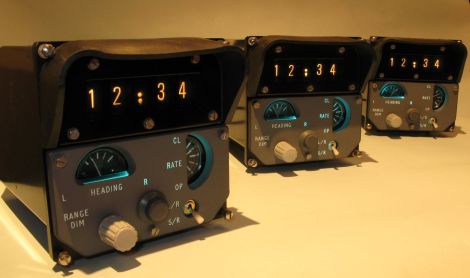
A few years ago, Tube Clock forum member[Sine1040] bought a set of four brand new aircraft indicator units that were built some time in the early 70’s. He had no idea what the units were actually used for, but he did know that he could repurpose them into some pretty slick looking clocks.

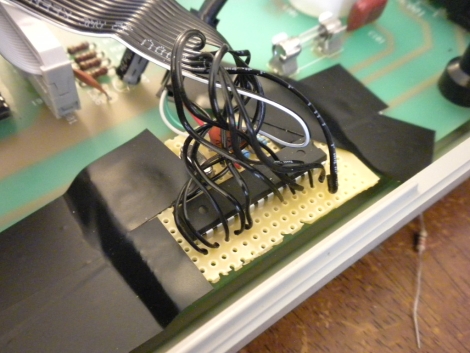
He disassembled all four boxes and between them, scrounged enough parts to build three clocks. After gutting the clocks and rearranging the digits, he built a timekeeping circuit using an ATMega8 which is clocked by a DS32 oscillator.

While the time is displayed using the large projection-style digit displays, the seconds are ticked off in the left-most analog meter. Minutes are also represented in the clock’s right-most analog window, swinging the needle from top to bottom as each one passes.

[Sine1040] paid special attention to keeping the boxes looking as stock as possible, with the only external modification being a power plug installed in place of an old grounding screw. The clock is definitely a different take on keeping time, and we think it looks great.

Continue reading to see a quick demo video of the clock in action.

[Thanks Brian]

Continue reading “Clocks Built From Old Aircraft Surplus Parts”