Should All Quadrotors Look Like This?

In recent years, quadrotors have exploded in popularity. They’ve become cheap, durable, and can do some really impressive things, but are they the most efficient design? The University of Queensland doesn’t think so.

Helicopters are still much more efficient and powerful due to their one big rotor, and with the swashplate mechanism, perhaps even more maneuverable — after all did you see our recent post on collective pitch thrust vectoring? And that was a plane! A few quick searches of helicopter tricks and we think you’ll agree.

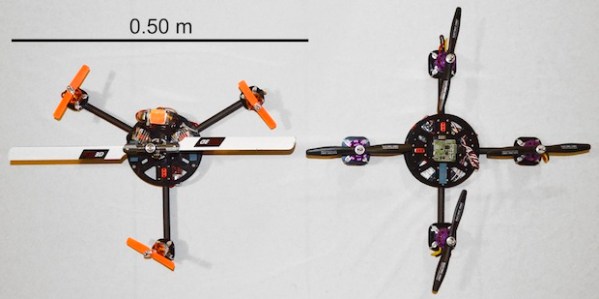
The new design, which is tentatively called the Y4, or maybe a “Triquad” is still a quadrotor, but it’s been jumbled up a bit, taking the best of both worlds. It has a main prop with a swashplate mechanism, and three smaller rotors fixed at 45 degree angles, that provide the counter torque — It’s kind of like a helicopter with three tails.

Regarding efficiency, the researchers expect this design could achieve an overall increase of about 25% in performance, compared to that of a standard quadrotor. So, they decided to test it and built a quad and a Y4 as similar as possible — the same size, mass, batteries, arms, and controller board. The results? The Y4 had an increased run time of 15%! They think the design could very well make the 25% mark, because in this test study, the Y4 was designed to meet the specifications of the quad, whereas a more refined Y4 without those limitations could perhaps perform even better.

Unfortunately there’s no video we can find, but if you stick around after the break we have a great diagram of how (and why) this design works!


Continue reading “Should All Quadrotors Look Like This?”

Collective Pitch Thrust Vectoring On A RC Plane

The RC plane shown above is hovering in that position. And that’s about the least impressive thing it can do. This is the power of Collective Pitch Thrust Vectoring… on a plane.

So what exactly is Collective Pitch Thrust Vectoring anyway? Put simply, it’s like strapping a helicopter rotor to the front of a plane. We think the basic mechanism behind this is called a Swashplate (as found on a helicopter rotor), which allows for thrust vectoring, meaning the propeller blades can actually change their pitch cyclically, while still spinning at high speeds! This is what allows helicopters to do crazy tricks like barrel rolls.

A normal RC plane can only increase or decrease thrust with the speed of the engine. But with this, the thrust can be changed cyclically as the blades spin allowing for thrust vectoring (advanced steering). Couple that with some huge control surfaces and wing stabilizers and that means some seriously crazy aerodynamic feats.

Watch the video after the break, it’s amazing.

Continue reading “Collective Pitch Thrust Vectoring On A RC Plane”

Human Powered Hydrofoil, The Wingbike!

[Steven] has been working for the past year on a very cool pedal powered hydrofoil, which he calls the Wingbike.

We’ve seen plenty of trampofoils before, which are hydrofoils that can convert a human bouncing up and down… to horizontal movement. There have even been some pedal powered versions before, but its a rather tricky mechanism to get just right.

[Steven] has built his Wingbike almost entirely out of carbon fiber, and it only weighs 10kg.The biggest problem is balance, as you’re about 1.5M above the foils. If you lean too much, you fall. If you slow down too much, you sink. The current model he is working on has fairly large foils, which does help a bit with the balance, but that also increases the amount of energy required to propel it. He plans on creating new designs with much smaller and faster foils in the future.

Unfortunately, the water is getting quite cold in the Netherlands, so he’s going to spend the rest of the winter months optimizing the bike from a design perspective. Stick around after the break to see his latest successful test video!

Continue reading “Human Powered Hydrofoil, The Wingbike!”

Raspberry Pi Driven 128×32 LED Sign

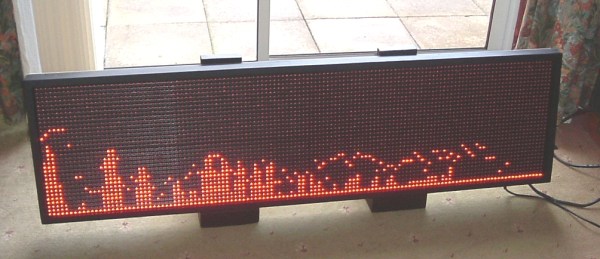
Looks like a commercial LED display sign… right? Not even close. This is a project of [Jon’s] from over a year ago, and it is a very impressive 128×32 LED display board, driven using a single Raspberry Pi.

It’s made of eight “P10” 32×16 LED panels that he bought off of eBay, housed in a wooden frame he built himself. The display runs off of a single Raspberry Pi and can receive a video signal from anything with an Ethernet port. The individual boards are daisy-chained in a rather odd arrangement to minimize cable length, which [Jon] says helps with clocking the data fast — he’s able to parse 2 bits per pixel to refresh the display at an impressive 400+ frames per second.

To power the display, he’s using a single ATX power supply with the Pi connected to the standby 5V power line. This is to avoid a voltage drop which might cause the Pi to crash — when all LEDs are on the display can draw a healthy 32A of juice. The P10’s use shift registers to serially load the pixel data. At any time, the 4096 pixel display can have 1024 pixels on, which means a fairly fast clock is required to update the display.

[Jon] has shared all the source code on his blog, and has a fairly in-depth explanation of all the systems used. Check it out for yourself, and don’t forget to stick around after the break to see the display in action!

Continue reading “Raspberry Pi Driven 128×32 LED Sign”

View-Master Video Player!

view master 3d video player

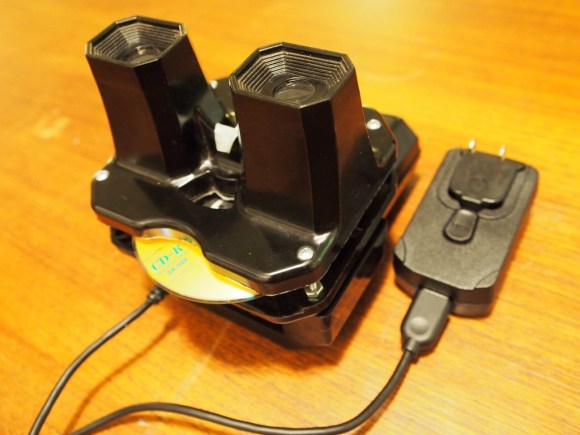
[Alec] just sent us this great project he’s been working on. Converting an antique View-Master from the early 50’s into a modern 3D video player, capable of reading Mini-CDs.

Most View-Masters don’t have much space for tinkering, let alone adding a Raspberry Pi, two displays and a CD drive, so [Alec] really lucked out when he found this model — complete with light and D-cell battery pack. Tons of space! He originally looked into getting some cheap digital photo frame LCDs from China, but soon realized the effort involved with making those work just wouldn’t be worth it, so instead he picked up some 0.9″ OLED displays from Adafruit. He still forgot to check if they had drivers for the Raspberry Pi though, and ended up on another detour of modifying FBTFT drivers to make it all work.

After that headache he got to the fun part — cramming all the hardware inside. He picked up a cheap laptop CD drive off of eBay, and discovered that using the 80MM Mini-CD standard, the discs would just fit inside of the View-Master, sticking out just a little bit, kind of like the original photo wheels!

Quite a bit of fiddling later, he managed to assemble the entire thing in layers, without damaging the external shell of the View-Master. Since it is an antique, it was important for him that his hack be reversible — and for the most part, it is! Stick around after the break to see a short video explanation!

Continue reading “View-Master Video Player!”

InFORM The Morphing Table Gets Even More Interactive

inform2

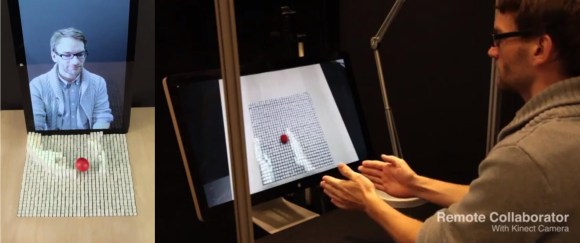
Remember last week’s post on the inFORM, MIT’s morphing table? Well they just released a new video showing off what it can do, and it’s pretty impressive.

The new setup features two separate interfaces, and they’ve added a display  so you can see the person who is manipulating the surface. This springs to life a whole new realm of possibilities for the tactile digital experience. The inFORM also has a projector shining on the surface, which allows the objects shown from the other side to be both visually and physically seen — they use an example of opening a book and displaying its pages on the surface. To track the hand movements they use a plain old Microsoft Kinect, which works extremely well. They also show off the table as a standalone unit, an interactive table — Now all they need to do is make the pixels smaller… 

Stick around after the break to see some more awesome examples of the possibilities of this new tactile-digital interface. There are also some great clips near the end of the video showing off the complex linkage system that makes it all work.

Continue reading “InFORM The Morphing Table Gets Even More Interactive”

Flying RC Toaster

Do you remember that screen saver from the 80’s of flying toasters? Well the guys over at Flite Test just made a real flying toaster.

The first challenge was converting a toaster to run off batteries, which [David] accomplished by splitting the elements in the 110V toaster into 4 segments, and running them off of 6-cell LiPo — when the toaster is on, it draws almost 700W. The next question was — how much of an effect does air flow have on a toaster’s ability to toast? As it turns out, not that much! They tested the system by driving down the street holding a toaster out of the passenger window of the car, and while they got some strange looks, they also successfully toasted the bread.

The next step was making a plane capable of carrying the extra batteries, and a bulky, not-so-aerodynamic toaster. This was probably the easiest part, as they have made a flying 20kg cinder block before. Needless to say, making a toaster capable of flight was not much of a challenge.

Our favorite part of the video is the test flight, where [Josh] wears a POV visor system to, wait for it… watch the bread toasting. Check it out after the break!

Continue reading “Flying RC Toaster”