Dad? Where Did Printed Circuit Boards Come From?

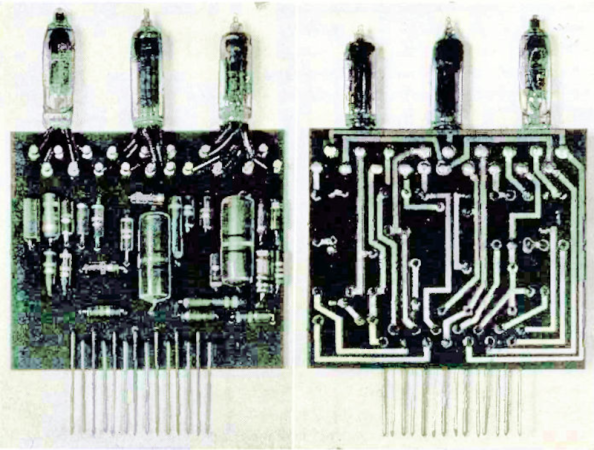
These days, it is hard to imagine electronics without printed circuit boards. They are literally in everything. While making PCBs at home used to be a chore, these days, you design on a computer, click a button, and they show up in the mail. But if you go back far enough, there were no PC boards. Where did they come from? That’s the question posed by [Steven Leibson] who did some investigating into the topic.

There were many false starts at building things like PCBs using wires glued to substrates or conductive inks.  However, it wasn’t until World War II that mass production of PC boards became common. In particular, they were the perfect solution for proximity fuzes in artillery shells.

Continue reading “Dad? Where Did Printed Circuit Boards Come From?”
A Trip Down Electronic Toy Memory Lane

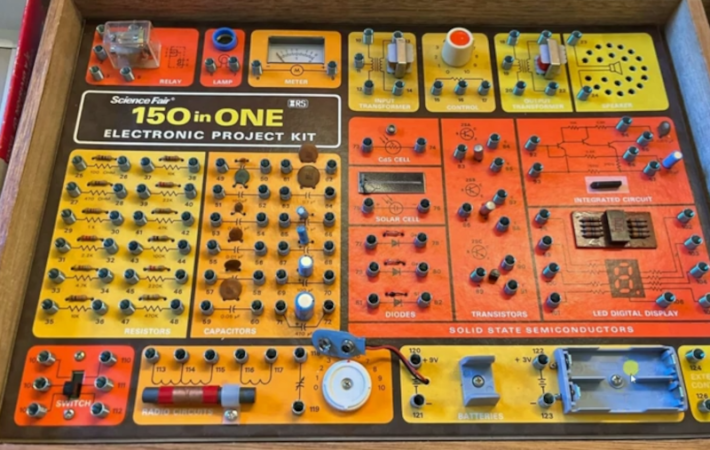
Like many of us, [MIKROWAVE1] had a lot of electronic toys growing up. In a video you can watch below, he asks the question: “Did electronic toys influence your path?” Certainly, for us, the answer was yes.

The CB “base station” looked familiar although ours was marked “General Electric.” Some of us certainly had things similar to the 150-in-one kit and versions of the REMCO broadcast system. There were many versions of crystal radio kits, although a kit for that always seemed a little like cheating.

Continue reading “A Trip Down Electronic Toy Memory Lane”

VHF/UHF Antennas, The Bad, The Ugly, And The Even Worse

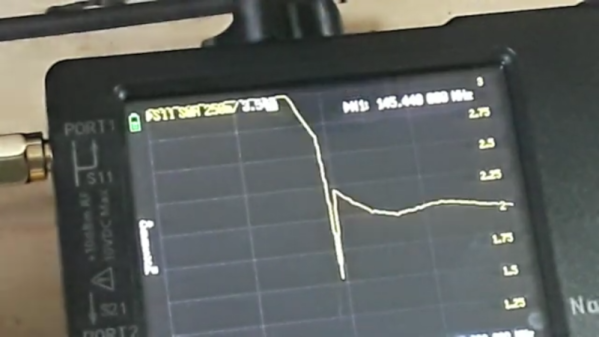
When you buy a cheap ham radio handy-talkie, you usually get a little “rubber ducky” antenna with it. You can also buy many replacement ones that are at least longer. But how good are they? [Learnelectronics] wanted to know, too, so he broke out his NanoVNA and found out that they were all bad, although some were worse than others. You can see the results in the — sometimes fuzzy — video below.

Of course, bad is in the eye of the beholder and you probably suspected that most of them weren’t super great, but they do seem especially bad. So much so, that, at first, he suspected he was doing something wrong. The SWR was high all across the bands the antennas targeted.

Continue reading “VHF/UHF Antennas, The Bad, The Ugly, And The Even Worse”

A Brief History Of Perpetual Motion

Conservation of energy isn’t just a good idea: It is the law. In particular, it is the first law of thermodynamics. But, apparently, a lot of people don’t really get that because history is replete with inventions that purport to run forever or produce more energy than they consume. Sometimes these are hoaxes, and sometimes they are frauds. We expect sometimes they are also simple misunderstandings.

We thought about this when we ran across the viral photo of an EV with a generator connected to the back wheel. Of course, EVs and hybrids do try to reclaim power through regenerative braking, but that’s recovering a fraction of the energy already spent. You can never pull more power out than you put in, and, in fact, you’ll pull out substantially less.

Not a New Problem

If you think this is a scourge of social media and modern vehicles, you’d be wrong. Leonardo da Vinci, back in 1494, said:

Oh ye seekers after perpetual motion, how many vain chimeras have you pursued? Go and take your place with the alchemists.

There was a rumor in the 8th century that someone built a “magic wheel,” but this appears to be little more than a myth. An Indian mathematician also claimed to have a wheel that would run forever, but there’s little proof of that, either. It was probably an overbalanced wheel where the wheel spins due to weight and gravity with enough force to keep the wheel spinning.

Continue reading “A Brief History Of Perpetual Motion”

Almost Google Glass In 1993

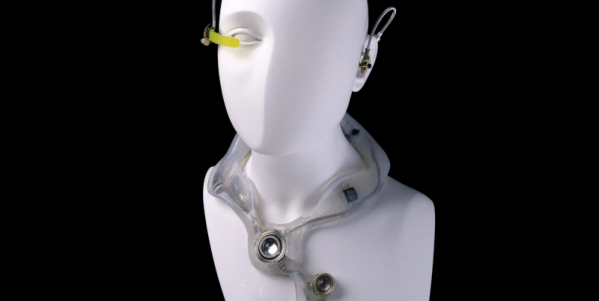
You might think Google Glass was an innovative idea, but [Allison Marsh] points out that artist [Lisa Krohn] imagined the Cyberdesk in 1993. Despite having desk in the name, the imagined prototype was really a wearable computer. Of course, in 1993, the technology wasn’t there to actually build it, but it does look like [Krohn] predicted headgear that would augment your experience.

Unlike Google Glass, the Cyberdesk was worn like a necklace. There are five disk-like parts that form a four-key keyboard and something akin to a trackpad. There were two models built, but since they were nonfunctional, they could have any imagined feature you might like. For example, the system was supposed to draw power from the sun and your body, something practical devices today don’t really do, either.

She also imagined a wrist-mounted computer with satellite navigation, a phone, and more. Then again, so did [Chester Gould] when he created Dick Tracy. The post also talks about a more modern reimagining of the Cyberdesk last year.

While this wasn’t a practical device, it is a great example of how people imagine the future. Sometimes, they miss the mark, but even then, speculative art and fiction can serve as goals for scientists and engineers who build the actual devices of the future.

We usually think about machines augmenting our intelligence and senses, but maybe we should consider more physical augmentation. We do appreciate seeing designs that are both artistic and functional.

3D Printing With A Twist

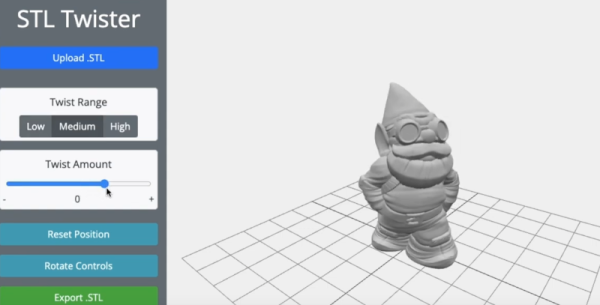
When we think about sending an STL off on the Internet for processing, we usually want someone to print it for us or we want mesh repair. But [Chuck] found an interesting project on GitHub from [Andrew Sink] that will let you add a variable amount of twist to any STL and then return it to you for printing or whatever else you use STLs for. If you don’t get what we mean, check out the video below.

The site that does the work initially loads a little gnome figure if you are too lazy to upload your own model. That’s perfect, though, because the little guy is a good example of why you might want to twist a model. With just a little work, you can make the gnome look in one direction or even look behind him.

[Chuck] shows how to use the tool for artistic effect by twisting his standard cube logo. The result is something that looks like it would be difficult to create, but could hardly be easier. The tool lets you rotate the object, too, so you can get the twist effect in the right orientation for what you want to accomplish. A great little tool for making more artistic 3D prints without learning new software. If you want some fun, you can try the version that uses sound from your microphone to control the twist.

If you’d rather twist in CAD, we can help. If you really want artsy 3D printing, you probably need to learn Blender.

Continue reading “3D Printing With A Twist”

Solar Energy Plant Creates Fuel

Normally, when you think of solar power, you think about photovoltaic cells or using the sun to generate steam. But engineers at Synhelion — a spin off from ETH Zurich — had a crazy idea. Could you reverse combustion and change waste products back into fuel? The answer is yes if you can use the sun to turn things up to 1,500°C.

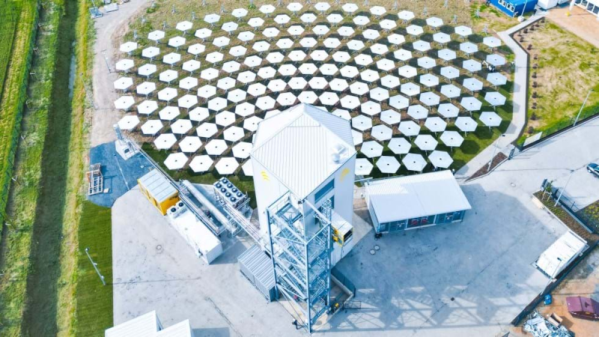
The input is water, carbon dioxide, and methane into syngas. The pilot plant in Germany is set to begin operations using a thermal storage device to allow the plant to operate around the clock. The new plant is slated to produce several thousand liters of fuel a year. Future plants will produce more, and they are targeting a cost of $1 per liter of fuel. The pilot plant has a 20-meter-tall tower and around 1,500 square meters of mirrors, producing 600 kW of output. The hexagonal mirrors are very thin, and the plant uses drones to aim the mirrors quickly compared to other methods.

Syngas shows up a lot lately. Getting to 1,500 degrees is a big ask, although we’ve seen ETH Zurich get to 1,000 using solar.