1950s Switching Power Supply Does It Mechanically

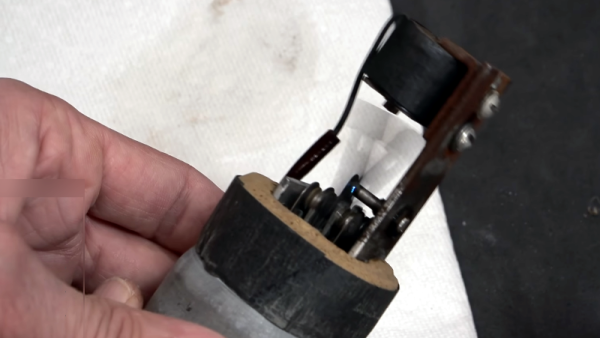
When you hear about a switching power supply, you think of a system that uses an inductor and a switch to redistribute energy from the input to the output. But the original switching power supply was the vibrator supply, which was common in automotive applications back in the middle part of the last century. [Mr. Carlson] has a 1950s-era example of one of these, and he invites us to watch him repair it in the video below.

Most of the vibrator supplies we’ve seen have been built into car radios, but this one is in a box by itself. The theory is simple. A DC voltage enters the vibrator, which is essentially a relay that has a normally-closed contact in series with its coil. When current flows, the relay operates, breaking the contact. With no magnetic field, the springy contact returns to its original position, allowing the whole cycle to repeat.

Continue reading “1950s Switching Power Supply Does It Mechanically”
Fixing An Expensive Smart Toaster Is Worth The Time

There was a time when the simplest and cheapest kitchen appliance you could think of was a toaster. Some nichrome wire, a spring, and a mechanical thermostat were all you needed. Those days are gone and today’s toasters are full of special features, network connections, and fancy cases.

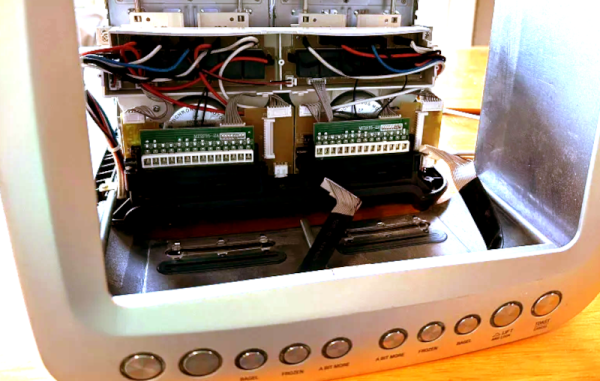
Take [boilerbot]’s Breville die-cast smart toaster. The four-slice model is upwards of $200. As Star Trek’s [Mr. Scott] said, “The more they overthink the plumbing, the easier it is to stop up the drain.” That seems to be the case here. The toaster failed and while [boilerbot] did fix it, he got lucky. He mentions that if the damage had been lower in the toaster, getting to it would have been nearly impossible.

Continue reading “Fixing An Expensive Smart Toaster Is Worth The Time”

Comparing Desoldering Tools

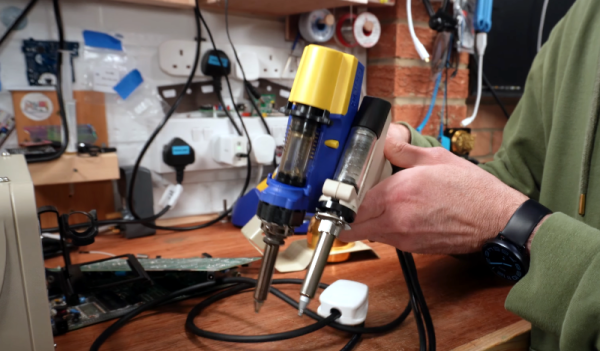
[Lee] has a Hakko FR301 desoldering gun and a Duratool knockoff. He freely admits that the Hakko is probably better, but he wonders if it’s good enough to justify being four times as expensive. He shows both of them off in a recent video that you can see below.

Often, desoldering doesn’t get as much attention as soldering, but for repairs or if you make mistakes —  and who doesn’t — it is an essential skill. Many of the differences will be either good or bad, depending on your personal preference. For example, the Hakko is an all-in-one unit, so it doesn’t have a bulky box to sit on your bench. However, that also means the Hakko is larger and heavier. It also lacks controls and indicators the other unit has on the base station box.

Continue reading “Comparing Desoldering Tools”

Inside A Hisense TV Repair Attempt

Many of us misspent our youth fixing televisions. But fixing a 1970s TV is a lot different than today — the parts were big and tubes were made to be replaced. Have you torn into a big flat screen lately? It is a different world, as [The Fixologist] shows us in the video below.

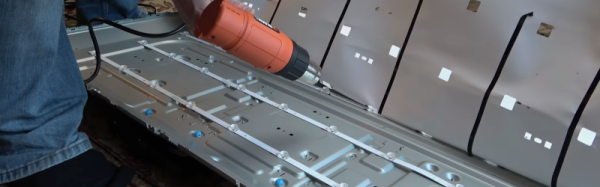
The TV in question was rescued from a neighbor who was about to throw it away. If you are like us, you’ll watch the first few minutes and see it powers up, but the screen is very dark. Back light problem, right? No problem. But it turned out to be more than we thought.

Honestly, we assumed it might be the power supply, and we would have put a power supply on the LED leads to test that first. That would have been smart because taking the panel off to reveal the LEDs was very difficult! There were two bad LEDs, though, so in the end you’d have had to do it anyway.

We were disappointed that after fixing the LED, he cracked the LCD panel during the reinstallation. So, in the end, this was more of a teardown video and not a repair video. He seemed to think a lot of the tape in the unit was to thwart repairs. That could be, but we wondered if it made manufacturing the TV easier which, after all, is mostly what they care about.

This isn’t the first time we’ve heard people tearing into a TV and wondering if the factory was against them. We’ve considered it, but we are pretty sure it isn’t the case.

Continue reading “Inside A Hisense TV Repair Attempt”

DIY 6 GHZ Pulse Compression Radar

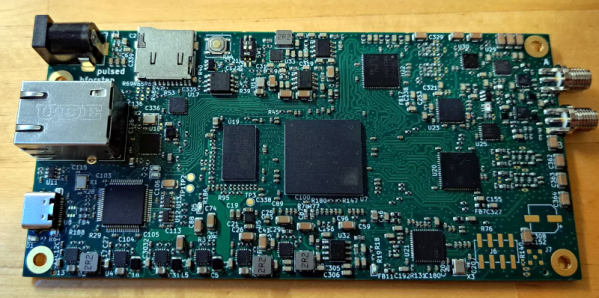
Conceptually, radar is pretty simple: send out a radio wave and time how long it takes to get back via an echo. However, in practice, there are a number of trade-offs to consider. For example, producing a long pulse has more energy and range, but limits how close you can see and also the system’s ability to resolve objects that are close to each other. Pulse compression uses a long transmission that varies in frequency. Reflected waves can be reconstituted to act more like a short pulse since there is information about the exact timing of the reflected energy. [Henrik] didn’t want to make things too easy, so he decided to build a pulse compression radar that operates at 6 GHz.

In all fairness, [Henrik] is no neophyte when it comes to radar. He’s made several more traditional devices using a continuous wave architecture. However, this type of radar is only found in a few restricted applications due to its inherent limitations. The new system can operate in a continuous wave mode, but can also code pulses using arbitrary waveforms.

Some design choices were made to save money. For example, the transmitter and receiver have limited filtering. In addition, the receiver isn’t a superheterodyne but more of a direct conversion receiver. The signal processing is made much easier by using a Zynq FPGA with a dual-core ARM CPU onboard. These were expensive from normal sources but could be had from online Chinese vendors for about $17. The system could boot Linux, although that’s future work, according to [Henrik].

At 6 GHz, everything is harder. Routing the PCB for DDR3 RAM is also tricky, but you can read how it was done in the original post. To say we were impressed with the work would be an understatement. We bet you will be too.

Radar has come a long way since World War II and is in more places than you might guess. We hate to admit it, but we’d be more likely to buy a ready-made radar module if we needed it.

IRC Client On Bare Metal

In the beginning, there was the BIOS, and it was good. A PC’s BIOS knows how to set up the different hardware devices, grab a fixed part of a hard drive, load it, and run it. That’s all you need. While it might be all you need, it isn’t everything people want, so a consortium developed UEFI, which can do all the things a normal BIOS can’t. Among other things, UEFI can load code for the operating system over the network instead of from the hard drive.

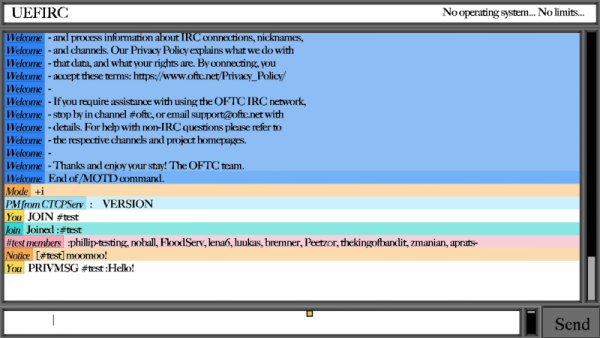
In true hacker fashion, [Phillip Tennen] thought, “Does it have to be an operating system?” The answer, of course, is no. It could be an IRC client. He chose Rust to implement everything. While UEFI does provide a network stack, it isn’t very easy to use, apparently. It also provides support for a mouse. [Phillip] ported his GUI toolkit library over, and then the rest is just building an IRC client.

The client isn’t the easiest to use because, after all, this is a lark. Why would you want to do this? On the other hand, we can think of reasons we might want to take control of a UEFI motherboard and use it for something. If you want to do that, this project is a great template to jump-start your endeavors.

We’ve looked at the UEFI system a few times. Or, you can use it to play DOOM.

Continue reading “IRC Client On Bare Metal”

Linear Feedback Shift Registers For FPGAs

If you want to start an argument at a Hackaday meeting, you have only to ask something like “How much does this weigh?” or “What time is it?” But if you really want to start a street brawl, you can always say, “Are these numbers random?” Making random numbers that are actually random is actually a tough nut to crack. Most of what we do is, technically, pseudo-random (but we’ll say random number and assume you know what we mean). One way to generate seemingly random sequences is to use a linear feedback shift register or LFSR. You can use LFSRs in software, but they are also very useful in hardware design and [Adam Taylor] takes us through his use of them on FPGAs in a recent post. Continue reading “Linear Feedback Shift Registers For FPGAs”