The Emperor’s New Computer

You walk into a home office and see an attractive standing desk that appears bare. Where’s the computer? Well, if it is [DIY Perk]’s office, the desk is the computer. Like a transformer robot, the desk transforms into a good-looking PC.

He starts with a commercial desk and creates a replacement desktop out of some aluminum sheets and extrusions. The motion uses some V-slot profiles and linear rails. The monitor and keyboard shelf pop up on invisible hinges. When closed, there’s no trace of a computer.

Continue reading “The Emperor’s New Computer” →

Reinventing Rotary Switches With Stepper Motors

When you need to make very tiny measurements, even noise in closed relays can throw you off. [Marco] was able to observe this effect and wanted to build a switch that didn’t have this problem. He found a technical paper that used rotary switches operated by stepper motors instead of relays. So he decided to try making his own version. The video below shows how it turned out.

The first part of the video talks about why relays sometimes inject a tiny voltage into a closed circuit. He then looks at costly switches that would work. However, since he needed many switches, he decided to roll his own.

Continue reading “Reinventing Rotary Switches With Stepper Motors” →

Weird Old Stereo Accessories

Some people trick out their cars. Some, their computers. There are even people who max out their audio systems, although back in 1979, there was more of that going on, probably, than today where you discresionary income is split so many ways. Case in point: [Alan Cross] remembers how excited he was to get the Radio Shack catalog that year. He was working at a grocery store, saved his money, and — over time — picked up a haul ranging from an equalizer to a strobe light.

Who didn’t need a power meter or a “light organ?” These gadgets seem cheap until you realize it was 1979 and [Alan] was a student working at a grocery store. He points out that the $20 power meter is about the same as $80 today.

Continue reading “Weird Old Stereo Accessories” →

One Man’s Trash Is… A Rare $60,000 Historical Computer

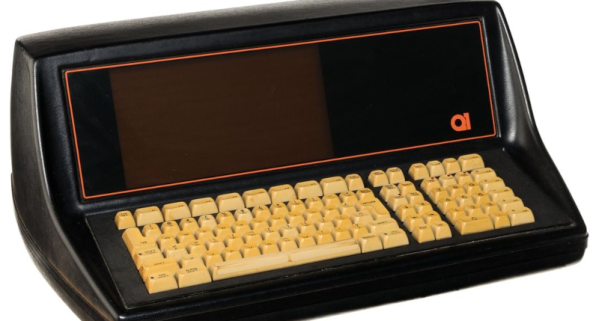
According to Smithsonian Magazine, a salvage company in London was cleaning out a property and found an odd-looking computer device. No one knew what it was, and they couldn’t find anything with a quick online search. The devices in question were two ultra-rare Q1 computers dating from the early 1970s.

While these machines looked formidable, they contained Intel 8008 CPUs but did have built-in screens, keyboards, and printers. The two machines had a few minutes of fame at Kingston University London and are now for sale. They will probably bring about $60,000 each. Not bad for salvage junk.

Continue reading “One Man’s Trash Is… A Rare $60,000 Historical Computer” →

Grid Leak Radio Draws The Waves

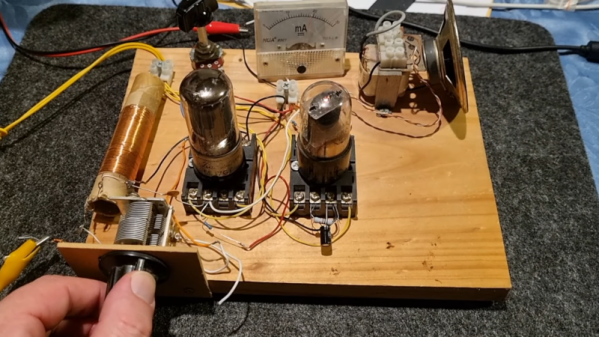
[Stephen McNamera] found a schematic for a grid leak radio online and decided to throw together a few tubes on a piece of wood and see how it worked. As you can see in the video below, it works well. The video is a bit light on details, but the web page he found the plans on also has quite a bit of explanation.

The name “grid leak detector” is due to the grid leak resistor between the grid and ground, in this case, a 2.7 megaohm resistor. The first tube does everything, including AM detection. The second tube is just an audio amplifier that drives the speaker. This demodulation method relies on the cathode to control grid conduction characteristics and was found in radios up to about the 1930s. The control grid performs the usual function but also acts as a diode with the cathode, providing demodulation. In a way, this is similar to a crystal radio but with an amplified tube diode instead of a crystal.

It looks like [Stephen] wound his own coil, and the variable capacitor looks suspiciously like it may have come from an old AM radio. The of the old screw terminal tube sockets on the wood board looks great. Breadboard indeed! What we didn’t see is where the 150 V plate voltage comes from. You hope there is a transformer somewhere and some filter capacitors. Or, perhaps he has a high-voltage supply on the bench.

While tubes are technologically passe, we still like them. Especially in old radios. Just take care around the high voltages, please.

Continue reading “Grid Leak Radio Draws The Waves” →

Amber Compiles To Bash

It certainly isn’t a new idea to compile a language into an intermediate language. The original C++ compiler outputs C code, for example. Enhanced versions of Fortran were often just conversions of new syntax to old syntax. Of course, it makes sense to output to some language that can run on lots of different platforms. So, using that logic, Amber makes perfect sense. It targets — no kidding — bash. You write with nice modern syntax and compile-time checks. The output is a bash script. Admittedly, sometimes a hard-to-read bash script, but still.

If you want to see the source code, it is available on GitHub. Since Windows doesn’t really support bash — if you don’t count things like Cygwin and WSL — Amber only officially supports Linux and MacOS. In addition to compiling files, Amber can also execute scripts directly which can be useful for a quick one-liner. If you use Visual Studio Code, you can find a syntax highlighter extension for Amber.

Continue reading “Amber Compiles To Bash” →

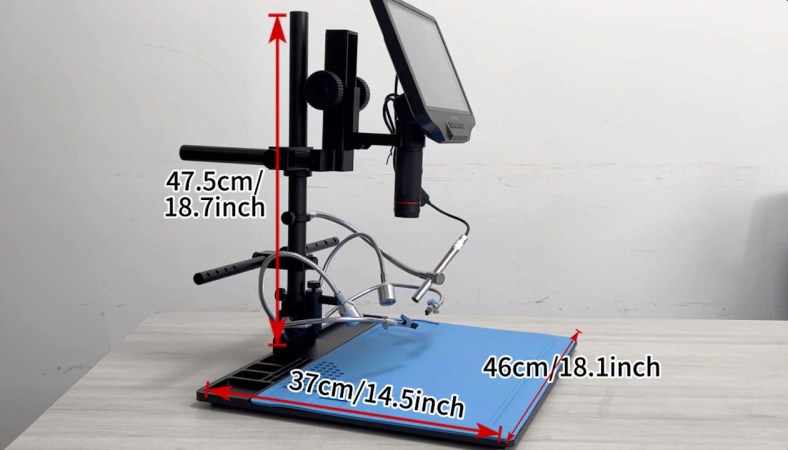
Hands On: AD409-Max Microscope

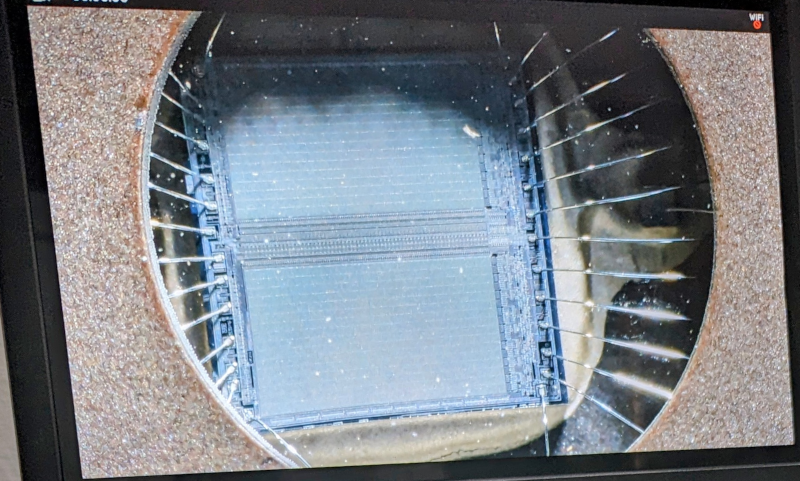
It used to be that only the most well-equipped home electronics lab had a microscope. However, with SMD parts getting smaller and smaller, some kind of microscope is almost a necessity.

Luckily, you can get USB microscopes for a song now. If you’re willing to spend a little more, you can get even get microscopes that have little LCD screens. However, there are some problems with the cheaper end of these microscopes.

Many of them have small and wobbly stands that aren’t very practical. Some don’t leave you much room to get a soldering iron in between the lens and the part. Worse still, many cheap microscopes have trouble staying still when you have to push buttons or otherwise make adjustments to the device.

It seems like every time a new generation of microscopes aimed at the electronics market arrives on the scene, many of the earlier flaws get taken care of. That’s certainly the case with the Andonstar AD409-Max.

Continue reading “Hands On: AD409-Max Microscope” →